Introduction: The Intersection of High-Precision Photonics and Industrial Grid Realities
The industrial landscape of São Paulo, particularly within the Greater ABC region and the Paraíba Valley, represents the highest concentration of manufacturing output in South America. As these sectors transition from traditional mechanical fabrication to high-throughput photonics, the demand for stable, high-kilowatt power delivery has surged. However, the metropolitan electrical infrastructure often presents challenges, including transient voltage spikes and frequency instabilities caused by heavy inductive loads from neighboring heavy industries. To maintain operational continuity, the deployment of the Heavy-Duty Beam Laser in this region now necessitates integrated power conditioning architectures. This article examines the technical exigencies of built-in voltage regulation and its role in securing grid stability for Tier 1 manufacturing facilities in Brazil.
Quantifying Grid Instability in the São Paulo Industrial Macro-Zone
São Paulo’s electrical grid, managed by entities such as Enel and CPFL, operates under significant stress due to the density of industrial consumption. For high-power laser applications, the primary concern is not merely total power failure, but “brownouts” and micro-fluctuations. In a standard CNC laser cutting or welding environment, a voltage drop of as little as 7% can lead to a significant shift in the laser’s duty cycle, affecting the beam’s transverse mode and focal stability.
Without localized regulation, these fluctuations penetrate the laser’s power supply unit (PSU), leading to inconsistent kerf widths in metal fabrication and potential damage to the diode modules. The implementation of a Heavy-Duty Beam Laser equipped with internal stabilization protocols mitigates these risks by decoupling the sensitive resonator electronics from the raw municipal supply.
Technical Architecture of Built-in Automatic Voltage Regulation (AVR)
The integration of Automatic Voltage Regulation (AVR) directly into the laser’s chassis represents a shift toward “grid-agnostic” hardware. Unlike external stabilizers which add footprint and latency, built-in AVR systems utilize high-speed solid-state switching or servo-controlled toroidal transformers to maintain an output tolerance of +/- 1%.
In the context of fiber laser oscillators, which are the core of the Heavy-Duty Beam Laser, the AVR must handle rapid load changes. When the laser fires, the instantaneous current draw is massive. An integrated system uses predictive algorithms to compensate for this internal “step load” while simultaneously filtering external noise. This dual-action regulation ensures that the pumping diodes receive a constant DC voltage, which is critical for maintaining the spectral purity of the beam.

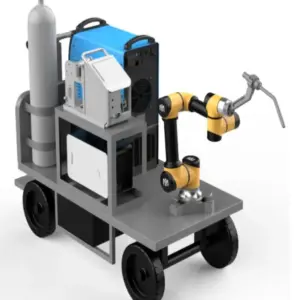
Industrial Application of Heavy-Duty Beam Laser
Power Factor Correction and Harmonic Distortion Mitigation
A significant technical hurdle in São Paulo’s industrial sectors is the presence of Total Harmonic Distortion (THD). High-power lasers, being non-linear loads, can contribute to THD, which often results in financial penalties from Brazilian utility providers. Modern heavy-duty systems incorporate active Power Factor Correction (PFC) circuits.
Active PFC ensures that the current waveform follows the voltage waveform, bringing the power factor closer to unity (0.99). This reduces the RMS current drawn from the grid, lowering the thermal stress on the facility’s transformers and cabling. Furthermore, Harmonic Distortion Mitigation filters out the high-frequency noise generated by the laser’s own switching power supplies, preventing interference with other sensitive metrology equipment on the same factory floor.
Thermal Management and Component Longevity
Voltage instability is a primary driver of premature component failure. When input voltage drops, the laser’s power supply must increase current to maintain the required wattage (P = V x I). This increase in amperage leads to exponential heat generation within the internal conductors and MOSFETs. By utilizing built-in regulation, the Heavy-Duty Beam Laser maintains a stable voltage-to-current ratio, significantly extending the Mean Time Between Failures (MTBF) for the laser source. In the humid, subtropical climate of São Paulo, where cooling systems are already under high ambient load, reducing internal heat through electrical efficiency is a critical design requirement.
Operational Impact on High-Volume Fabrication
In B2B manufacturing contracts—such as those serving the aerospace hub in São José dos Campos or the automotive plants in São Bernardo do Campo—precision is a contractual obligation. A voltage-induced “flicker” during a thick-plate cutting cycle can result in a scrapped workpiece, which, in the case of specialized alloys, represents a significant capital loss.
The Heavy-Duty Beam Laser with built-in regulation provides a consistent beam profile throughout the entire shift, regardless of whether the regional grid is at peak demand (typically 5:00 PM to 8:00 PM in Brazil). This consistency allows for tighter nesting of parts and higher feed rates, as the operator does not need to build in “safety buffers” for potential power-related beam fluctuations.
Compliance with Brazilian Regulatory Standards (ABNT)
Deployment of high-power industrial equipment in Brazil requires adherence to ABNT (Associação Brasileira de Normas Técnicas) standards. Systems with integrated voltage regulation are more likely to meet NBR 5410 (Electrical installations of buildings) and NBR IEC 61000 series (Electromagnetic compatibility). By housing the regulation technology within the laser unit, manufacturers simplify the certification process for the end-user, as the machine functions as a self-contained, compliant node within the factory’s electrical ecosystem.
Industry Insight: The Future of Grid-Resilient Manufacturing
As the global manufacturing sector moves toward Industry 4.0, the “intelligence” of a machine is increasingly measured by its ability to withstand environmental and infrastructural volatility. In emerging industrial powerhouses like Brazil, the reliance on external power conditioning is becoming a legacy approach. The future of the Heavy-Duty Beam Laser lies in total autonomy—where the machine not only processes material with micron-level precision but also actively manages its relationship with the electrical grid.
For global stakeholders looking to invest in the São Paulo industrial corridor, the priority must shift from raw wattage to “clean wattage.” Equipment that integrates power stabilization, harmonic filtering, and active power factor correction is no longer an optional upgrade; it is a fundamental requirement for operational viability. As grid demands increase due to the electrification of transport and the expansion of data centers in the region, only those systems capable of self-regulation will maintain the high OEE (Overall Equipment Effectiveness) levels required for global competitiveness.
Industrial Expertise & Support
Are you looking for high-performance Heavy-Duty Beam Laser tailored for the Global market? Our engineering team provides comprehensive solutions for modern manufacturing.