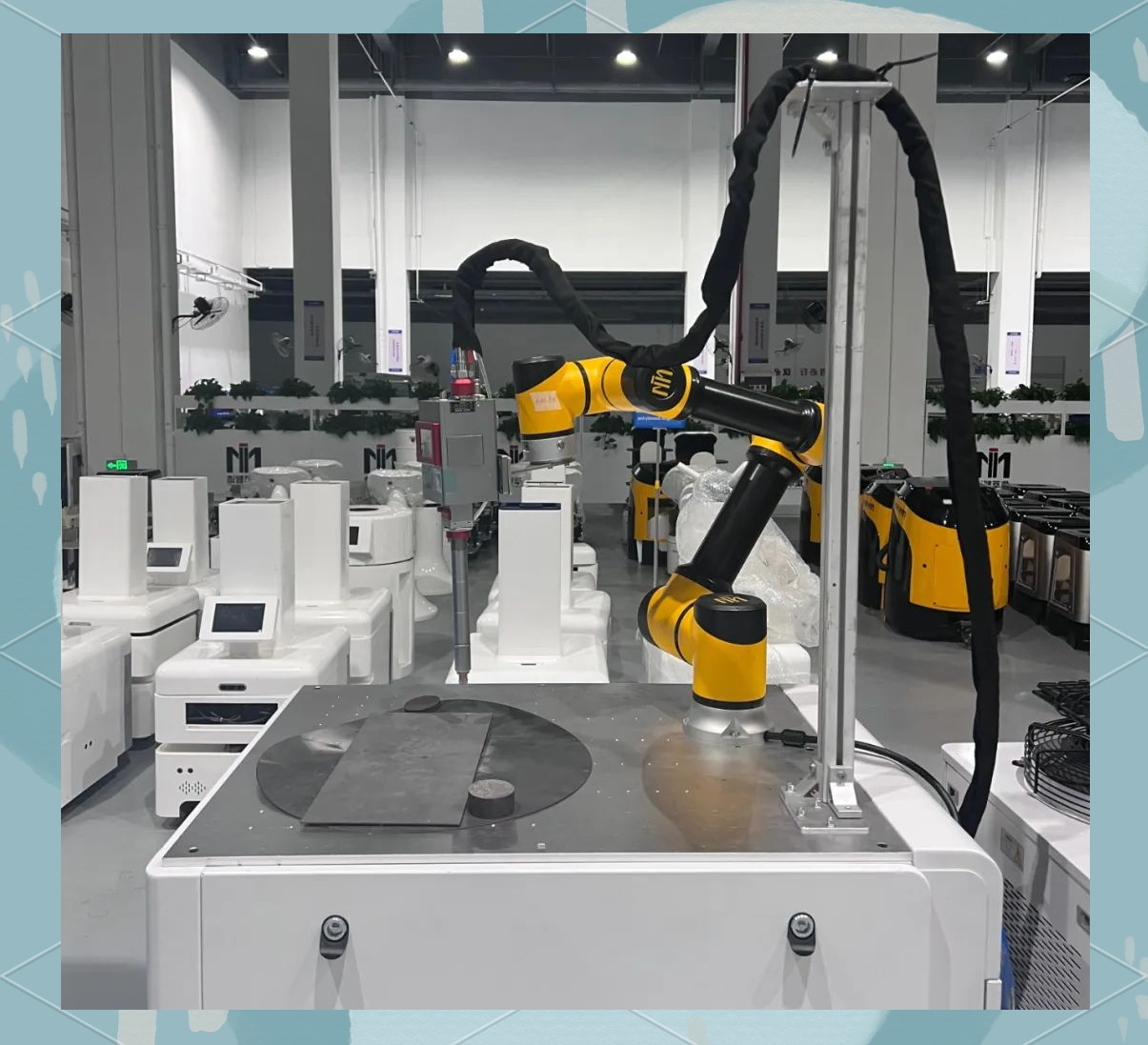
- Optimized for High-Efficiency 1500W Fiber Laser Welding Cobot
- Industrial Grade Duty Cycle & Precision
- Easy Plug-and-Play Integration
Executive Summary: High-Efficiency 1500W Fiber Laser Welding Cobot
The CMC-LW-1500W-PRO is a precision-engineered industrial solution designed to bridge the gap between manual labor shortages and the high capital expenditure of traditional fixed-cell robotics. By integrating a high-density 1500W continuous wave (CW) fiber laser source with a 6-axis collaborative robotic arm, this system delivers a 4x to 6x increase in throughput compared to conventional TIG welding. The primary use case involves high-volume, high-repeatability fabrication of stainless steel, carbon steel, and aluminum components where aesthetic finish and structural integrity are non-negotiable.
For engineering managers and procurement officers, the ROI is driven by three primary factors: the elimination of post-weld grinding due to minimal heat-affected zones (HAZ), a 100% duty cycle for continuous multi-shift operation, and the ability for non-specialized operators to program complex paths via lead-through teaching. The CMC-LW-1500W-PRO is not merely a tool but a modular production asset that standardizes weld quality across every shift, significantly reducing scrap rates and consumable overhead.
Detailed Technical Specification Matrix
The following table outlines the critical engineering parameters of the CMC-LW-1500W-PRO. These specifications are validated under standard industrial operating conditions (25°C ambient temperature, 50% humidity).
| Parameter | Specification Details |
|---|---|
| Laser Power Output | 1500W Continuous Wave (CW) |
| Laser Wavelength | 1080nm ± 5nm |
| Beam Quality (M2) | < 1.1 (Single Mode) |
| Duty Cycle | 100% at 1500W |
| Robotic Reach | 1300 mm (Spherical Workspace) |
| Repeatability | ± 0.03 mm |
| Wire Feed Speed | 0 – 80 mm/s (Synchronized Pulse) |
| Wobble Width | 0 mm – 5 mm (Adjustable via Controller) |
| Ingress Protection | IP54 (Control Cabinet and Arm Joints) |
| Cooling System | Integrated Dual-Circuit Industrial Chiller |
| Input Voltage | 220V/380V Three-Phase (Configurable) |
| Gas Requirements | Argon / Nitrogen / CO2 (Application Dependent) |
| Safety Compliance | ISO 13849-1 (PLd), Laser Class 4 |
Advanced Motion Control and Laser Integration
The core competitive advantage of the CMC-LW-1500W-PRO lies in its proprietary motion control architecture. Unlike standard cobots that treat the laser as a simple binary end-effector, our system utilizes a fully integrated control loop. This allows for real-time synchronization between the robotic arm’s TCP (Tool Center Point) velocity and the laser’s power modulation.
Dynamic Power Scaling: As the cobot navigates tight radii or complex geometries, the motion controller automatically adjusts the laser’s output power to prevent burn-through at lower velocities. This ensures a consistent penetration depth and bead width regardless of the path complexity. The 1500W fiber source maintains a beam quality M2 of less than 1.1, resulting in a highly concentrated energy density that enables deep penetration with minimal thermal distortion.
Wobble Welding Technology: To accommodate variations in part fit-up and gap tolerances, the welding head features an integrated wobble function. Operators can select from various patterns—including circular, O-type, and figure-eight—with adjustable widths up to 5mm. This oscillation effectively increases the weld pool size, allowing the system to bridge gaps that would typically be impossible for traditional laser welding, all while maintaining the structural properties of the joint.
Lead-Through Programming and Path Planning: The CMC-LW-1500W-PRO utilizes a zero-gravity teaching mode. An engineer can manually guide the arm along the desired weld seam, recording waypoints with a single button press. The software then interpolates these points into a smooth trajectory. This reduces the setup time for new part numbers from hours to minutes, making the system viable for high-mix, low-volume production environments.
ROI Case Study: Manual TIG vs. CMC-LW-1500W-PRO
To quantify the financial impact of deploying the CMC-LW-1500W-PRO, we conducted a comparative analysis based on a mid-sized fabrication facility producing 304 Stainless Steel enclosures (2mm thickness).
Manual TIG Welding Baseline: A skilled welder (average cost $35/hr including benefits) completes a 500mm seam in approximately 4 minutes, including setup and tacking. Post-weld cleaning and heat tint removal require an additional 3 minutes per part. Total labor time per unit: 7 minutes. At 85% efficiency, daily output is approximately 60 units per shift.
Cobot Laser Welding Implementation: The CMC-LW-1500W-PRO completes the same 500mm seam at a travel speed of 25mm/s, totaling 20 seconds of arc-on time. Due to the precision of the fiber laser, the heat-affected zone is so localized that post-weld grinding is eliminated. Total cycle time, including loading and unloading, is 90 seconds. Daily output per shift increases to 320 units.
Financial Summary: Labor cost per unit (Manual): $4.08 Labor cost per unit (Cobot): $0.87 Annual Labor Savings (Single Shift): $77,040 Consumable Savings: The elimination of tungsten electrodes and a 40% reduction in shielding gas consumption (due to higher travel speeds) results in an additional $4,500 in annual savings. Total Year 1 ROI: With an initial investment of approximately $95,000, the CMC-LW-1500W-PRO achieves a break-even point in approximately 14.5 months, assuming single-shift operation. In multi-shift environments, the payback period drops to under 8 months.
Post-Installation Maintenance FAQ
What is the maintenance schedule for the fiber laser source? The fiber laser source is virtually maintenance-free due to its solid-state design. Unlike CO2 lasers, there are no mirrors to align or gas blowers to service. The primary requirement is ensuring the integrated chiller’s coolant is replaced every 3 to 6 months with deionized water and the appropriate algaecide to maintain optimal thermal regulation of the laser diodes.
How often must the protective lenses be replaced? The protective window (cover glass) is a consumable item designed to protect the internal optics from weld spatter. Depending on the material and the use of the wire feeder, a lens typically lasts between 40 to 80 hours of arc-on time. The system includes a quick-change drawer allowing for replacement in under 60 seconds without tools.
Does the IP54 rating allow for use in grinding environments? While the IP54 rating protects the internal electronics from dust and splashing water, we recommend that the CMC-LW-1500W-PRO be shielded from direct metallic dust plumes generated by heavy grinding. Fine conductive dust can eventually degrade seal integrity. A standard robotic sleeve is recommended for environments with high concentrations of airborne particulates.
What are the requirements for the wire feed system? The integrated wire feeder supports 0.8mm to 1.6mm wire diameters. It is critical to use high-quality, straight-drawn wire to prevent bird-nesting at high wire feed speeds (up to 80mm/s). The drive rolls should be inspected weekly for tension and groove wear to ensure consistent delivery to the weld pool.
How is the beam quality M2 maintained over time? Beam quality is a function of the fiber delivery system and the output coupler. To maintain an M2 < 1.1, the fiber optic cable must never be bent beyond its minimum bend radius (typically 200mm) and the output connector must remain sealed. The system’s self-diagnostic software monitors the back-reflection levels; if a contamination event occurs, the system will trigger an E-stop to prevent damage to the laser source.
What training is required for the IP54-rated controller? The controller features a Linux-based GUI designed for fabricators, not computer scientists. A technician with basic welding knowledge can be trained to operate and program the system in 2 days. Advanced logic (IO integration with rotators or conveyors) typically requires an additional day of systems-level training.
cobot welding 01
cobot welder 02
free programming 03
robot welding 04
how to use Teach pendant 05