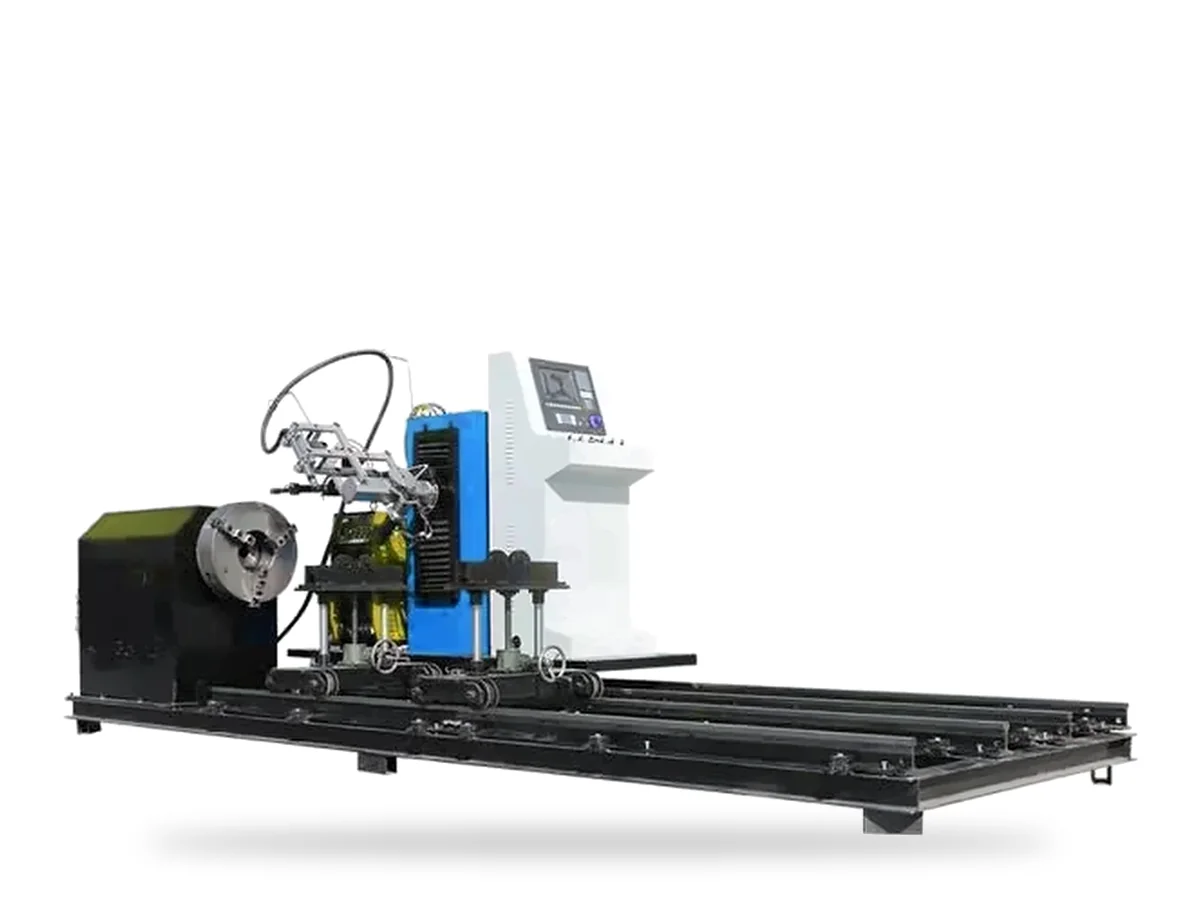
5-Axis CNC Pipe Cutting and Beveling Machine
A 5-axis plasma machine for pipe end preparation. Pipe rotation, gantry travel and a swing-and-tilt torch move together, so the torch keeps the right angle to the curved pipe surface and the bevel stays consistent all the way round. It cuts saddles, branch holes and bevels from 0 to ±45° (V, Y, K or X) on pipe from 2 to 24 in, in 20 ft or 40 ft lengths.
- 2–24 inpipe diameter
- 20 / 40 ftcutting length
- 5 axessynchronized
- 0 to ±45°bevel angle
Specifications
Swipe the table sideways to see all columns.
| Parameter | 5-axis pipe machine |
|---|---|
| Pipe diameter | 2–24 in (about Ø60–610 mm); larger on request |
| Cutting length | 20 ft or 40 ft (about 6 or 12 m) |
| Motion | 5-axis linkage: pipe rotation, longitudinal gantry, swing and tilt torch |
| Torch control | Continuous bevel-angle adjustment round the pipe |
| Bevel angle | 0 to ±45° |
| Bevel types | V, Y, K and X |
| Plasma source | Hypertherm, LGK or other industrial sources |
Why the torch has to swing and tilt
On a flat plate a fixed torch angle gives a fixed bevel. On a pipe, the surface curves away from the torch, and at a branch or saddle cut the joint angle changes all the way round. A torch that only moves up and down gives the right bevel at one point and the wrong bevel everywhere else. The swing-and-tilt head corrects the angle in real time, so the bevel is the same through the full 360°.
Bevel types
Swipe the table sideways to see all columns.
| Bevel | Shape | Typical use |
|---|---|---|
| V | One side bevelled, open root | Butt joints on thin and medium wall |
| Y | V bevel with a flat land (root face) | Most pipe butt welds; the land controls burn-through |
| X | Double V, bevelled from both sides | Thick wall where you can weld from inside and outside |
| K | Double bevel on one member | T-joints and branch connections in thick wall |
Cuts it makes
Straight cut-off and bevel
Square or bevelled pipe ends for butt welding.
Saddles
Branch pipe ends shaped to sit on a header pipe.
Branch holes
Holes in the header for set-on and set-in branches.
Eccentric intersections
Offset branches and miters for pipe racks and structures.
Less grinding before welding
Hand-cut and hand-ground bevels vary from welder to welder. Because the machine cuts the bevel close to final weld preparation, grinding becomes a light clean-up. Compared with manual cutting, shops can save up to 80% of grinding and labour time on pipe end preparation.
Who uses it
Oil and gas
Pipelines, pipe spools and station piping.
Pressure vessels
Nozzles and branch connections.
Offshore engineering
Tubular braces and jacket nodes.
Steel structures
Pipe trusses and tubular columns.
Shipping, installation and support
Free production layout
Send your parts list or shop drawing and our engineers suggest the machine size, plasma source and table layout before you order.
Packed for sea freight
Machines are packed for container shipping. We quote to your nearest port in South America, Africa or elsewhere and prepare the export documents.
Installation and training
Remote installation guidance and operator training are included. On-site commissioning can be arranged.
Remote diagnostics
Our team supports the control, the plasma source and the nesting software remotely, so most problems are solved without waiting for a visit.
Get a configuration and price
Send the material, the thickest plate or largest pipe you cut, your sheet or pipe size and how many hours a day the machine will run. An engineer replies with the right pipe range and plasma source, the options and a price delivered to your port.
Frequently asked questions
Why does the bevel angle need to change round the pipe?
Because the pipe surface is curved. A fixed torch angle gives the correct bevel at only one point; the swing-and-tilt head adjusts the angle continuously.
What pipe sizes can it cut?
2 to 24 in diameter as standard, in 20 ft or 40 ft lengths. Larger diameters are possible depending on configuration; for Ø600–2000 mm see the large pipe profile cutting machine.
Which bevel angles and types can it cut?
Bevel angles from 0 to ±45°, as V, Y, X and K bevels, plus saddles and branch holes.
Which plasma sources are used?
Hypertherm, LGK or other standard industrial plasma sources, sized to your wall thickness.
How much grinding does it save?
Up to 80% of grinding and labour time compared with manual cutting, because the bevel comes off the machine close to final weld preparation.
Related machines and guides
Last updated 15 October 2026. Specifications are for standard configurations and can change with options; confirm on your quotation.