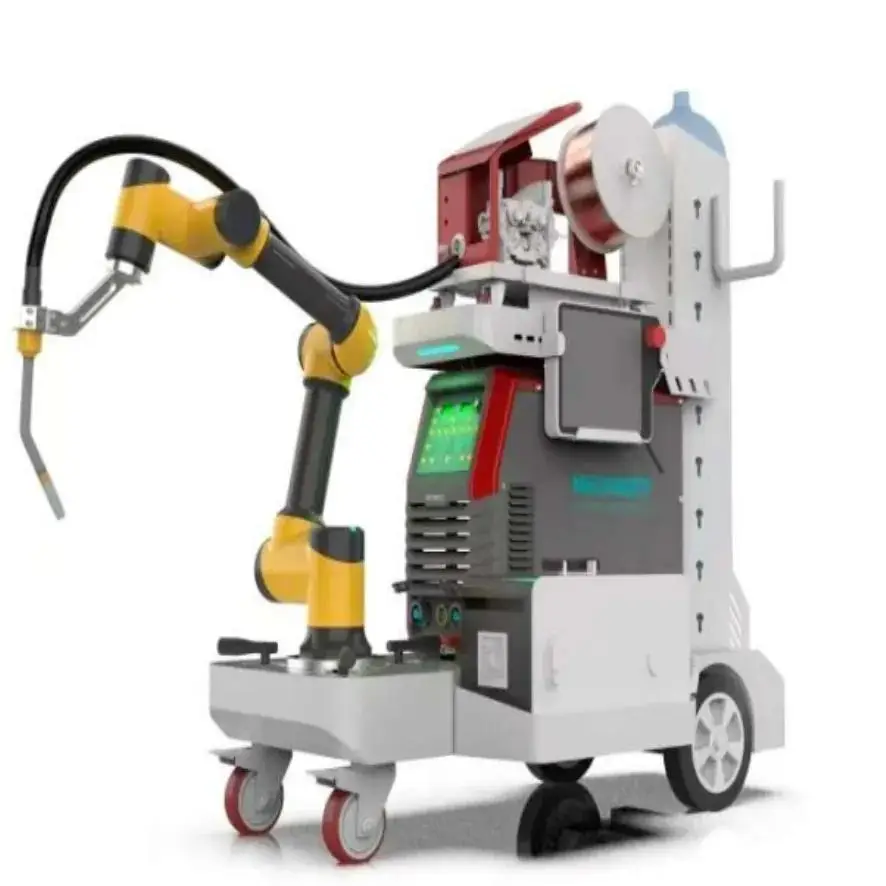
- Optimized for 2000W Handheld & Cobot Fiber Laser Welder
- Industrial Grade Duty Cycle & Precision
- Easy Plug-and-Play Integration
Executive Summary: CMC-LW-2000-AUTO Industrial Fiber Laser System
The CMC-LW-2000-AUTO is a high-performance 2000W fiber laser welding system engineered for high-throughput industrial environments requiring both manual flexibility and automated precision. Designed to bridge the gap between traditional manual welding and fully robotic cells, this unit features a dual-mode interface that allows for rapid switching between handheld operation and cobot-integrated motion control. For engineering departments and production managers, the primary value proposition lies in the 4x to 10x increase in travel speed compared to traditional TIG welding, coupled with a significant reduction in the Heat Affected Zone (HAZ).
The integration of a 2000W continuous wave (CW) fiber source provides sufficient power density to achieve deep penetration in stainless steel, carbon steel, and aluminum alloys up to 6mm. By utilizing a high-stability fiber delivery system with a Beam Quality M2 < 1.1, the CMC-LW-2000-AUTO ensures consistent weld bead morphology and minimal spatter. This system is specifically designed for Tier 1 and Tier 2 suppliers in the automotive, aerospace, and medical device sectors where weld integrity and repeatable ROI are critical procurement metrics.
Detailed Technical Specification Matrix
The following table outlines the core engineering parameters for the CMC-LW-2000-AUTO. These specifications are validated under standard operating conditions (25°C, 50% humidity).
| Parameter | Specification Details |
|---|---|
| Laser Output Power | 2000W (Continuous Wave / Modulated) |
| Operating Wavelength | 1080 nm ± 10 nm |
| Beam Quality (M2) | < 1.1 (Single Mode Fiber) |
| Duty Cycle | 100% at 2000W (24/7 Operation Capable) |
| Wire Feed Speed Range | 0 – 80 mm/s (Synchronized Pulse Control) |
| Wobble Width / Frequency | 0 – 5 mm / 0 – 300 Hz |
| Fiber Cable Length | 10 Meters (Standard) / 15 Meters (Optional) |
| Cooling Method | Dual-Circuit Industrial Water Chiller |
| Environmental Protection | IP54 Rated Cabinet and Optical Head |
| Input Voltage | 220V/380V ± 10%, 50/60Hz AC |
| Shielding Gas Pressure | 0.1 – 0.2 MPa (Argon or Nitrogen) |
| Positioning Accuracy (Cobot) | ± 0.02 mm Repeatability |
| Weight (Total System) | 240 kg (Including Chiller and Wire Feeder) |
Advanced Motion Control and Cobot Integration
The CMC-LW-2000-AUTO distinguishes itself through its sophisticated motion control architecture. Unlike standard handheld units, the AUTO variant includes a dedicated External Control Interface (ECI). This allows for seamless integration with 6-axis Collaborative Robots (Cobots) via Modbus/TCP or digital I/O protocols. When mounted to a cobot arm, the laser head utilizes its internal Galvanometer-driven Wobble Technology to compensate for fit-up inconsistencies in the workpiece.
The “Wobble” function is critical for industrial applications where part tolerances may vary. By oscillating the beam in various patterns (Circle, Line, Figure-8, or Triangle), the system can bridge wider gaps that would typically cause burn-through or incomplete fusion in a static laser setup. The motion control software allows for real-time adjustment of the Wire Feed Speed, ensuring that the filler material deposition rate perfectly matches the travel speed of the cobot arm. This synchronization prevents “cold starts” and ensures a uniform weld reinforcement height across complex geometries.
Furthermore, the system includes Adaptive Power Scaling. As the cobot decelerates during tight radius turns, the laser controller automatically modulates the output power to maintain a constant energy density per linear millimeter. This prevents overheating and warping in thin-gauge materials, a common failure point in manual laser welding applications.
ROI Case Study: Manual TIG vs. CMC-LW-2000-AUTO Cobot Cell
To evaluate the financial viability of the CMC-LW-2000-AUTO, we conducted a comparative analysis based on a production run of 5,000 stainless steel (304 grade) enclosures with a 2.5mm wall thickness and a total weld length of 1,200mm per unit.
1. Labor and Throughput Efficiency
Traditional TIG welding requires a highly skilled technician. Average travel speed for a high-quality TIG weld on 2.5mm stainless is approximately 150mm/min. Total arc time per unit is 8 minutes. Including setup and cleaning, total production time is 15 minutes per unit. In an 8-hour shift, a manual welder produces 32 units.
The CMC-LW-2000-AUTO, integrated with a cobot, operates at a travel speed of 1,200mm/min. Total arc time per unit is 1 minute. Total production time, including cobot loading/unloading, is 3 minutes per unit. In an 8-hour shift, the automated cell produces 160 units. Throughput is increased by 500%.
2. Consumables and Post-Processing
TIG welding requires significant shielding gas (Argon) and tungsten electrodes. More importantly, TIG welding creates a large HAZ, necessitating post-weld grinding and polishing to meet aesthetic standards, adding roughly $4.00 in labor/abrasive costs per unit. The fiber laser’s concentrated energy results in a negligible HAZ and a “finished” quality bead. Post-processing costs are reduced by 90%, saving $18,000 over the 5,000-unit run.
3. Total Cost of Ownership (TCO)
While the initial capital expenditure (CAPEX) for the CMC-LW-2000-AUTO is higher than a TIG power source, the Payback Period is typically reached within 6.5 months in multi-shift environments. This calculation factors in the reduction of scrap rates (from 4% in manual welding to <0.5% in automated laser welding) and the ability to utilize lower-cost operators to oversee the cobot cell rather than high-cost certified TIG welders.
Post-Installation Maintenance and Reliability FAQ
Q: How does the IP54 rating impact the machine’s longevity in a fabrication shop?
A: The IP54 rating ensures that the internal fiber source and sensitive electronics are protected against dust ingress and splashing water. In a metal fabrication environment, conductive dust (from grinding) is a primary cause of PCB failure. The CMC-LW-2000-AUTO uses a sealed cabinet with a heat exchanger to isolate internal components from the shop floor atmosphere.
Q: What is the expected lifespan of the protective windows?
A: The protective lens (cover glass) is a consumable. Under optimal conditions with correct gas flow, a lens should last 40-80 hours of arc time. The system includes a “Lens Dirty” alarm integrated into the HMI, which monitors back-reflection to prevent damage to the internal optics.
Q: How critical is water quality in the dual-circuit chiller?
A: Extremely critical. The system requires deionized water or high-purity distilled water with specific conductivity levels. The chiller maintains the laser source at 25°C and the welding head at 30°C to prevent condensation. We recommend a full coolant flush and filter replacement every 6 months to prevent microbial growth and maintain thermal efficiency.
Q: Can the system handle high-reflectivity materials like Copper or Brass?
A: Yes. The 2000W fiber source is equipped with an Optical Isolator. This hardware component protects the laser diodes from back-reflections common when welding reflective alloys. However, for consistent results in copper, we recommend using Nitrogen as a shielding gas to increase absorption rates.
Q: What are the maintenance requirements for the wire feeder?
A: The wire feeder should be inspected weekly for drive roll wear. Because the laser process is highly sensitive to wire positioning, any “slippage” in the feed speed will affect weld quality. We utilize a four-roll drive system to ensure constant tension and precision delivery of 0.8mm to 1.6mm wires.
cobot welding 01
cobot welder 02
free programming 03
robot welding 04
how to use Teach pendant 05