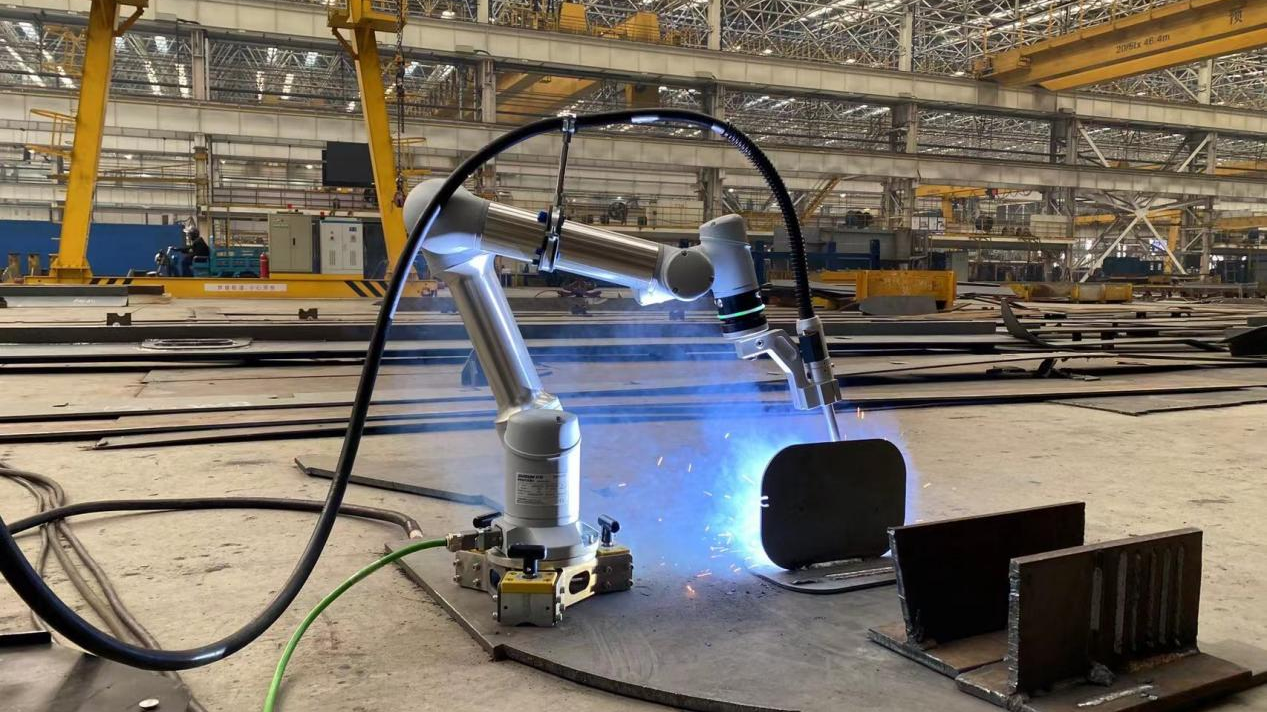
- Optimized for Precision Cobot MIG Welding System for Aluminum
- Industrial Grade Duty Cycle & Precision
- Easy Plug-and-Play Integration
Executive Summary: Precision Aluminum Fabrication Redefined
The CMC-MIG-1200AL is a high-performance, collaborative robotic welding system engineered specifically for the complexities of aluminum alloy fabrication. Unlike standard MIG systems, the CMC-MIG-1200AL integrates advanced pulse-on-pulse wave modulation with a 6-axis high-precision cobot arm to address the narrow melting window and high thermal conductivity inherent in 5XXX and 6XXX series aluminum. This system is designed for Tier 1 and Tier 2 suppliers in the aerospace, automotive, and maritime sectors where weld integrity and aesthetic consistency are non-negotiable.
The primary use case for the CMC-MIG-1200AL is the high-mix, low-volume production of aluminum assemblies such as heat exchangers, structural frames, and pressure vessels. By automating the welding process, manufacturers can achieve a 100% duty cycle at peak amperage, significantly outperforming manual operations that are limited by operator fatigue and heat exposure. The immediate ROI is realized through a 40% reduction in post-weld grinding, a 25% decrease in filler wire waste, and the elimination of burn-through defects common in manual thin-gauge aluminum welding.
Technical Specification Matrix
The following table outlines the core engineering parameters of the CMC-MIG-1200AL system. These specifications are validated under ISO 9001:2015 standards and represent the baseline performance in a controlled industrial environment.
| Parameter | Specification Value | Engineering Notes |
|---|---|---|
| Power Source Output | 400A @ 100% Duty Cycle | Inverter-based with high-speed IGBT switching. |
| Wire Feed Speed (WFS) | 0.5 – 25.0 m/min | Encoder-controlled 4-roll drive system. |
| Cobot Reach | 1300 mm | Spherical workspace with zero-footprint mounting. |
| Payload Capacity | 10 kg | Accommodates water-cooled torch and sensors. |
| Pose Repeatability | ±0.03 mm | Critical for maintaining consistent arc length. |
| Ingress Protection | IP54 Rating | Protected against dust and splashing water. |
| Beam Quality (Sensor) | M2 < 1.2 | Applies to integrated laser seam-tracking module. |
| Input Voltage | 480V AC, 3-Phase, 50/60 Hz | Industrial-grade power requirement. |
| Communication Protocols | EtherNet/IP, Modbus TCP, PROFINET | Seamless integration with Factory 4.0 systems. |
| Wire Diameter Compatibility | 0.8 mm – 1.6 mm | Optimized for 4043 and 5356 aluminum alloys. |
| Motion Speed | 1 m/s (Maximum Tool Speed) | Optimized for rapid air-cut transitions. |
| Safety Standards | ISO 10218-1, ISO/TS 15066 | Dual-channel safety monitoring with PLd Cat 3. |
| Cooling System | Integrated Liquid-to-Air Chiller | 1.5 kW cooling capacity for high-amperage cycles. |
Advanced Motion Control Features
The CMC-MIG-1200AL utilizes a proprietary motion control kernel that synchronizes the robotic arm’s kinematics with the power source’s pulse frequency. This synchronization is vital for aluminum, where the oxide layer must be broken by the arc’s cleaning action without over-penetrating the base metal.
Adaptive Arc Length Control
The system employs a real-time feedback loop that monitors the arc voltage at a frequency of 20 kHz. If the distance between the contact tip and the workpiece changes due to thermal warping—a common issue in aluminum—the motion controller adjusts the Z-axis height instantaneously. This maintains a constant wire feed speed and current density, ensuring uniform bead profile and penetration depth.
Multi-Axis Weave Patterns
For wide-gap joints, the CMC-MIG-1200AL offers programmable weave patterns including zigzag, circular, and trapezoidal motions. These patterns are not merely geometric; they are synchronized with the pulse-on-pulse output. By oscillating the torch, the system manages the heat input more effectively, allowing the weld pool to solidify rapidly, which refines the grain structure of the aluminum weldment and improves tensile strength.
Laser Seam Tracking and Beam Quality
The integrated laser profiling sensor features a beam quality M2 of less than 1.2, providing a highly focused spot size for precision edge detection. This sensor scans the joint geometry 50mm ahead of the arc, compensating for fit-up discrepancies in real-time. The high IP54 rating of the sensor housing ensures that the optics remain functional in the presence of fine aluminum oxide dust and metallic spatter.
ROI Case Study: Manual vs. Cobot Labor Savings
To evaluate the financial viability of the CMC-MIG-1200AL, we conducted a comparative analysis between a certified manual welder and the automated system over a 12-month production cycle (2,000 operational hours).
Manual Welding Baseline
A skilled manual welder specializing in aluminum typically commands a high hourly rate due to the technical difficulty of the material. In a standard shift, the effective “arc-on” time is approximately 30% due to the need for frequent breaks from heat radiation and the time required for part repositioning. Furthermore, manual aluminum welding often results in a 5-8% scrap rate due to burn-through or porosity issues discovered during X-ray or dye-penetrant testing.
CMC-MIG-1200AL Performance
The cobot system operates at an 85% arc-on time, as it does not require breaks and can be integrated with a dual-station turntable for continuous loading and unloading. The precision of the motion control reduces the scrap rate to less than 0.5%.
Annual Savings Projection:
1. Labor Productivity: The cobot completes the work of 2.5 manual welders. At an average loaded labor cost of $75,000 per welder, this equates to a gross labor saving of $187,500 per year.
2. Consumables and Scrap: By optimizing the wire feed speed and reducing rework, the system saves approximately $12,000 in filler wire and $22,000 in scrapped aluminum components annually.
3. Total First-Year Impact: After accounting for the initial capital expenditure and maintenance, most facilities realize a full payback within 8 to 14 months, depending on shift configuration.
Post-Installation Maintenance FAQ
What is the recommended maintenance interval for the wire drive system?
The 4-roll drive system should be inspected every 150 arc-hours. Because aluminum wire is softer than steel, it is prone to “shaving.” Ensure that the U-groove rollers are clean and that the tension is set to the minimum required to prevent wire slippage. Replace the Teflon liner every 500 arc-hours to ensure low-friction delivery.
How does the IP54 rating affect the cleaning protocol?
The IP54 rating indicates that the system is protected against dust ingress and water splashes. However, for aluminum welding, we recommend a weekly dry-compressed air blow-down of the cobot joints and the power source heat sinks to prevent the accumulation of conductive aluminum dust, which can cause short circuits in non-sealed electronic components.
How is the TCP (Tool Center Point) calibrated after a torch collision?
The system includes an automated TCP calibration routine. In the event of a collision, the operator can run a 5-point calibration check using a fixed reference pin. The software will automatically calculate the 3D offset and update the motion paths. This process takes less than three minutes and ensures that pose repeatability remains within the ±0.03 mm specification.
What are the requirements for the cooling fluid?
Use only deionized water mixed with a specialized anti-corrosive coolant designed for high-frequency welding environments. Standard tap water will lead to mineral scaling inside the torch neck, reducing the duty cycle and potentially overheating the contact tip, which leads to wire burn-back.
Can the system handle 7XXX series aluminum?
While the CMC-MIG-1200AL is optimized for 5XXX and 6XXX series, 7XXX series (zinc-alloyed) can be welded using specific pulse parameters and specialized filler wires. Contact our application engineering team for a custom pulse-profile consultation to manage the higher crack sensitivity of 7XXX alloys.
cobot welding 01
cobot welder 02
free programming 03
robot welding 04
how to use Teach pendant 05