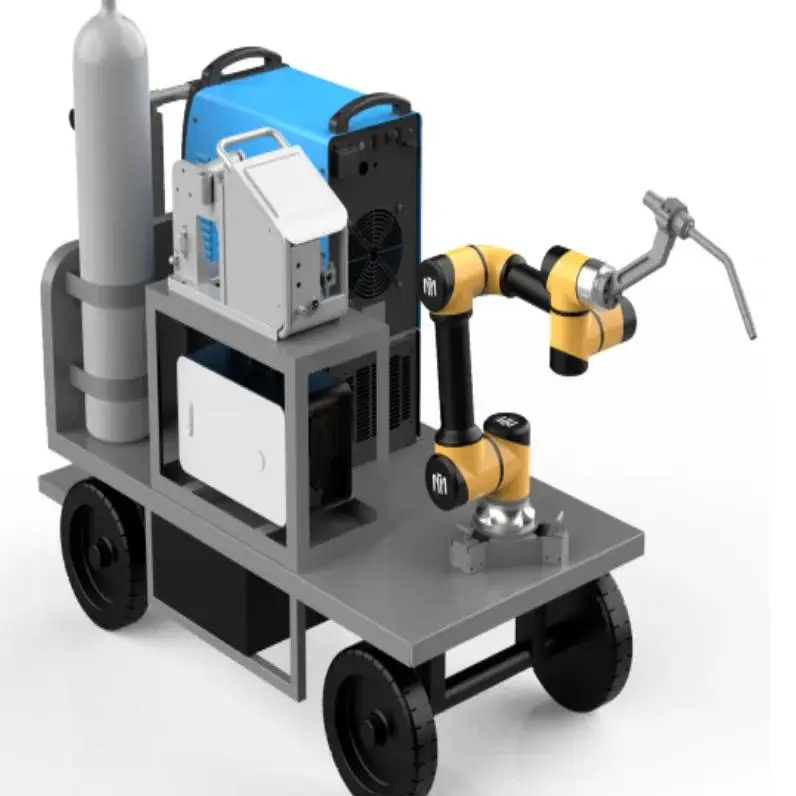
- Optimized for Dual-Process MIG/MAG Robotic Welding Cell
- Industrial Grade Duty Cycle & Precision
- Easy Plug-and-Play Integration
Executive Summary: CMC-DUAL-ARC-V1 Industrial Welding Solution
The CMC-DUAL-ARC-V1 is a high-performance, dual-process MIG/MAG robotic welding cell engineered for high-volume Tier 1 and Tier 2 automotive and heavy machinery manufacturing. Designed to bridge the gap between manual inconsistency and full-scale factory automation, this system integrates a high-torque 6-axis robotic manipulator with a synchronized digital power source. The primary use case involves the precision joining of carbon steels, stainless steels, and aluminum alloys where structural integrity and aesthetic bead quality are non-negotiable.
By implementing the CMC-DUAL-ARC-V1, engineering departments can expect an immediate ROI through a 35-50% increase in throughput and a significant reduction in post-weld grinding and rework. The system utilizes advanced waveform control to minimize spatter and optimize heat input, ensuring that even thin-gauge materials are processed without thermal distortion. With a 100% duty cycle at peak amperage, the CMC-DUAL-ARC-V1 is built for 24/7 continuous operation in harsh industrial environments.
Detailed Technical Specification Matrix
The following table outlines the core mechanical and electrical parameters of the CMC-DUAL-ARC-V1 system. These specifications are validated under ISO 9283 standards for industrial robots.
| Parameter | Specification Value | Unit / Detail |
|---|---|---|
| Robot Reach | 2010 | mm |
| Payload Capacity | 20 | kg (at wrist) |
| Repeatability | ± 0.05 | mm |
| Duty Cycle | 100% @ 400A / 60% @ 500A | Continuous Operation |
| Wire Feed Speed | 1.5 – 25.0 | m/min |
| Input Power | 400/480V, 3-Phase | 50/60 Hz |
| Ingress Protection | IP54 (Controller) / IP67 (Wrist) | Rating |
| Communication Protocols | EtherNet/IP, PROFINET, DeviceNet | Standard I/O |
| Welding Current Range | 30 – 500 | Amperes |
| Cooling System | Integrated Liquid-Cooled Torch | 7.0 kW Cooling Capacity |
| Beam Quality M2 (Sensor) | < 1.1 (Laser Seam Tracker) | Optional Optical Module |
| Wire Diameter Range | 0.8 – 1.6 | mm (Steel/Flux-core) |
| Axis Motion Speed | Up to 210 | Degrees/sec (J1-J6) |
Advanced Motion Control and Path Integration
The CMC-DUAL-ARC-V1 leverages a proprietary motion control kernel that synchronizes the robotic arm movements with the power source’s pulse frequency. This “Arc-Sync” technology ensures that the wire feed speed is adjusted in micro-second intervals relative to the robot’s Tool Center Point (TCP) velocity. This prevents “humping” or thinning of the weld bead during complex cornering or circular interpolation.
Multi-Axis Coordination: The system supports external axis integration, allowing the robot to control a 2-axis positioner (tilt/turn) as a 7th and 8th axis. This ensures the weld pool remains in the gravity-flat (1G) position at all times, which is critical for maintaining penetration depth in MAG (Metal Active Gas) welding of heavy plate sections.
Seam Tracking and Sensing: For workpieces with loose tolerances, the CMC-DUAL-ARC-V1 is equipped with “Through-the-Arc” Seam Tracking (TAST). By monitoring changes in welding current, the robot automatically adjusts its vertical and lateral path to compensate for part warping or fit-up variations. For high-speed applications, an optional laser-line sensor with a beam quality M2 of less than 1.1 provides sub-millimeter topographical mapping of the joint prior to arc ignition.
Singularity Avoidance Algorithms: The controller utilizes advanced kinematics to predict and avoid gimbal lock (singularity) during complex maneuvers. This allows for uninterrupted welding paths across large workpieces, reducing the number of tie-ins and potential leak points in pressure-vessel applications.
ROI Case Study: Manual Labor vs. CMC-DUAL-ARC-V1
To evaluate the financial viability of the CMC-DUAL-ARC-V1, we conducted a comparative analysis based on a standard structural bracket assembly (12 individual 150mm welds per unit).
Manual Welding Scenario
A skilled manual welder typically achieves an “arc-on” time of 25-30% due to fatigue, part positioning, and helmet adjustments. In a standard 8-hour shift, a manual welder produces approximately 45 units. With an average burdened labor rate of $65.00/hour and a rework rate of 4% due to human error, the cost per unit remains high and scaling requires additional headcount.
CMC-DUAL-ARC-V1 Scenario
The robotic cell operates at an arc-on time of 85%. The system completes the same bracket assembly in 140 seconds, including load/unload time using a dual-station shuttle. This results in a throughput of 185 units per shift. Because the system maintains a consistent wire feed speed and voltage, the rework rate drops to less than 0.5%.
Financial Summary
Throughput Increase: 311% increase in daily output per station.
Consumable Savings: 15% reduction in shielding gas and wire waste due to optimized arc starts and stops.
Payback Period: Based on a two-shift operation, the CMC-DUAL-ARC-V1 achieves full capital recovery (CapEx) within 11.4 months. This calculation includes the cost of the robot, safety guarding, and initial programming integration.
Post-Installation Maintenance FAQ
Q: How does the IP54 rating impact the maintenance schedule?
A: The IP54 rating ensures the controller is protected against dust ingress and splashing water. Maintenance involves monthly inspections of the cabinet seals and heat exchanger filters to ensure thermal management components are not compromised by airborne metallic dust common in welding shops.
Q: What is the calibration frequency for the wire feed system?
A: We recommend a digital calibration of the wire feed speed every 2,000 arc-hours. This involves verifying the tachometer feedback against the commanded value in the pendant to ensure the 1.5 – 25.0 m/min range remains linear and accurate.
Q: How is the liquid-cooling system maintained?
A: The cooling reservoir should be checked weekly for fluid levels. A full flush of the glycol-based coolant is required every 12 months to prevent mineral buildup within the torch neck, which can lead to overheating and premature contact tip failure during 100% duty cycle operations.
Q: Can the system handle flux-cored arc welding (FCAW) as well as MIG/MAG?
A: Yes. The CMC-DUAL-ARC-V1 features hardened drive rolls and a high-torque motor capable of feeding 1.2mm to 1.6mm flux-cored wire. The software includes specific FCAW synergic lines to manage the different droplet transfer characteristics of cored wires.
Q: What is the expected lifespan of the robotic arm cable harness?
A: The internal dress pack is rated for 5 million flex cycles. We recommend a visual inspection of the corrugated conduit every quarter to check for signs of abrasion or heat damage from weld spatter. High-wear areas are reinforced with Kevlar-aramid sleeving for extended durability.
Q: How does the system handle power fluctuations?
A: The integrated power source features an automatic voltage compensation circuit that maintains arc stability within ±10% of the nominal input voltage. For facilities with unstable grids, an external line conditioner is recommended to protect the logic boards and motion encoders.
cobot welding 01
cobot welder 02
free programming 03
robot welding 04
how to use Teach pendant 05