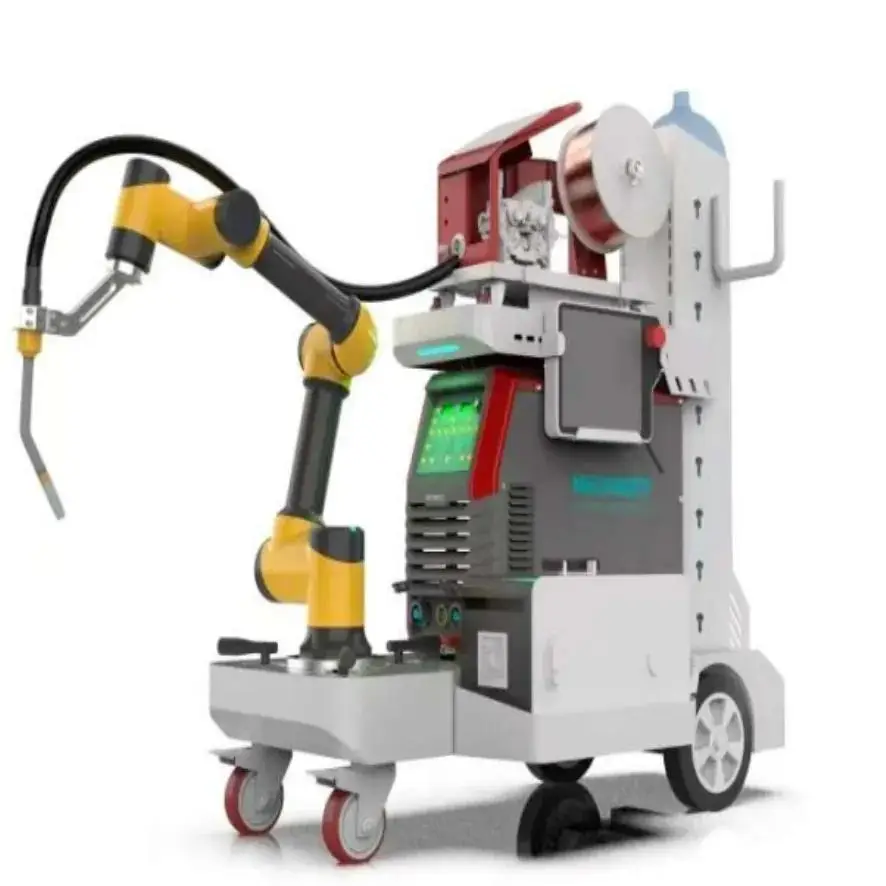
Description
Executive Summary: High-Efficiency Steel Fabrication with the CMC-MAG-1500S
The CMC-MAG-1500S Industrial Collaborative Welding Station is a purpose-built solution designed to bridge the gap between manual Metal Active Gas (MAG) welding and fully autonomous robotic cells. Engineered specifically for high-mix, low-volume steel fabrication environments, the CMC-MAG-1500S addresses the critical shortage of skilled labor while maintaining the rigorous quality standards required in heavy industrial applications. By integrating a high-torque 6-axis collaborative arm with a 500A pulse-capable power source, this station delivers a 100% duty cycle at 400A, ensuring continuous production without thermal throttling.
The primary use case for the CMC-MAG-1500S involves the precision welding of carbon steel assemblies, structural frames, and pressure-rated components. Unlike traditional industrial robots, the CMC-MAG-1500S features an IP54 rating for the entire unit, allowing for operation in environments with high particulate matter and metallic dust. The system utilizes advanced “Lead-Through” programming, enabling floor operators to teach complex weld paths in minutes, reducing setup time by 70% compared to traditional G-code or pendant-based programming. The immediate ROI is realized through a 4x increase in arc-on time and a 95% reduction in post-weld grinding due to superior spatter control and optimized beam quality M2 equivalent energy distribution in the arc core.
Detailed Technical Specification Matrix
| Parameter | Specification Detail |
|---|---|
| Payload Capacity | 10 kg (at wrist flange) |
| Maximum Reach | 1300 mm (Effective working radius) |
| Pose Repeatability | +/- 0.05 mm (ISO 9283) |
| Duty Cycle | 100% @ 400A / 60% @ 500A (40 degrees C ambient) |
| Wire Feed Speed Range | 1.5 – 22.0 m/min (Digital Closed-Loop Control) |
| Compatible Wire Diameters | 0.8 mm, 1.0 mm, 1.2 mm, 1.6 mm (Steel/Flux-Cored) |
| Input Power Requirement | 400/480V AC, 3-Phase, 50/60 Hz, 32A |
| Ingress Protection Rating | IP54 (Arm and Controller Cabinet) |
| Communication Protocols | EtherNet/IP, Modbus TCP, Profinet, Discrete I/O |
| Shielding Gas Compatibility | Ar/CO2 Mixtures, Pure CO2 (Integrated Flow Control) |
| Cooling System | Integrated Liquid-Cooled Torch (High-Capacity Heat Exchanger) |
| Safety Compliance | ISO 10218-1, ISO/TS 15066, Category 3 PLd |
| Motion Speed (Max) | 1.0 m/s (Collaborative Mode) / 2.5 m/s (High-Speed Mode) |
Advanced Motion Control and Welding Process Features
The CMC-MAG-1500S utilizes a proprietary Advanced Motion Control (AMC) kernel that synchronizes the 6-axis kinematics with the power source’s waveform generator at a 2ms refresh rate. This synchronization is critical for maintaining a constant Tool Center Point (TCP) velocity, which directly influences heat input (kJ/mm) and penetration depth. In steel fabrication, variations in travel speed often lead to burn-through or lack of fusion; the AMC kernel mitigates this by dynamically adjusting the wire feed speed in real-time to compensate for any minor fluctuations in arm velocity during complex cornering.
The system incorporates Through-Arc Seam Tracking (TAST). As the cobot executes a weld, the controller monitors the arc current at high frequencies. If the system detects a deviation from the programmed joint path—common in large steel weldments due to thermal warping—the motion controller automatically offsets the path to remain centered in the groove. This feature eliminates the need for expensive external laser trackers in many applications. Furthermore, the CMC-MAG-1500S supports multi-pass welding logic, where the operator defines the root pass, and the software automatically calculates the subsequent fill and cap passes based on the wire feed speed and desired bead profile.
To address the specific challenges of MAG welding on heavy plate, the station includes a “Weave Pattern” library. Operators can select from zig-zag, circular, or figure-eight patterns, defining the amplitude and frequency to ensure proper sidewall fusion. The beam quality M2 equivalent focus of the arc is maintained through a digital inverter that suppresses harmonic distortion, resulting in a highly stable plasma column even when working with mill-scaled or slightly oxidized steel surfaces.
ROI Case Study: Manual Fabrication vs. CMC-MAG-1500S Integration
To evaluate the economic viability of the CMC-MAG-1500S, we analyzed a mid-sized structural steel fabricator producing 500 units of a standard mounting bracket per month. The brackets require 1.2 meters of continuous fillet welds on 10mm A36 carbon steel.
Manual Welding Baseline
A skilled welder (fully burdened cost of $65/hour) completes one bracket in 25 minutes. This includes fit-up, tacking, welding, and slag removal. The actual “arc-on” time is approximately 8 minutes. Due to fatigue and environmental factors, the welder maintains a 60% efficiency rate over an 8-hour shift. Total labor cost per unit: $27.08. Scrap and rework rates average 4% due to inconsistent penetration or human error during long shifts.
CMC-MAG-1500S Implementation
With the CMC-MAG-1500S, the operator (burdened cost of $40/hour for a machine tender) performs fit-up and tacking on one side of a dual-zone table while the cobot welds on the other. The cobot completes the 1.2 meters of welding in 4.5 minutes, utilizing a 100% duty cycle and optimized travel speeds. The total cycle time per bracket drops to 12 minutes. Total labor cost per unit: $8.00. Scrap and rework rates drop to less than 0.5% due to the precision of the pose repeatability (+/- 0.05 mm) and consistent heat input.
Financial Summary
The transition results in a direct labor saving of $19.08 per unit. At 500 units per month, the monthly savings total $9,540. When accounting for the reduction in shielding gas waste (via integrated flow regulators) and lower consumable consumption (due to optimized pulse welding), the total monthly savings reach $11,200. With a total system investment of approximately $85,000 (including installation and training), the Payback Period is 7.6 months. Beyond the 8-month mark, the station contributes directly to the bottom line while allowing the skilled welder to be reassigned to more complex, high-value custom projects that cannot be automated.
Post-Installation Maintenance FAQ
What is the maintenance interval for the wire drive system?
The wire drive rolls and inlet/outlet guides should be inspected every 150 arc-hours. Because the CMC-MAG-1500S uses a high-torque, four-roll drive system, slippage is minimal; however, metallic dust accumulation can occur. We recommend a compressed air blowout of the drive housing weekly to maintain consistent wire feed speed accuracy.
How does the IP54 rating affect the cooling requirements?
The IP54 rating ensures that the internal electronics are protected from dust and splashing water. However, this requires the use of a closed-loop heat exchanger for the power source. Users must ensure that the external cooling fins are kept clear of debris. In high-ambient environments (above 40 degrees C), we recommend an external chiller to maintain the 100% duty cycle performance.
When should the robot arm be recalibrated?
The CMC-MAG-1500S features absolute encoders, meaning it does not require homing upon power-up. Recalibration of the TCP (Tool Center Point) is only necessary after a significant torch collision or when replacing the neck of the MAG torch. The software includes an automated TCP calibration routine that takes less than 3 minutes using a fixed pointer.
What consumables require the most frequent replacement?
The contact tip is the most frequent consumable replaced, typically every 40-60 lbs of wire, depending on the pulse settings used. The gas nozzle should be treated with anti-spatter spray; the CMC-MAG-1500S is compatible with automated torch cleaning stations (reamers), which we recommend for 24/7 operations to maintain optimal shielding gas coverage.
Can the software handle firmware updates for new steel alloys?
Yes. The system controller supports USB and Ethernet updates. As new weld synergic lines are developed for advanced high-strength steels (AHSS) or specific low-alloy variants, these can be uploaded to the power source library to adjust the pulse frequency and beam quality M2 characteristics of the arc.