The Evolution of Structural Fabrication in the Manaus Industrial Pole
The Manaus Free Trade Zone (Polo Industrial de Manaus) represents one of the most complex logistical environments in the global manufacturing sector. Located in the heart of the Amazon region, industrial operations in this hub face unique challenges regarding raw material lead times and finished goods distribution. For structural steel fabricators serving the oil and gas, shipbuilding, and heavy infrastructure sectors, the bottleneck has historically been the processing of large-scale profiles. Traditional methods involving manual layout, mechanical drilling, and band-sawing often resulted in extensive production lead times. However, the recent implementation of a Heavy-Duty Beam Laser system has redefined these operational benchmarks, transitioning a standard fabrication cycle from 72 hours down to a mere 3 hours.
This drastic reduction in cycle time is not merely a result of faster cutting speeds. It is the outcome of a comprehensive technological integration that replaces multiple discrete manufacturing steps with a single, automated workflow. In the context of heavy industry, where labor costs and energy consumption are critical variables, the transition to high-power fiber laser technology for structural profiles represents a significant shift in capital equipment strategy.
Deconstructing the 72-Hour Traditional Fabrication Cycle
To understand the magnitude of a 95 percent reduction in cycle time, one must analyze the legacy processes previously employed by fabricators in the region. A typical structural assembly involving I-beams, H-channels, and square hollow sections required a fragmented workflow. The process began with manual measurement and marking, where technicians used physical templates to indicate hole locations, weld preparations, and cut-to-length points. This stage alone, prone to human error, could consume 12 to 16 hours for a complex batch of profiles.
Following the layout, the material moved to mechanical drilling stations. Mechanical drilling is intrinsically slow, requiring high torque and constant cooling to manage thermal expansion and tool wear. Subsequent to drilling, the beams were moved via overhead cranes to band saws for straight cuts or oxy-fuel stations for complex geometries and coping. Each move between stations introduced “wait time” and increased the risk of material damage. Finally, manual grinding was necessary to remove slag and prepare edges for welding. When accounting for setup times, tool changes, and material handling, the cumulative time for a standard production run frequently reached the 72-hour mark.

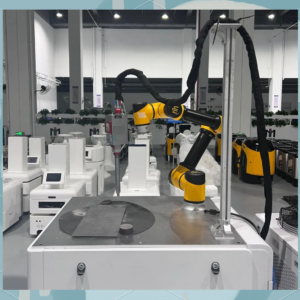
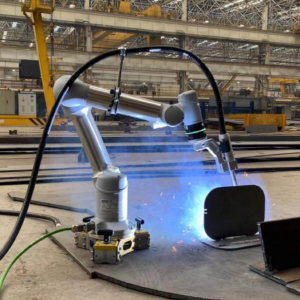
Industrial Application of Heavy-Duty Beam Laser
Technical Integration: The Role of the Heavy-Duty Beam Laser
The introduction of the Heavy-Duty Beam Laser consolidates these disparate operations into a single-pass execution. Utilizing a high-kilowatt Fiber Laser Source, the system is capable of penetrating thick-walled structural steel with a precision that mechanical methods cannot replicate. The core of this technology lies in its 6-axis or 7-axis robotic cutting head, which allows for 3D processing of the beam on all sides without the need to rotate the workpiece manually.
The system utilizes advanced CAD/CAM software to import Tekla or SolidWorks files directly, converting engineering designs into machine code without manual intervention. This digital continuity ensures that every hole, notch, and bevel is executed according to the exact specifications of the 3D model. By employing Nesting Optimization, the software calculates the most efficient arrangement of parts on a single raw beam, significantly reducing material scrap rates—a critical factor in Manaus, where the cost of importing steel is high due to river-based logistics.
Advanced Material Handling and Sensing
The 3-hour cycle is further facilitated by Automated Material Handling systems. These systems utilize infeed and outfeed conveyors equipped with sensors that detect the exact dimensions and orientation of the incoming profile. Because structural steel beams often possess slight deviations or “camber,” the laser system employs touch-probing or laser-scanning to map the actual surface of the beam in real-time. The cutting path is then adjusted dynamically to compensate for these variances, ensuring that the finished component meets stringent tolerances for bolt-hole alignment and structural integrity.
Quantifying the Efficiency Gains: From 72 Hours to 3 Hours
The transition to a 3-hour cycle time is validated through several technical performance metrics. First, the cutting speed of a 12kW to 20kW fiber laser allows for rapid piercing and high-velocity linear movement. While a mechanical drill might take minutes to penetrate a 25mm flange, a high-power laser accomplishes the task in seconds. Furthermore, the laser performs “coping”—the removal of sections of the beam to allow for interlocking joints—with extreme speed, eliminating the need for secondary oxy-fuel or plasma processes.
Second, the elimination of manual layout removes the single largest source of downtime. The time required to load a digital file is negligible compared to the hours spent with chalk and tape measures. Third, the “all-in-one” nature of the machine means that the beam does not wait for crane availability to move from a drill to a saw. The material enters the machine as a raw profile and exits as a finished component, ready for immediate assembly or galvanization. In a data-driven environment, this represents a massive increase in “Green Light Time”—the actual percentage of time the machine is performing value-added work.
Thermal Impact and Edge Quality
A frequent concern in Structural Steel Fabrication is the Heat Affected Zone (HAZ). Modern beam laser systems utilize high-pressure nitrogen or oxygen assist gases to minimize the thermal footprint. The resulting edge quality is superior to oxy-fuel cutting, with a surface roughness that typically meets or exceeds ISO 9013 standards. This removes the need for secondary grinding, allowing the 3-hour cycle to conclude with a part that is weld-ready, further compressing the downstream assembly timeline.
Strategic Implications for the Global Supply Chain
The success of this implementation in Manaus provides a blueprint for global fabricators operating in high-stakes environments. The ability to compress a three-day process into a single morning shift allows for “Just-In-Time” fabrication, reducing the capital tied up in work-in-progress (WIP) inventory. For large-scale infrastructure projects, such as bridge building or industrial plant expansion, this throughput capability allows contractors to respond to design changes in real-time without derailing the project schedule.
Furthermore, the reduction in labor-intensive steps addresses the global shortage of skilled welders and layout technicians. By shifting the complexity from the shop floor to the programming office, companies can achieve higher quality consistency across multiple shifts. The data generated by these machines—tracking gas consumption, power usage, and cutting time per part—enables precise cost accounting and more competitive bidding on international contracts.
Industry Insight: The Future of Autonomous Fabrication
The leap from 72 hours to 3 hours in Manaus is a harbinger of a broader trend toward autonomous structural fabrication. As fiber laser power continues to scale and software algorithms become more adept at handling complex geometries, we are moving toward an era where the “Machine Shop” becomes a “Processing Center.” The integration of Artificial Intelligence (AI) in nesting and predictive maintenance will likely push these cycle times even lower, potentially reaching a state where the only limiting factor is the physical speed of material logistics. For B2B stakeholders, the investment in heavy-duty laser technology is no longer an optional upgrade; it is a fundamental requirement for maintaining relevance in a market that increasingly demands extreme precision at unprecedented speeds.
Industrial Expertise & Support
Are you looking for high-performance Heavy-Duty Beam Laser tailored for the Global market? Our engineering team provides comprehensive solutions for modern manufacturing.