The Industrial Evolution of Joinville: Precision Engineering in Furniture Manufacturing
Joinville, Santa Catarina, stands as Brazil’s primary industrial engine, particularly within the metal-mechanical and furniture production sectors. As global demand for high-end, modular, and metal-integrated furniture rises, regional manufacturers are transitioning from traditional mechanical shearing and plasma cutting to advanced thermal processing. The integration of the Heavy-Duty Beam Laser into the Joinville industrial corridor marks a significant shift in how structural components are fabricated for the international export market. For furniture exporters, the transition is not merely about speed; it is about achieving a level of geometric precision and edge quality that eliminates the need for secondary finishing processes.
The global furniture market dictates rigorous standards for structural integrity and aesthetic consistency. Exporters in Joinville are increasingly utilizing high-wattage fiber laser systems to process hollow sections, open profiles, and heavy-duty structural beams. These systems provide the mechanical rigidity required to handle large-format raw materials while maintaining the micron-level accuracy necessary for complex joinery. By leveraging advanced motion control and high-frequency laser pulsing, these machines ensure that every cut meets the strict tolerances required by European and North American distributors.
Technical Specifications of Heavy-Duty Beam Laser Systems
The core of the technology utilized in Joinville’s fabrication centers is the high-power Fiber Laser Resonator. Unlike CO2 lasers, fiber-based systems operate at a wavelength of approximately 1.06 microns, allowing for superior absorption rates in reflective metals such as aluminum and stainless steel, which are frequently used in modern furniture frames. The “Heavy-Duty” designation refers to the machine’s chassis stability and its ability to support payloads exceeding 100kg per meter, ensuring that long-form beams do not vibrate or deflect during high-speed cutting cycles.

Industrial Application of Heavy-Duty Beam Laser
These systems are typically equipped with a 3D cutting head capable of +/- 45-degree beveling. This capability is critical for furniture exporters who require miter joints and complex intersections in tubular frames. The integration of automated loading and unloading cycles allows for continuous operation, significantly reducing the lead time for high-volume export orders. Furthermore, the CNC interfaces used in these machines allow for direct importing of CAD data, ensuring that the physical output is a 1:1 replica of the digital design, with zero margin for human error in the measurement phase.
Achieving Burrs-Free Quality Through Kerf Width Optimization
One of the primary challenges in metal furniture production is the presence of dross or burrs on the underside of the cut. In traditional thermal cutting, the Heat-Affected Zone (HAZ) is often wide enough to cause material deformation and slag accumulation. For exporters, burrs represent an additional cost center, requiring manual grinding or chemical deburring before the components can be powder-coated or plated. The Heavy-Duty Beam Laser mitigates this through precise Kerf Width Optimization and high-pressure nitrogen assist gases.
By utilizing nitrogen as an assist gas, the laser process displaces molten material instantly before it can oxidize or bond to the edge of the cut. This results in a “bright” finish that is chemically stable and ready for immediate finishing. The concentrated energy density of the beam ensures that the HAZ is kept to a minimum, preserving the metallurgical properties of the steel. For furniture applications where structural tubing is often thin-walled, preventing thermal warping is essential for maintaining the alignment of the final assembly. The result is a burr-free edge that meets the safety and aesthetic requirements of high-end commercial and residential furniture markets.
Impact on Supply Chain Efficiency and Export Compliance
For Joinville-based exporters, the adoption of beam laser technology directly impacts the bottom line by optimizing material nesting and reducing scrap rates. Modern software algorithms can nest complex furniture components within a single beam length, maximizing the utilization of raw materials. Because the laser cut is so narrow, components can be placed closer together than would be possible with mechanical saws. This efficiency is vital given the fluctuating costs of raw steel and aluminum in the global market.
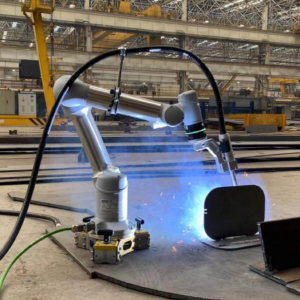
Furthermore, international export compliance often requires adherence to ISO standards regarding edge quality and structural weldability. A burr-free, laser-cut edge provides a superior surface for robotic welding cells. Without the interference of slag or oxidation layers, weld penetration is more consistent, leading to stronger joints and fewer product failures in the field. This reliability is a key selling point for Brazilian manufacturers competing with producers in Eastern Europe and Southeast Asia.
Streamlining Post-Processing for High-Gloss Finishes
In the luxury furniture segment, many designs call for chrome plating or high-gloss powder coating. These finishes are notoriously unforgiving; even the slightest surface imperfection or edge burr will be magnified once the coating is applied. The precision of the Heavy-Duty Beam Laser ensures that the perimeter of each component is perfectly smooth. By eliminating the mechanical stress associated with traditional punching or sawing, the laser also prevents micro-fractures in the material, ensuring that the finish remains adhered to the substrate over the product’s lifespan.
This level of quality control allows Joinville exporters to move up the value chain, transitioning from basic component manufacturing to the production of fully finished, “ready-to-assemble” (RTA) luxury goods. The ability to provide a product that requires no additional onsite refinement is a significant competitive advantage in the B2B furniture sector, where assembly labor costs in destination countries like the US or Germany are prohibitively high.
Industry Insight: The Future of South American Manufacturing Hubs
The concentration of high-power laser technology in Joinville is indicative of a broader trend in South American manufacturing: the move toward specialized, high-tech industrial clusters. As global supply chains continue to de-risk by diversifying their sourcing locations, Brazil is positioning itself as a high-quality alternative to traditional manufacturing hubs. The investment in Heavy-Duty Beam Laser systems is not just a localized upgrade; it is a strategic alignment with Industry 4.0 principles.
The data-driven nature of laser fabrication allows for a seamless “digital twin” workflow, where design changes can be implemented globally and executed locally with zero latency. For the furniture industry, this means the ability to produce small-batch, customized export runs with the same unit-cost efficiency as mass production. The future of the Joinville furniture export market lies in this intersection of heavy-duty mechanical capability and precision digital control. As laser power continues to scale and assist-gas technologies become more efficient, the “burr-free” standard will shift from being a premium offering to a baseline requirement for any manufacturer seeking to compete on the global stage. The integration of these systems ensures that Joinville remains at the forefront of this industrial transition, providing the global market with furniture components that require no compromise between structural durability and aesthetic perfection.
Industrial Expertise & Support
Are you looking for high-performance Heavy-Duty Beam Laser tailored for the Global market? Our engineering team provides comprehensive solutions for modern manufacturing.