Precision Structural Fabrication: The Rise of Heavy-Duty Beam Laser Technology in Belo Horizonte
The industrial landscape of Belo Horizonte, Brazil, situated within the strategic Iron Quadrangle, has long been a cornerstone of global mining and metallurgy. As the demand for complex infrastructure and high-capacity industrial machinery escalates, the transition from traditional thermal cutting methods to advanced laser processing has become a technical necessity. Specifically, the implementation of the Heavy-Duty Beam Laser has redefined the parameters of structural steel fabrication, offering a level of precision that was previously unattainable with plasma or oxy-fuel systems. This shift is driven by the requirement for high-tolerance components that facilitate seamless welding integration in large-scale construction projects.
Belo Horizonte’s manufacturing sector is currently pivoting toward automated 3D laser processing to handle the rigorous demands of heavy-duty H-beams, I-beams, and C-channels. By utilizing multi-axis fiber laser systems, fabricators can execute complex geometries and precise bevels in a single pass. This technological evolution is not merely an incremental improvement in speed; it represents a fundamental change in how structural integrity is calculated and achieved in heavy engineering.
Technical Specifications of 3D Five-Axis Laser Systems
The core of modern beam processing in the Minas Gerais region involves 3D five-axis fiber laser heads. Unlike standard flatbed lasers, these systems are engineered to move around a fixed or rotating workpiece, allowing for the processing of all four sides of a beam without manual repositioning. The heavy-duty nature of these machines refers to their ability to support workpieces weighing several tons while maintaining a positioning accuracy of ±0.05mm over long spans.
The integration of high-kilowatt fiber sources—ranging from 12kW to 30kW—enables the penetration of thick-walled structural steel. The high energy density of the laser beam minimizes the Heat-Affected Zone (HAZ), ensuring that the metallurgical properties of the base metal remain intact. This is critical for structural components used in seismic zones or high-load industrial environments where material fatigue is a primary concern. Furthermore, the use of nitrogen or oxygen as assist gases allows for dross-free cuts, eliminating the need for secondary mechanical finishing.
The Mechanics of 45-Degree Beveling for Weld Preparation
One of the most significant advantages of the Heavy-Duty Beam Laser is its capacity for high-precision 45-degree beveling. In traditional fabrication, creating a bevel for a V-groove or K-groove weld required a separate operation, often involving manual grinding or specialized edge-milling machines. These methods are prone to human error and inconsistency, which can lead to poor weld penetration or excessive filler material usage.
Industrial Application of Heavy-Duty Beam Laser
Laser beveling solves these issues by incorporating the bevel angle into the primary cutting program. The 5-axis head tilts to the programmed 45-degree angle, maintaining a constant focal distance from the material surface. This creates a uniform “knife-edge” or “land” profile across the entire length of the beam. For the heavy industries in Belo Horizonte, such as bridge construction and high-rise framework, this precision ensures that when two beams are brought together, the fit-up is nearly perfect. A zero-gap fit-up is the prerequisite for automated robotic welding, which is increasingly becoming the standard in global B2B supply chains.
Optimizing the Welding Workflow through Laser Precision
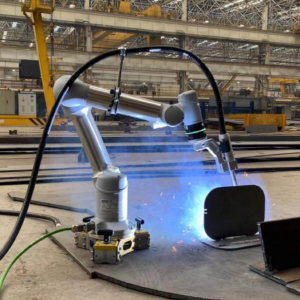
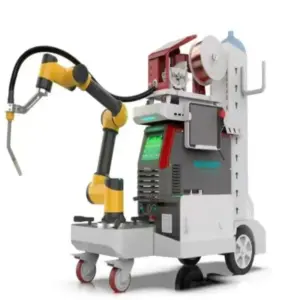
The transition to laser-beveled beams significantly impacts the downstream welding process. When a 45-degree bevel is executed with laser precision, the volume of the weld groove is consistent. This allows welding engineers to program automated welding tractors or robots with precise parameters for wire feed speed and travel speed, knowing that the joint geometry will not vary.
Furthermore, the clean, oxide-free edges produced by fiber lasers (when using nitrogen) or the controlled oxide layer (when using oxygen) provide a superior surface for arc stability. In Belo Horizonte’s heavy-duty sectors, reducing the time spent on joint preparation by 70% to 80% has allowed firms to increase their throughput without expanding their physical footprint. The reduction in filler metal consumption—due to the absence of over-gapping—also contributes to a lower total cost of ownership for each fabricated unit.
Material Handling and Throughput in Large-Scale Operations
Processing heavy-duty beams requires more than just a powerful laser; it requires a sophisticated material handling ecosystem. In the industrial hubs of Brazil, these laser systems are often paired with automated loading and unloading conveyors that can handle beams up to 12 meters in length. Sensors detect the exact dimensions and any slight deviations in the beam’s straightness, allowing the software to compensate in real-time. This “measure-and-cut” capability ensures that even if a raw beam has a slight bow, the laser-cut features remain perfectly aligned with the theoretical center line.
This level of automation is essential for Belo Horizonte’s role as a global exporter of processed steel. By minimizing manual intervention, manufacturers can guarantee a level of repeatability that meets international standards such as ISO 9001 and AWS D1.1. The ability to track each part via laser-etched barcodes during the cutting process further enhances the traceability required in modern structural steel fabrication.
Environmental and Economic Considerations
Beyond technical performance, the adoption of heavy-duty laser technology offers significant environmental benefits. Traditional plasma cutting generates substantial amounts of dust and hazardous fumes, requiring massive filtration systems. While laser cutting also requires filtration, the narrower kerf width results in less material being vaporized. Additionally, the high energy efficiency of modern fiber laser resonators reduces electricity consumption compared to older CO2 or plasma technologies.
From an economic perspective, the reduction in scrap is a vital metric. Advanced nesting software for beam processing allows for the placement of multiple parts on a single length of raw material with minimal spacing. The precision of the laser allows for “common-line cutting” in certain applications, further maximizing material utilization. In a market where steel prices are volatile, the ability to extract more value from every ton of raw material provides a decisive competitive advantage.
Industry Insight: The Future of Autonomous Fabrication
The integration of the Heavy-Duty Beam Laser in Belo Horizonte is a precursor to the broader trend of autonomous fabrication in South America. As Industry 4.0 principles take hold, we are seeing a shift from isolated machines to integrated digital ecosystems. In this environment, the CAD model of a building or a machine is fed directly into the laser’s control system, which then determines the optimal cutting path, bevel angles, and assembly markings.
The future of the industry lies in the “Digital Twin” concept, where the physical beam produced in a Brazilian facility is a perfect replica of the digital design. This eliminates the “trial and error” phase of assembly on construction sites, significantly reducing project timelines. For global stakeholders, the development of high-tech fabrication hubs in regions like Belo Horizonte means that high-quality, weld-ready structural components can be sourced with the same level of confidence as those from traditional manufacturing powerhouses in Europe or East Asia. The 45-degree bevel is no longer just a geometric feature; it is a symbol of the precision-first approach that will define the next decade of heavy industrial evolution.
Industrial Expertise & Support
Are you looking for high-performance Heavy-Duty Beam Laser tailored for the Global market? Our engineering team provides comprehensive solutions for modern manufacturing.