Advanced Structural Steel Fabrication: The Rise of High-Efficiency Plasma Cutting in São Paulo
The industrial landscape of São Paulo, Brazil, serves as the primary engine for South American infrastructure development. As the demand for complex steel structures—ranging from logistics hubs to high-rise commercial frames—increases, the regional fabrication sector is transitioning from traditional mechanical processing to automated thermal cutting solutions. Central to this transition is the deployment of the H-Beam Plasma Cutter, a system engineered to address the specific challenges of structural steel geometry. In a market where raw material costs fluctuate significantly, the integration of Zero-tailing technology has emerged as a critical factor for maintaining operational margins and ensuring high-precision output.
Traditional H-beam processing often involves a combination of band sawing and drilling, a multi-step process that introduces cumulative tolerances and significant material waste. By contrast, modern plasma systems integrate these functions into a single robotic or multi-axis CNC platform. The adoption of these systems in São Paulo’s manufacturing corridors reflects a global shift toward “lean” fabrication, where the objective is to maximize throughput while minimizing the footprint of secondary operations.
Technical Analysis of Zero-Tailing Technology
The primary inefficiency in conventional CNC beam processing is the “tailing” waste. Standard feeding mechanisms require a specific length of material to remain clamped within the drive rollers to maintain stability during the final cuts. This typically results in a remnant or “tail” of 300mm to 600mm that cannot be processed, leading to a material utilization rate that rarely exceeds 85% to 90%.
Zero-tailing technology utilizes a secondary carriage system or a specialized dual-clamping mechanism that transfers the workpiece through the cutting zone without losing mechanical reference. This allows the plasma torch to execute profiles, bolt holes, and coping cuts to within 50mm or less of the beam’s trailing edge. For a standard 12-meter H-beam, reducing the scrap from 500mm to 50mm represents a significant recovery of usable material. When scaled across a project involving thousands of tons of structural steel, the cumulative savings directly impact the project’s bottom line.
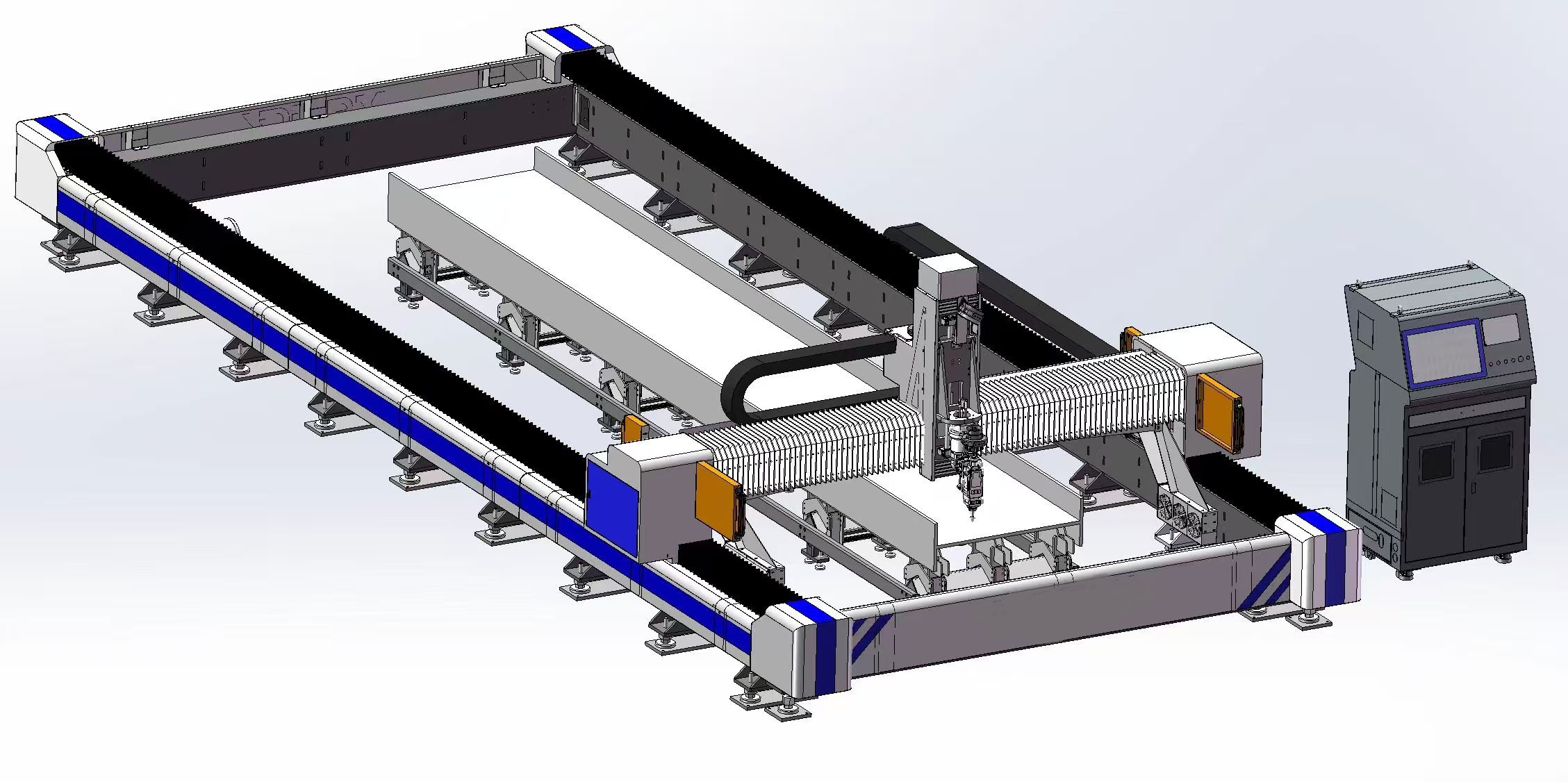
Industrial Application of H-Beam Plasma Cutter
Mechanical Precision and 8-Axis Motion Control
To achieve 95% material utilization, the H-Beam Plasma Cutter must maintain extreme positional accuracy even when the material is at its most unstable point (the end of the beam). This is achieved through 8-axis robotic motion control. These axes govern the longitudinal movement of the beam (X-axis), the rotation and elevation of the plasma head (Y, Z, and rotational axes), and the autonomous adjustment of the clamping pressure to prevent flange deformation.
The integration of laser sensors for real-time beam profiling is essential. Structural steel, particularly H-beams and I-beams produced in large batches, often exhibits slight dimensional variances or “camber.” The 8-axis system uses high-speed sensing to map the actual dimensions of the beam before the arc is struck. The CNC then compensates for these variances in real-time, ensuring that bolt holes are perfectly centered on the web and that bevel cuts for weld preparations meet AWS (American Welding Society) standards for fit-up.
Optimizing Material Utilization to 95%
Achieving a 95% utilization rate is not merely a function of the hardware; it requires a sophisticated interaction between nesting software and the plasma power source. In the São Paulo industrial context, fabricators utilize specialized CAD/CAM suites that integrate directly with TEKLA or Autodesk Revit files. These software packages perform “common-line cutting” and intelligent nesting, where multiple parts are oriented to share a single cut path, further reducing the kerf loss and the number of pierces required.
Thermal Management and Kerf Compensation
Plasma cutting involves intense localized heat. On thinner-web H-beams, excessive heat input can lead to warping, which compromises the 95% utilization goal by rendering the final sections out of tolerance. Modern systems utilize high-definition plasma power sources that employ ventilated cutting beds and precision gas flow control (using O2 or N2/H35 mixtures) to narrow the plasma arc. This results in a smaller heat-affected zone (HAZ) and a narrower kerf. By maintaining a stable arc voltage and adjusting travel speed based on the thickness of the flange versus the web, the system ensures consistent edge quality, eliminating the need for post-cut grinding.
Economic Impact on the São Paulo Steel Market
The economic rationale for implementing a H-Beam Plasma Cutter with Zero-tailing capabilities in São Paulo is driven by three primary factors: labor costs, energy efficiency, and scrap value. While Brazil has a robust steel industry, the overhead associated with manual fabrication is rising. An automated plasma line can replace the output of four to six manual stations, significantly reducing the “man-hours per ton” metric.
Furthermore, the reduction of scrap from 10-15% down to 5% alters the procurement strategy. Fabricators can order more precise lengths from the mills or utilize shorter remnants that would previously have been discarded. In a high-volume facility processing 500 tons per month, a 5% increase in material utilization saves 25 tons of steel. At current market rates for structural carbon steel, the ROI (Return on Investment) for the Zero-tailing upgrade is often realized within 12 to 18 months of operation.
Integration with Industry 4.0 Standards
The modern fabrication facility in São Paulo is increasingly data-driven. The H-Beam Plasma Cutter serves as a data node within the factory ecosystem. Through IoT (Internet of Things) connectivity, production managers can monitor consumable wear, arc-on time, and material throughput in real-time. This connectivity allows for predictive maintenance, ensuring that the machine does not experience unscheduled downtime during critical project phases.
The ability to import DSTV files directly from the design office to the machine floor eliminates manual data entry errors. This end-to-end digital workflow is essential for the “Zero-defect” mandate required by international construction firms operating in Brazil. When the machine knows the exact geometry of the beam and the nesting plan, the Zero-tailing logic is applied automatically, ensuring that the operator does not need to manually intervene to save the last few centimeters of the workpiece.
Concluding Industry Insight: The Future of Structural Automation
The transition toward 95% material utilization via Zero-tailing technology represents a maturation of the structural steel industry. We are moving away from an era where steel was viewed as a commodity with acceptable waste margins, toward an era of high-precision manufacturing. For fabricators in São Paulo and globally, the competitive advantage no longer lies solely in the ability to source cheap material, but in the technical capacity to process that material with near-total efficiency.
As environmental regulations and carbon footprint tracking become more stringent, the reduction of industrial waste will shift from a financial preference to a regulatory requirement. Systems that minimize “tailing” waste are inherently more sustainable, reducing the energy required for recycling scrap steel. The future of the industry lies in the further refinement of robotic tool paths and the potential integration of AI-driven nesting algorithms that can predict material behavior under thermal stress. For the B2B sector, investing in high-utilization plasma technology is not just an operational upgrade; it is a strategic alignment with the future of global sustainable construction.
Industrial Expertise & Support
Are you looking for high-performance H-Beam Plasma Cutter tailored for the Global market? Our engineering team provides comprehensive solutions for modern manufacturing.