Introduction: The Evolution of Structural Fabrication in the Andean Region
The industrial landscape of Quito, Ecuador, has undergone a significant transformation in its approach to heavy machinery fabrication. As the primary hub for agricultural equipment manufacturing in the northern Andean region, the demand for high-durability structural components has necessitated a shift from traditional mechanical sawing and manual oxy-fuel cutting to automated thermal processes. The integration of the H-Beam Plasma Cutter into local production lines represents a pivotal advancement in metallurgical precision. This technology addresses the specific challenges of fabricating harvesters, trailers, and soil preparation implements that must withstand extreme mechanical stress and varying soil conditions. By focusing on the minimization of the thermal footprint during the fabrication process, manufacturers are achieving unprecedented levels of structural reliability.
The Technical Significance of a Small Heat Affected Zone (HAZ)
In thermal cutting, the Heat Affected Zone (HAZ) is the area of base metal that has not been melted but has had its microstructure and mechanical properties altered by the intense heat of the cutting process. For agricultural machinery, where components are subjected to cyclic loading and high vibration, a large HAZ is a primary precursor to structural failure. Excessive heat input leads to grain growth, localized hardening, and the potential for hydrogen embrittlement.
Modern plasma systems utilized in Quito leverage high-definition (HD) plasma technology to constrict the arc, resulting in a higher energy density. This concentration allows for faster travel speeds, which directly reduces the duration of thermal exposure to the surrounding metal. By maintaining a narrow thermal gradient, the H-Beam Plasma Cutter ensures that the mechanical properties of the structural steel—such as yield strength and ductility—remain consistent from the edge of the cut through the center of the beam. This is critical for the longevity of agricultural chassis that operate in high-torque environments.
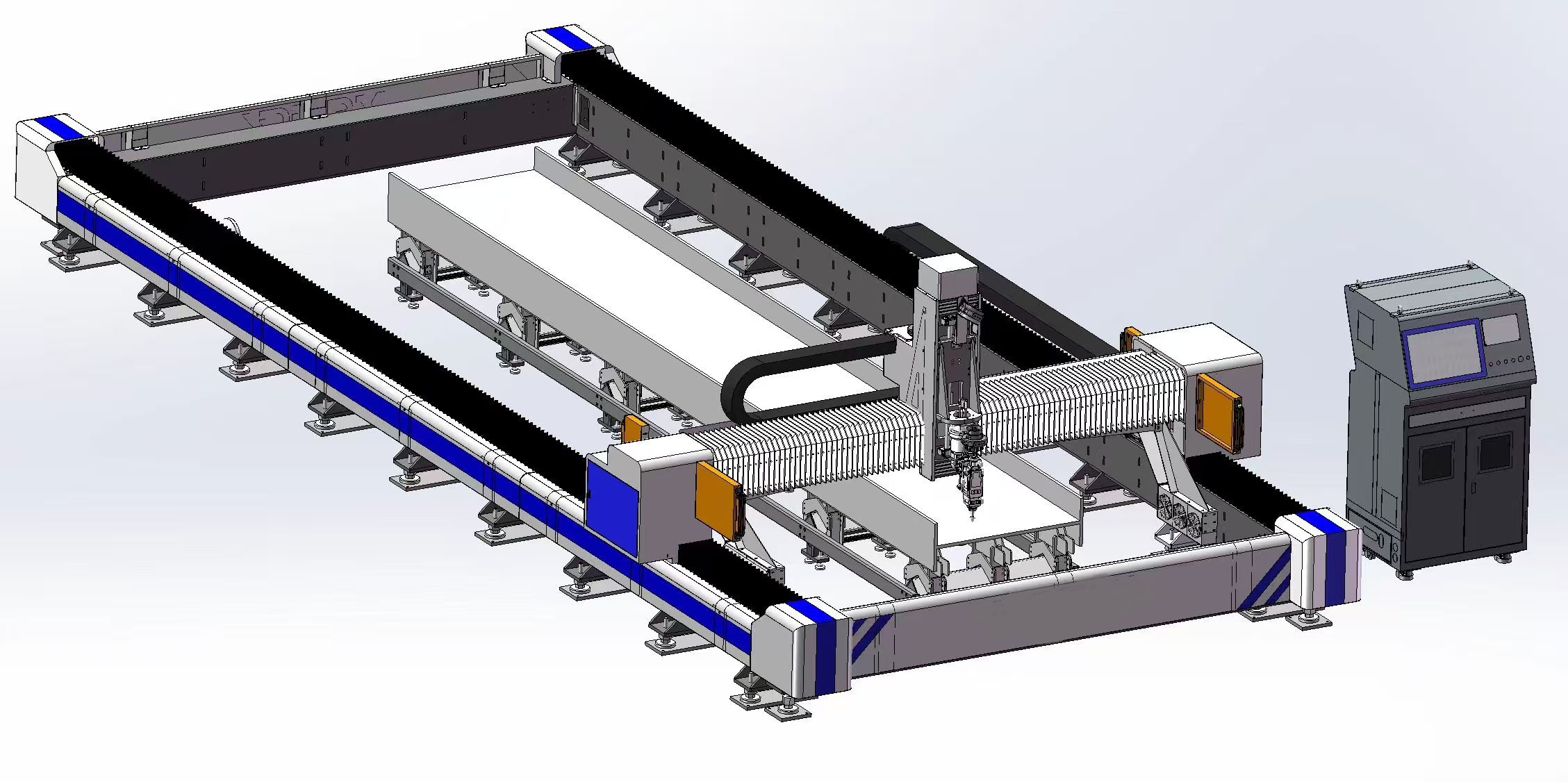
Industrial Application of H-Beam Plasma Cutter
Robotic Kinematics and 3D Structural Processing
Processing H-beams, I-beams, and channels requires more than a standard linear cut. It requires Robotic 5-axis Kinematics to navigate the complex geometries of structural sections. The systems currently being deployed in Ecuador’s industrial sectors feature multi-axis robotic arms equipped with specialized plasma torches capable of beveling, coping, and creating bolt holes in a single pass.
The precision of these robotic systems eliminates the need for secondary grinding or drilling. When a plasma cutter operates with high angular accuracy, the fit-up for subsequent welding processes is significantly improved. In the context of agricultural machinery, where weld integrity is paramount, the clean, dross-free edges produced by an automated plasma system ensure deeper penetration and fewer inclusions in the weld bead. This synergy between precise cutting and superior weldability is the cornerstone of machinery longevity.
Material Integrity in High-Altitude Manufacturing
Operating a plasma system in Quito, situated at approximately 2,850 meters above sea level, presents unique atmospheric challenges. The lower air density affects the cooling rates of the plasma arc and the efficiency of the gas shielding. Technical calibrations for an H-Beam Plasma Cutter in this region must account for adjusted gas flow rates and voltage settings to maintain arc stability.
Despite these environmental variables, the objective remains the same: minimizing the thermal input. Advanced power supplies now feature real-time Kerf Compensation and adaptive current control. These features allow the system to adjust the plasma intensity based on the thickness of the beam’s flange versus its web, ensuring that the heat distribution remains uniform across varying cross-sections. This prevents the warping or twisting of the beam, which is a common issue in lower-tier thermal cutting methods.
Optimizing Agri-Machinery Longevity Through Edge Quality
Agricultural machinery is frequently exposed to corrosive fertilizers and abrasive soil. When a structural beam is cut with a high-heat process like oxy-fuel, the resulting wide HAZ creates a zone that is more susceptible to stress corrosion cracking. Furthermore, the rough edge profile of inferior cuts acts as a “stress riser,” where cracks can initiate under the heavy loads characteristic of deep-plowing equipment.
By utilizing small-HAZ plasma technology, Quito-based manufacturers are producing components with smoother surface finishes and minimal metallurgical alteration. Technical data suggests that components processed with high-definition plasma exhibit a fatigue life up to 30% longer than those processed with traditional thermal methods. This increase in durability reduces the total cost of ownership for the end-user by extending the intervals between structural maintenance and decreasing the likelihood of catastrophic field failure.
Efficiency Metrics and Post-Processing Reduction
From a B2B operational perspective, the adoption of automated H-beam cutting is driven by throughput. Traditional methods of marking, cutting, and drilling an H-beam for an agricultural trailer chassis could take several hours of manual labor. An automated plasma system can execute the same sequence of operations—including complex miter cuts and slotting—in under twenty minutes.
The reduction in post-processing is a significant factor in the return on investment (ROI). Because the plasma arc is so focused, the “kerf” (the width of the material removed) is minimized, leading to better material utilization. Moreover, the lack of dross (hardened slag) on the bottom of the cut means that parts can move directly from the cutting table to the welding station. This streamlined workflow is essential for Ecuadorian manufacturers looking to compete in the global agricultural export market, where production efficiency and build quality are the primary differentiators.
Industry Insight: The Shift Toward Integrated Structural Steel Processing
The global trajectory for structural fabrication is moving toward fully integrated digital workflows. In Quito, the adoption of the H-Beam Plasma Cutter is not merely a hardware upgrade but a step toward Industry 4.0. By utilizing BIM (Building Information Modeling) and CAD/CAM software that communicates directly with the plasma controller, manufacturers are eliminating human error in the layout phase.
The concluding insight for the industry is this: Longevity in agricultural machinery is no longer achieved simply by using thicker steel. It is achieved through the precision of the fabrication process. As material costs rise, the ability to use high-strength, low-alloy (HSLA) steels becomes more important. These steels are particularly sensitive to heat; therefore, the “Small HAZ” approach is not just a preference but a technical requirement for the next generation of agri-machinery. Manufacturers who master the balance of thermal control and robotic automation will define the standards for durability in the global market, ensuring that equipment can withstand the rigors of modern farming for decades rather than years.
Industrial Expertise & Support
Are you looking for high-performance H-Beam Plasma Cutter tailored for the Global market? Our engineering team provides comprehensive solutions for modern manufacturing.





