Introduction: The Intersection of Structural Engineering and Grid Reliability
Industrial manufacturing in Quito, Ecuador, presents a unique set of variables for heavy machinery operations. At an elevation of approximately 2,850 meters, the geographic location necessitates specific engineering considerations for thermal management and electrical insulation. However, the most critical operational hurdle for structural steel fabricators in this region remains power quality. The deployment of an H-Beam Plasma Cutter in such environments requires more than just high-precision kinematics; it demands robust internal power conditioning to mitigate the risks associated with grid instability and voltage transients.
For global manufacturers sourcing or operating heavy equipment in developing industrial hubs, the integration of built-in voltage regulation is no longer an optional feature but a core technical requirement. This article examines the mechanical and electrical architecture required to maintain high-tolerance plasma cutting on structural profiles while operating under fluctuating electrical loads.
The Impact of Grid Volatility on Plasma Arc Stability
Plasma cutting technology relies on the maintenance of a highly ionized gas stream. The consistency of this arc is directly proportional to the stability of the input current. In many industrial zones within Quito, the local power grid can experience significant voltage sags and surges caused by the simultaneous switching of heavy inductive loads in neighboring facilities. Without internal regulation, these fluctuations lead to several failure modes in the cutting process.
First, voltage drops result in a decrease in arc pressure, which leads to incomplete penetration of the H-beam flange or web. This necessitates secondary grinding or, in worst-case scenarios, the scrapping of the structural component. Second, transient voltage spikes can damage the sensitive IGBT Inverter Technology used to modulate the power supply. By integrating a multi-stage regulation system, the equipment isolates the internal logic and high-frequency firing circuits from the external grid, ensuring that the plasma torch maintains a constant amperage regardless of input variations.
Technical Architecture of Built-in Voltage Regulation
The internal Voltage Stabilization Circuitry within modern H-beam processing units utilizes a combination of active and passive components. The primary stage typically involves a heavy-duty isolation transformer that provides a physical buffer between the machine and the grid. This is followed by a rectification stage where AC power is converted to DC, during which large capacitor banks act as energy reservoirs to “smooth” out minor voltage dips.
Advanced units utilize Pulse Width Modulation (PWM) to adjust the output in real-time. If the input voltage drops by 10 percent, the controller increases the duty cycle of the switching transistors to maintain the commanded output current. This response occurs in microseconds, far faster than external mechanical stabilizers. For the structural steel industry, this means the kerf width and dross levels remain uniform throughout the entire length of a 12-meter H-beam, even if the factory’s primary supply is fluctuating.
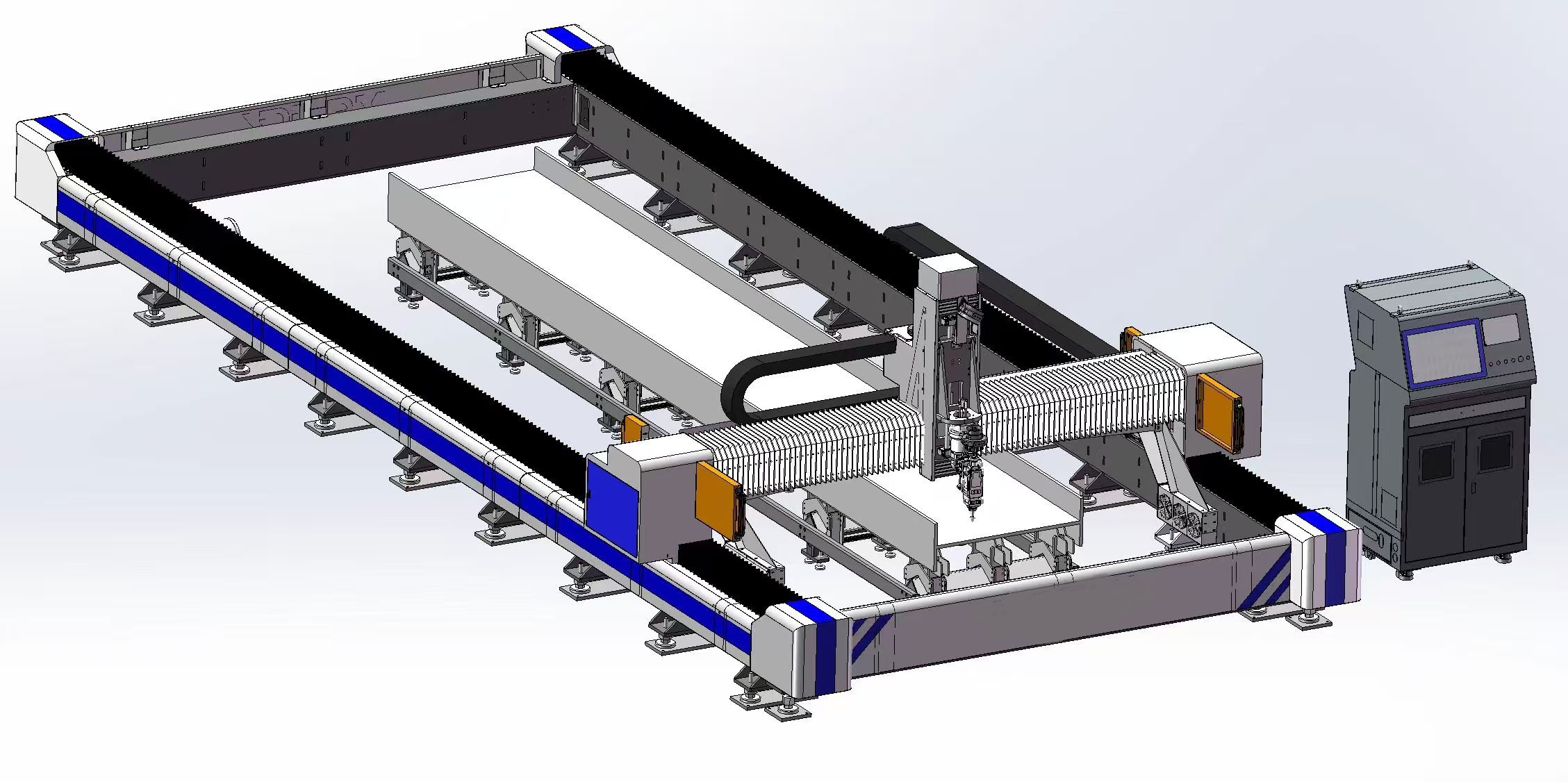
Industrial Application of H-Beam Plasma Cutter
High-Altitude Considerations for Electrical Insulation
Operating an H-Beam Plasma Cutter in Quito also requires addressing the reduced dielectric strength of air at high altitudes. As the air density decreases, the breakdown voltage—the point at which air becomes conductive—also drops. This increases the risk of internal arcing within the power supply cabinets.
To compensate, manufacturers must increase the “creepage and clearance” distances between high-voltage components. Furthermore, the cooling efficiency of standard fans is reduced in thinner air. Therefore, the voltage regulation system must be paired with an oversized thermal management system. Sensors must monitor the temperature of the transformer windings and the heat sinks of the power semiconductors to prevent thermal runaway, which is often exacerbated by the electrical stress of regulating a poor-quality power input.
Precision Kinematics and Torch Height Control (THC)
While voltage regulation handles the power supply, the physical accuracy of the cut on an H-beam depends on the THC (Torch Height Control) system. On structural beams, surfaces are rarely perfectly flat; there is often a degree of camber or sweep. The THC system uses the arc voltage itself as a feedback loop to determine the distance between the nozzle and the workpiece.
If the input grid voltage is unstable, a standard THC might misinterpret a grid-induced voltage drop as a change in torch height, causing the Z-axis to crash into the beam or move too far away. By utilizing a regulated internal power bus, the THC receives a “clean” signal, allowing it to maintain an accuracy of plus or minus 0.1mm. This is essential for the complex 5-axis or 6-axis movements required to cut bolt holes, copes, and weld preparations on all four sides of the beam in a single pass.
Economic Advantages of Integrated Regulation
From a B2B perspective, the Total Cost of Ownership (TCO) of a plasma system is heavily influenced by consumable life and downtime. Unstable voltage is a primary cause of premature electrode and nozzle wear. When the arc stutters due to power fluctuations, the hafnium insert in the electrode erodes unevenly. By stabilizing the power, a facility in Quito can achieve a consumable lifespan comparable to facilities in regions with highly stable grids, such as Western Europe or North America.
Furthermore, the elimination of external voltage stabilizers reduces the footprint of the installation and simplifies the electrical infrastructure requirements for the factory. This “all-in-one” approach reduces the points of failure and streamlines the maintenance schedule, as the internal regulation components are designed to match the duty cycle of the cutting system itself.
Concluding Industry Insight
The industrial shift toward decentralized manufacturing means that high-precision equipment is increasingly being deployed in regions with developing infrastructure. The case of H-beam processing in Quito illustrates a broader industry trend: the decoupling of machine performance from local utility limitations. As global structural steel demands rise, the competitive edge will belong to manufacturers who prioritize “grid-agnostic” machinery.
Engineering resilience into the power electronics of heavy machinery does more than protect the hardware; it guarantees process repeatability in non-ideal environments. For the global B2B sector, the technical takeaway is clear: when specifying high-precision CNC equipment for diverse geographic locations, the internal electrical conditioning architecture is as vital to the final output as the mechanical tolerances of the cutting head itself. Stability, both mechanical and electrical, remains the fundamental prerequisite for automation success.
Industrial Expertise & Support
Are you looking for high-performance H-Beam Plasma Cutter tailored for the Global market? Our engineering team provides comprehensive solutions for modern manufacturing.