Introduction: The Industrial Nexus of the Southern Cone
Montevideo, Uruguay, has emerged as a critical logistical and industrial hub for the Southern Cone, serving as a gateway for infrastructure projects spanning across Uruguay, Northern Argentina, and Southern Brazil. In these vast geographical regions, the demand for structural steel fabrication is accelerating, driven by energy, maritime, and large-scale civil engineering sectors. However, the primary challenge for fabricators in this region is not merely the procurement of raw materials, but the maintenance of operational uptime for sophisticated machinery located far from original equipment manufacturer (OEM) headquarters.
The implementation of the H-Beam Plasma Cutter in Montevideo represents a shift toward localized high-precision manufacturing. By integrating advanced 6-Axis Robotic Kinematics with remote cloud diagnostics, regional fabricators can now bypass the traditional logistical delays associated with physical on-site technical support. This article examines the technical architecture of these systems and how cloud-based telemetry is revolutionizing structural steel processing in geographically isolated industrial zones.
Technical Specifications of H-Beam Plasma Cutting Systems
The modern H-Beam Plasma Cutter utilized in Montevideo’s industrial sector is designed to handle complex structural profiles, including I-beams, H-beams, channels, and square tubing. Unlike traditional manual layouts, these systems utilize automated measuring and feeding mechanisms to ensure dimensional accuracy within tolerances of less than 1mm. The core of the system is a high-definition plasma power source capable of piercing thick-walled structural steel with minimal dross and a reduced heat-affected zone (HAZ).
The robotic arm typically features a multi-axis configuration that allows for 360-degree rotation around the workpiece. This enables the execution of bolt holes, cope cuts, miter cuts, and weld preparations in a single pass. The integration of sophisticated Kerf Compensation Algorithms ensures that the plasma arc’s physical width is accounted for during the cutting path generation, maintaining the integrity of the structural fit-up. This precision is vital for the modular construction methods currently favored in the South American energy sector.
The Role of 3D Profiling and Nesting Software
Efficiency in Montevideo’s fabrication shops is dictated by material utilization rates. Advanced nesting software takes BIM (Building Information Modeling) data—typically in DSTV or STEP formats—and optimizes the layout of parts on a single beam. This reduces scrap rates significantly. The software calculates the optimal cutting sequence to minimize thermal distortion, which is a critical factor when dealing with the high-tensile steel grades often required for regional bridge and port infrastructure.
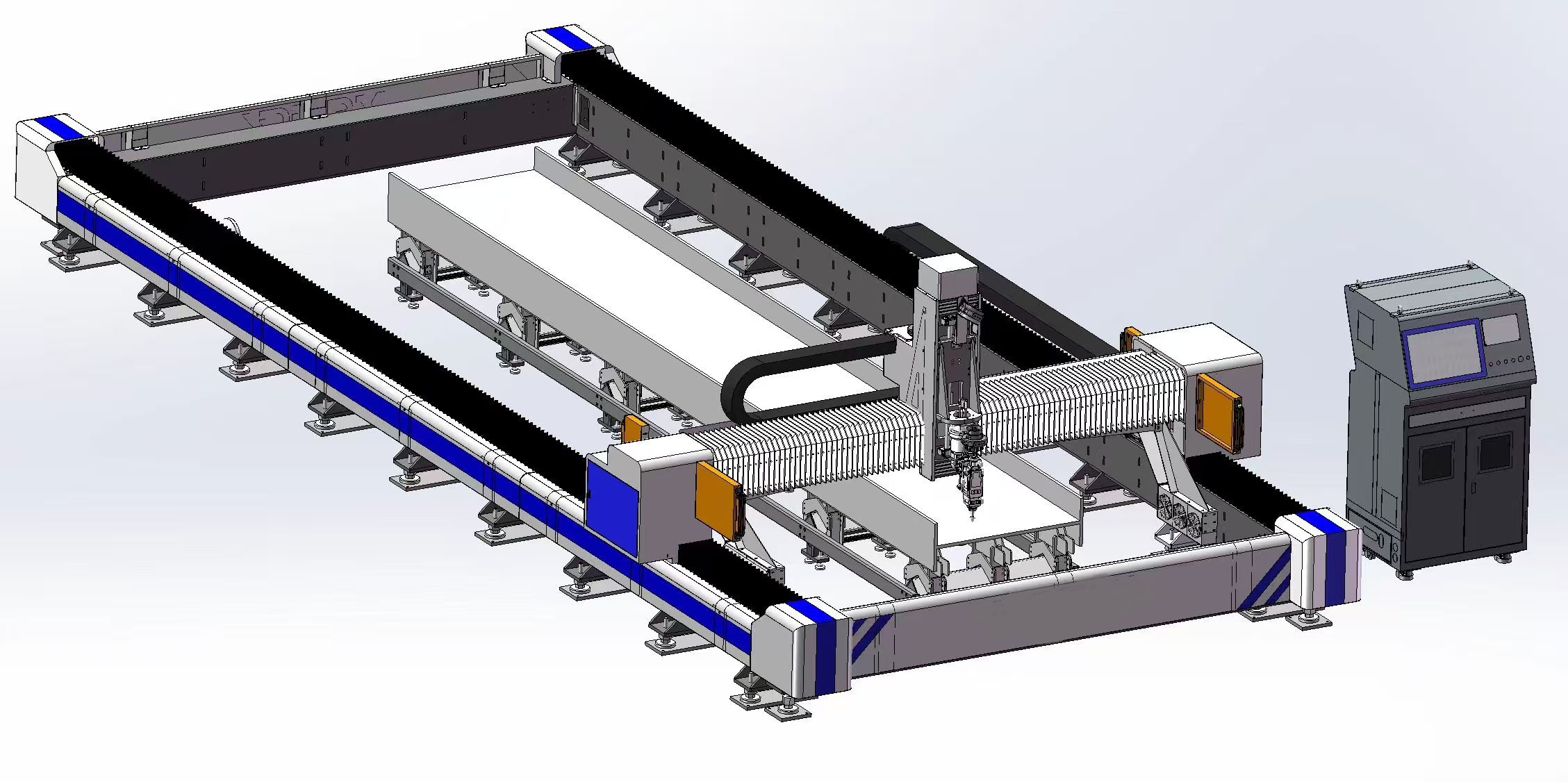
Industrial Application of H-Beam Plasma Cutter
Remote Cloud Diagnostics: Bridging the Geographical Gap
The most significant barrier to adopting high-end automation in regions like Uruguay has historically been the “service lag.” When a machine malfunctions in a remote region, the downtime required to fly in a specialized technician from Europe, North America, or Asia can be catastrophic for project timelines. Remote cloud diagnostics have transformed this paradigm by providing real-time transparency into the machine’s internal logic and hardware status.
Through IoT Telemetry Protocols, the H-Beam plasma system in Montevideo is constantly connected to a secure cloud server. This connection transmits a continuous stream of data points, including motor torque levels, gas flow rates, arc voltage, and controller temperature. If a deviation from the baseline is detected, the system generates an automated alert, often before a physical failure occurs.
Architectural Components of Cloud Monitoring
The diagnostic architecture consists of three primary layers: the Edge Layer, the Transport Layer, and the Application Layer. At the Edge Layer, sensors integrated into the plasma cutter collect high-frequency data. This data is processed locally to filter out noise before being sent through the Transport Layer (typically via encrypted VPN) to the cloud. At the Application Layer, OEM engineers can access a digital twin of the machine in Montevideo, allowing them to visualize the exact state of the robotic arm and the CNC controller.
This allows for several remote interventions:
1. PLC (Programmable Logic Controller) logic updates and bug fixes.
2. Calibration adjustments for the 6-axis robotic arm.
3. Fine-tuning of gas pressures based on the specific metallurgical properties of the local steel supply.
4. Real-time software patches to optimize cutting paths for new structural profiles.
Operational Reliability in Vast Regions
For a fabricator operating out of Montevideo but serving projects in the remote interior of the continent, reliability is synonymous with profitability. The cloud diagnostic system enables predictive maintenance, where components such as plasma torches, lead screws, and cooling units are monitored for wear. Instead of reactive repairs, the system predicts the remaining useful life (RUL) of consumables and critical parts.
In the context of the Southern Cone, this allows for a streamlined supply chain. Parts can be shipped to Montevideo in anticipation of a failure, ensuring that the H-Beam Plasma Cutter remains operational during peak production cycles. This data-driven approach eliminates the “guesswork” often associated with maintaining complex mechatronic systems in developing industrial markets.
Data Security and Latency Considerations
A common concern in B2B cloud integration is data security and network latency. Modern systems utilize industrial-grade encryption and local data buffering. Even if the internet connection in the industrial zone is intermittent, the machine continues to operate using its local buffer, syncing the diagnostic data once the connection is restored. This ensures that the cutting process is never interrupted by external network fluctuations.
Economic Impact on the Regional Supply Chain
The deployment of high-capacity plasma cutting with remote support significantly lowers the total cost of ownership (TCO). By reducing the need for on-site visits, companies in Uruguay can save thousands of dollars in travel expenses and, more importantly, prevent weeks of lost production. Furthermore, the ability to produce high-precision structural components locally reduces the reliance on imported pre-fabricated steel, fostering a more robust local economy and faster response times for regional infrastructure emergencies.
Concluding Industry Insight: The Future of Distributed Manufacturing
The integration of the H-Beam Plasma Cutter in Montevideo, backed by robust cloud diagnostics, is a microcosm of a larger trend in global manufacturing: the decoupling of physical location from technical expertise. We are moving toward an era where the “factory floor” is a global entity. The expertise required to maintain a complex robotic system no longer needs to reside within the same four walls as the machine itself.
For vast regions like the Southern Cone, this technological leap is essential. It levels the playing field, allowing regional fabricators to compete with global giants by maintaining the same levels of precision and uptime. The future of industrial growth in remote regions will not be built on labor arbitrage, but on the seamless integration of high-end hardware with globalized, cloud-based support structures. As these systems become more autonomous and their diagnostic capabilities more predictive, the geographical barriers to industrial excellence will continue to dissolve, making hubs like Montevideo central players in the global structural steel landscape.
Industrial Expertise & Support
Are you looking for high-performance H-Beam Plasma Cutter tailored for the Global market? Our engineering team provides comprehensive solutions for modern manufacturing.





