Introduction: The Evolution of Structural Steel Fabrication in the Southern Cone
The industrial landscape of Montevideo, Uruguay, has undergone a significant transformation as it positions itself as a logistics and manufacturing hub for the MERCOSUR region. Central to this evolution is the adoption of high-precision thermal cutting systems designed to meet rigorous international standards for structural integrity. In high-volume steel construction, the primary overhead costs are dictated by raw material waste and secondary processing times. The deployment of the H-Beam Plasma Cutter equipped with Zero-tailing technology represents a shift toward extreme material efficiency, achieving up to 95% utilization. This technical analysis explores the mechanical and algorithmic frameworks that allow fabricators in Montevideo to minimize scrap while maintaining the tolerances required for complex infrastructure projects.
The Mechanics of Zero-Tailing Technology
Traditional plasma cutting systems for structural profiles often require a significant “clamping zone” at the end of the workpiece. This results in a “tail” or remnant piece, typically ranging from 300mm to 800mm, which cannot be processed and is subsequently discarded as scrap. In a high-tonnage environment, this waste represents a direct loss of capital and increases the carbon footprint of the project.
Zero-tailing technology utilizes a dual-chuck or multi-gripper feed system. In these configurations, the primary chuck feeds the H-beam through the cutting envelope while a secondary support mechanism or a specialized pass-through chuck takes control as the beam end approaches the plasma torch. This transition allows the H-Beam Plasma Cutter to execute cuts within millimeters of the beam’s edge. By eliminating the mechanical “dead zone” of the clamping system, the software can nest parts across the entire length of the raw material. This capability is particularly critical in Montevideo’s maritime and port expansion projects, where heavy-gauge H-beams are standard and material costs are subject to international market volatility.
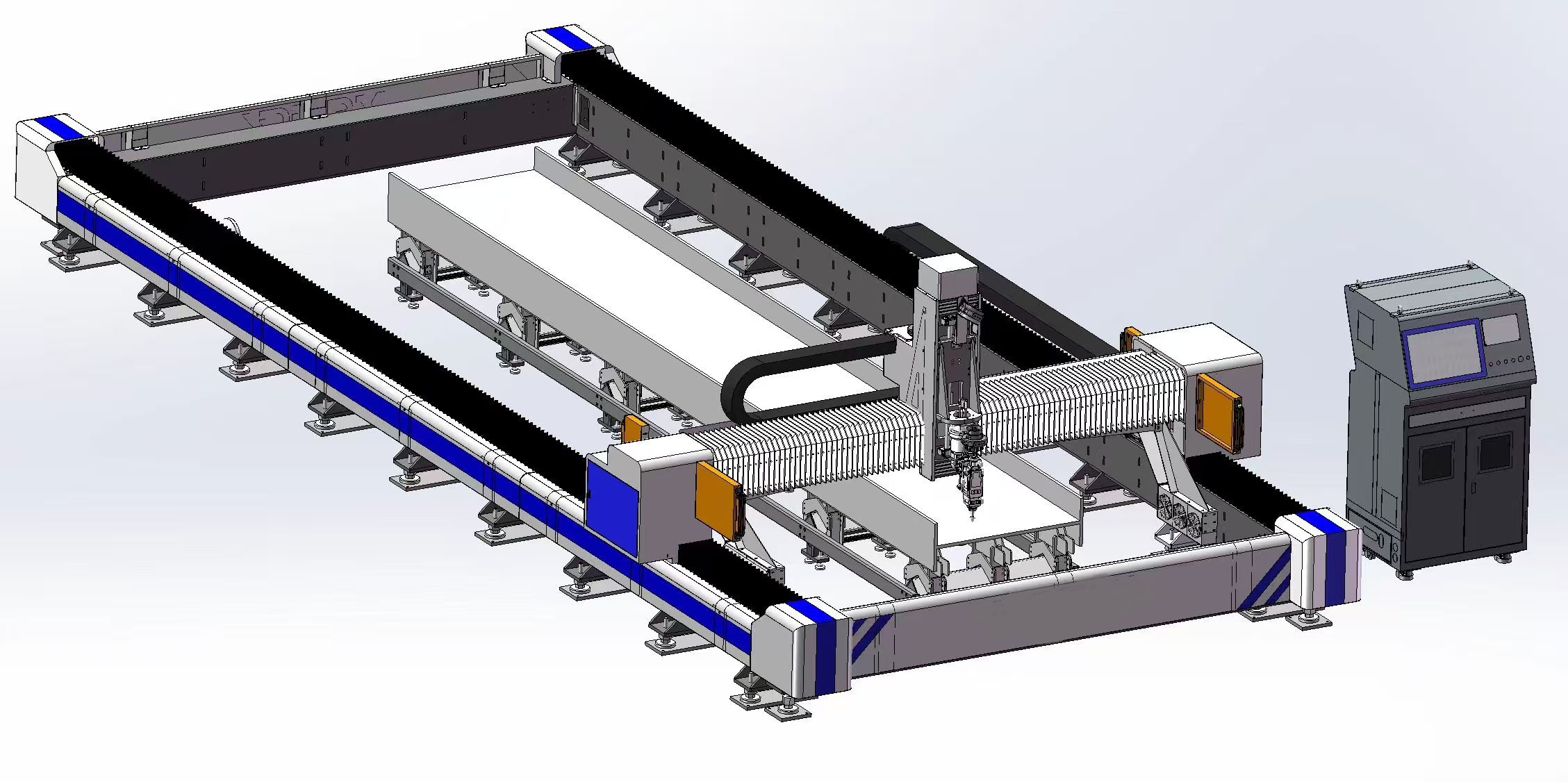
Industrial Application of H-Beam Plasma Cutter
95% Material Utilization: A Data-Driven Analysis
Achieving a 95% material utilization rate is not merely a result of the clamping mechanism; it is an integration of nested structural profiles and precise kerf compensation. Standard structural fabrication often hovers around 80-85% efficiency due to lead-in/lead-out requirements and remnant loss. To bridge the 10-15% efficiency gap, the system employs advanced CAD/CAM algorithms specifically tuned for 3D profiles.
The software calculates the optimal placement of bolt holes, copes, and notches across a batch of beams, ensuring that the “web” and “flange” cuts are interleaved to minimize the distance between finished parts. In the context of Montevideo’s industrial sector, where high-grade steel is often imported, the reduction of scrap from 15% to 5% results in a direct 10% reduction in raw material procurement costs. Furthermore, the reduction in scrap weight lowers the logistical burden of waste management, streamlining the internal workflow of the fabrication facility.
Technical Specifications and Plasma Arc Stability
The H-Beam Plasma Cutter operating in these environments typically utilizes a high-definition plasma power source capable of delivering 130 to 400 amps. The integration of multi-axis robotic heads allows for the compensation of the “bevel angle” inherent in plasma arcs. When cutting thick-walled H-beams, maintaining perpendicularity on both the web and the flanges is essential for weld preparation.
Key technical parameters include:
- Repeatability: +/- 0.1mm.
- Positioning Speed: Up to 30m/min.
- Plasma Gas Control: Automatic gas consoles for O2, N2, and H35 to optimize the thermal distortion control across different metallurgical compositions.
- Torch Height Control (THC): High-frequency sensing to maintain a constant standoff distance, preventing collisions during the transition between the flange and the web.
In the humid coastal environment of Montevideo, the system must also account for surface oxidation. Advanced sensors detect the material surface through mill scale, ensuring that the arc ignition is consistent and that the pierce point does not degrade the nozzle life prematurely.
Integration with BIM and Digital Workflows
Modern structural steel fabrication in Uruguay is increasingly reliant on Building Information Modeling (BIM). The H-Beam Plasma Cutter serves as the physical execution point for digital designs. TEKLA or Revit models are exported via DSTV or STEP files directly into the cutter’s processing engine. This eliminates manual layout and marking, which are traditional sources of human error.
The zero-tailing system enhances this digital workflow by providing accurate feedback on material consumption. Real-time monitoring allows floor managers to track exactly how many kilograms of steel have been converted into finished components versus the remaining stock. This level of transparency is vital for B2B contractors who must provide documented proof of material efficiency and quality control to international developers and government agencies overseeing Uruguayan infrastructure.
Operational Efficiency in the Montevideo Industrial Zone
The operational logic of deploying such high-end machinery in Montevideo is rooted in the “Just-in-Time” (JIT) manufacturing model. By utilizing zero-tailing tech, fabricators can produce finished, ready-to-assemble beams with all necessary holes and notches in a single pass. This replaces multiple traditional stations: the band saw, the drill line, and the manual coping station.
By consolidating these processes into a single H-Beam Plasma Cutter, the footprint of the fabrication shop is optimized, and the labor hours per ton of steel are drastically reduced. In a competitive global market, the ability to deliver high-precision structural elements with minimal lead time allows Uruguayan firms to bid successfully on projects across South America and beyond.
Concluding Industry Insight: The Shift Toward Lean Structural Fabrication
The convergence of zero-tailing technology and high-definition plasma cutting marks a definitive end to the era of high-waste structural fabrication. As global steel prices remain volatile and environmental regulations regarding industrial waste become more stringent, the metric of “Material Utilization” will become as important as “Cutting Speed.”
The industry is moving toward a “Closed-Loop” fabrication model where the digital twin of the H-beam dictates the most efficient physical path, leaving almost no trace of waste. For the B2B sector, the investment in zero-tailing capabilities is no longer an optional upgrade but a baseline requirement for economic viability. Facilities in Montevideo that adopt these 95% utilization standards are not just saving on material; they are redefining the benchmarks for structural efficiency. The future of the industry lies in the precision of the software-hardware interface, where every millimeter of steel is accounted for and every arc second is optimized for structural integrity and resource conservation.
Industrial Expertise & Support
Are you looking for high-performance H-Beam Plasma Cutter tailored for the Global market? Our engineering team provides comprehensive solutions for modern manufacturing.