Introduction: The Industrial Evolution of the Manaus Free Trade Zone
The Manaus Free Trade Zone (Zona Franca de Manaus) stands as a critical industrial hub in South America, serving as a gateway for high-tech manufacturing and heavy infrastructure development. As Brazil continues to invest in logistical corridors and large-scale urban projects, the demand for precision-engineered structural steel has reached an inflection point. Traditional manual layout and sawing methods no longer meet the throughput requirements of modern engineering projects. In this landscape, the deployment of the H-Beam Plasma Cutter equipped with a 4-chuck stability system represents a significant shift toward automated efficiency. This technical analysis explores how 4-chuck technology addresses the specific challenges of heavy structural steel fabrication in the unique logistical environment of Northern Brazil.
The Mechanical Significance of 4-Chuck Synchronous Rotation
In the domain of heavy structural steel processing, stability is the primary determinant of accuracy. Conventional plasma cutters often utilize two or three chucks, which can lead to material sagging or vibration when handling long-span H-beams. The 4-chuck system, however, introduces a redundant support mechanism that ensures the workpiece remains perfectly centered along the longitudinal axis throughout the entire cutting cycle.
The 4-chuck synchronous rotation system functions by utilizing two feeding chucks and two rotating chucks that work in tandem. This configuration allows for “zero-tailing” processing. When the plasma torch reaches the end of a profile, the fourth chuck maintains a firm grip on the remaining material, allowing the machine to cut within millimeters of the edge. This is particularly vital in Manaus, where the cost of transporting raw steel from southern mills is high; reducing material waste by 5% to 10% through zero-tailing technology directly impacts the bottom line of regional fabricators.
Plasma Power Sources and Cutting Precision in Humid Environments
Manaus presents a unique set of environmental challenges, specifically high relative humidity and consistent temperatures. For an H-Beam Plasma Cutter to operate at peak efficiency, the integration of a high-definition plasma power source is non-negotiable. These power sources must feature robust internal cooling systems and moisture separation units to ensure the ionized gas stream remains stable.
The technical advantage of high-definition plasma over standard air plasma lies in the narrowed arc. By utilizing secondary gases (such as Oxygen or Nitrogen/Hydrogen mixes), the system achieves a higher energy density. This results in a significantly reduced heat-affected zone (HAZ) and a dross-free finish on thick-walled H-beams. For structural applications where weld integrity is paramount—such as bridge components or industrial warehouses—the precision of the plasma arc ensures that the beveling and bolt-hole piercing meet ISO 9001 and AISC standards without the need for secondary grinding.
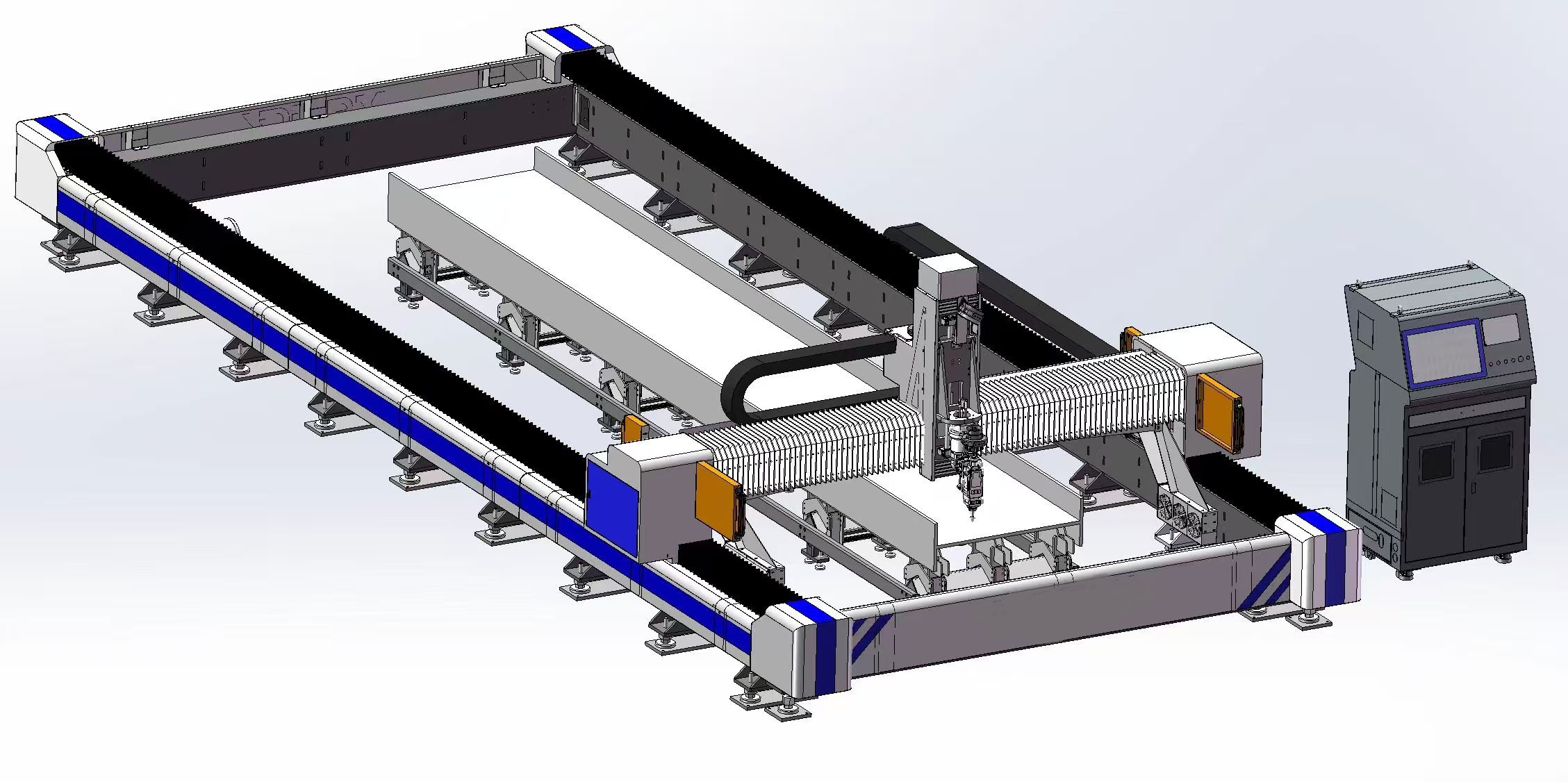
Industrial Application of H-Beam Plasma Cutter
CNC Motion Control and Software Integration
The brain of the H-beam processing unit is the CNC motion control system. In the context of the 4-chuck machine, the controller must manage up to 10 axes of synchronized movement simultaneously. This includes the rotation of four independent chucks, the longitudinal movement of the gantry, and the multi-axis orientation of the plasma robotic arm.
Modern systems deployed in Brazil are increasingly integrated with TEKLA or AutoCAD software. The workflow involves importing a 3D model directly into the machine’s CAM software, which automatically generates the cutting paths for complex geometries, including:
- Coping cuts for interlocking joints.
- Precision bolt holes with minimal taper.
- Complex miter cuts for architectural steel.
- Marking and part identification for downstream assembly.
This automation eliminates human error in the layout phase, which is a critical factor when skilled labor is at a premium. The ability to move from a digital blueprint to a finished structural member in a single setup drastically reduces the lead times for large-scale construction projects in the Amazon region.
Structural Stability and Vibration Dampening
Heavy H-beams, often exceeding 12 meters in length and weighing several tons, generate significant kinetic energy during rotation. A 4-chuck system provides superior vibration dampening compared to 3-chuck variants. By clamping the beam at four distinct points, the system neutralizes the harmonic vibrations that occur when a plasma torch operates at high speeds.
This mechanical rigidity is essential for maintaining the “kerf” width—the width of the cut made by the plasma arc. If the beam vibrates even by a fraction of a millimeter, the kerf becomes inconsistent, leading to poor fitment during site erection. In the structural steel industry, where tolerances are often measured in microns, the stability provided by the 4-chuck architecture ensures that every notch and hole aligns perfectly during the final assembly, reducing the need for costly field corrections.
Logistical Advantages for the Manaus Industrial Pole
Operating a heavy-duty H-Beam Plasma Cutter in Manaus requires a focus on uptime and maintenance. The 4-chuck machines designed for this market often feature dust extraction systems and heavy-duty filtration to protect the precision rails and rack-and-pinion drives from the fine metallic dust generated during the plasma process. Furthermore, the use of modular components allows for rapid servicing, a necessity given the geographic isolation of the city from Brazil’s southern industrial centers.
The efficiency of these machines allows local fabricators to compete with imported pre-fabricated steel. By processing raw beams locally, companies in the Manaus Free Trade Zone can leverage tax incentives while maintaining the flexibility to adjust designs on the fly, a feat that is impossible when relying on pre-cut steel shipped from thousands of miles away.
Industry Insight: The Future of Automated Structural Fabrication
The transition toward 4-chuck plasma technology in Manaus is indicative of a broader global trend: the convergence of heavy mechanical engineering and digital manufacturing. As infrastructure projects become more complex and timelines more aggressive, the reliance on “smart” hardware—machines that can self-compensate for material irregularities and provide real-time data on consumable wear—will become the industry standard.
The true value of the 4-chuck H-beam cutter is not merely in its speed, but in its ability to transform the fabrication shop into a data-driven production line. For the Brazilian market, and specifically the burgeoning industrial sector in the Amazon, this technology represents the end of the “measure twice, cut once” era and the beginning of the “model once, automate forever” paradigm. The future of structural steel lies in this level of high-fidelity automation, where the physical constraints of heavy material are mitigated by sophisticated mechanical clamping and precision CNC control.
Industrial Expertise & Support
Are you looking for high-performance H-Beam Plasma Cutter tailored for the Global market? Our engineering team provides comprehensive solutions for modern manufacturing.





