Advancements in Structural Steel Fabrication: The H-Beam Plasma Cutter in Caracas
The industrial landscape in Caracas, Venezuela, is currently undergoing a significant transition toward high-precision automation within the structural steel sector. As infrastructure projects demand tighter tolerances and lower overhead costs, the deployment of the H-Beam Plasma Cutter has become a focal point for Tier-1 fabrication facilities. This transition is not merely a localized trend but reflects a global shift toward integrating high-definition plasma technology with sophisticated robotics to replace traditional manual sawing and drilling methods. The primary objective is the optimization of raw material consumption and the reduction of secondary processing stages.
In the context of Caracas’s heavy industry, the adoption of automated thermal cutting systems addresses specific logistical challenges related to material procurement and energy efficiency. By utilizing advanced CNC protocols, fabricators are now able to execute complex geometries on H-beams, I-beams, and channels with a level of repeatability that was previously unattainable. This technical evolution is centered on two critical performance metrics: the maximization of material yield and the elimination of scrap through specialized mechanical engineering.
The Mechanics of Zero-tailing Tech and 95% Material Utilization
Traditional structural steel cutting often results in significant “drop” or “tailing” waste—the unusable portion of the beam held by the machine’s clamping system. In conventional setups, this can account for 10% to 15% of the total material length. However, the integration of Zero-tailing Tech has fundamentally altered this ratio. This technology utilizes a dual-chuck or multi-point feeding system that allows the plasma torch to maintain proximity to the workpiece even at the extreme ends of the beam. By synchronizing the longitudinal movement of the beam with the rotational and vertical axes of the torch, the system can execute cuts within millimeters of the clamping zone.
Achieving 95% Material Utilization is the direct result of this mechanical precision. For a standard 12-meter H-beam, traditional methods might waste over a meter of steel. With zero-tailing functionality, the scrap is reduced to a nominal amount, often less than 200mm. This efficiency is facilitated by high-speed sensors that map the beam’s profile in real-time, compensating for any structural deviations or “mill-tolerance” irregularities. The software then calculates the optimal nesting path, ensuring that the maximum number of components is extracted from a single length of raw material.
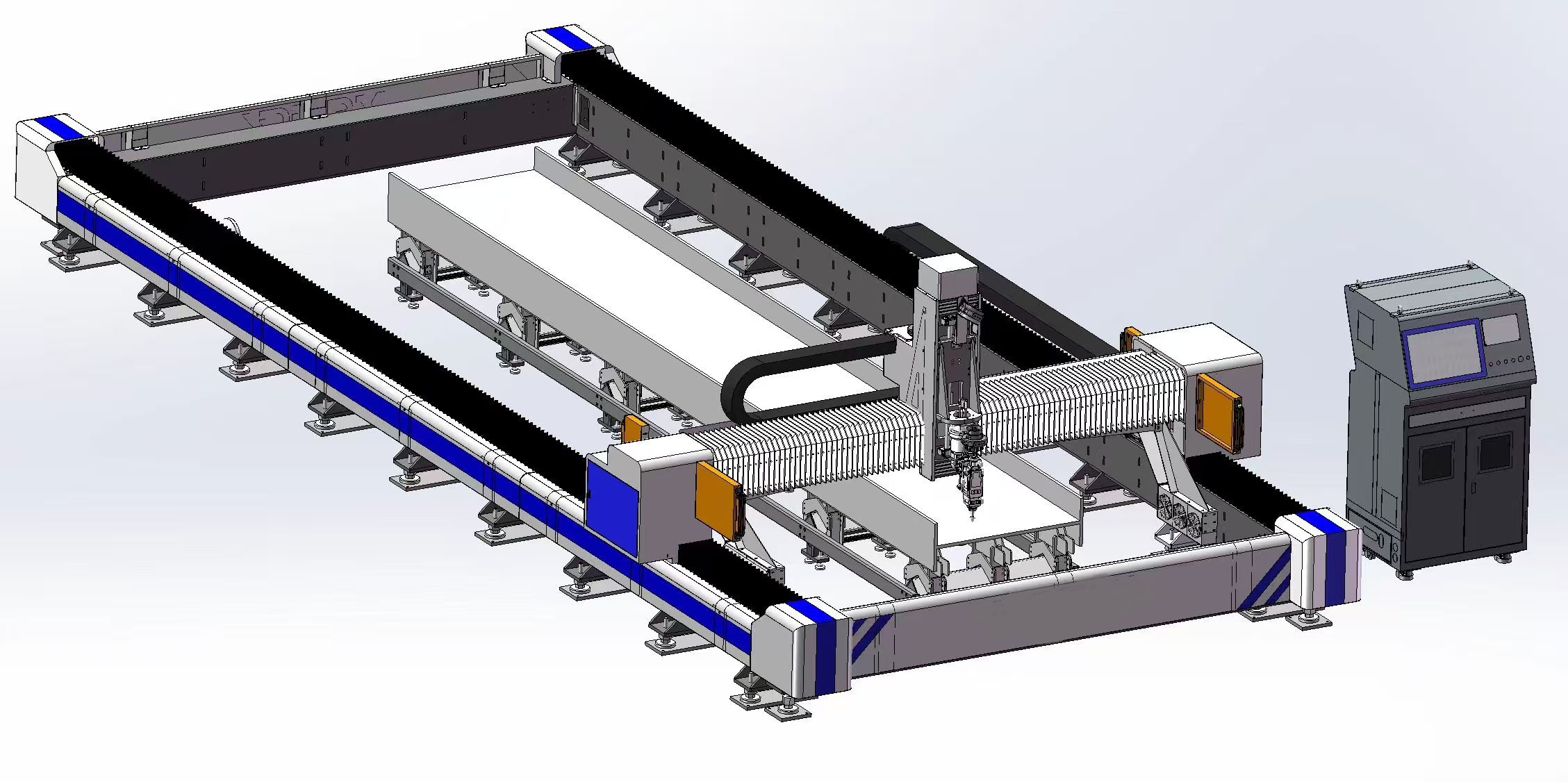
Industrial Application of H-Beam Plasma Cutter
Technical Specifications of Multi-axis Robotic Kinematics
The core of the modern H-Beam Plasma Cutter is its multi-axis robotic kinematics. Unlike 2D plasma tables, these systems utilize a 6-axis or 7-axis robotic arm capable of 360-degree rotation around the beam. This allows for the simultaneous cutting of webs and flanges, as well as the execution of complex bolt holes, notches, and weld preparations (bevels) in a single pass. The degree of freedom provided by these axes ensures that the plasma arc remains perpendicular or at the specified bevel angle relative to the surface at all times, which is critical for maintaining a narrow kerf width and reducing the Heat Affected Zone (HAZ).
High-definition plasma power sources are integrated into these robotic cells to provide a stabilized arc. These power units utilize oxygen or nitrogen as plasma gases, depending on the metallurgical composition of the steel. The precision of the arc is managed by a dedicated CNC controller that adjusts the gas flow and current intensity based on the thickness of the material being penetrated. This level of control is essential for Caracas-based operators who must adhere to international standards such as AISC (American Institute of Steel Construction) or Eurocode 3, where hole quality and edge finish directly impact the structural integrity of the final assembly.
Software Integration and Automated Nesting Algorithms
The efficiency of the hardware is maximized through the use of nested nesting algorithms within the CAD/CAM environment. These software suites allow engineers to import Tekla, AutoCAD, or SolidWorks files directly into the machine interface. The software then performs a comprehensive analysis of the production queue, automatically arranging parts to minimize travel time and maximize material usage. This process eliminates human error in the measurement phase and ensures that the 95% utilization target is consistently met across different production batches.
Furthermore, the software provides real-time monitoring of consumables. By tracking the wear on the electrode and nozzle, the system can predict maintenance intervals, thereby preventing downtime. In the Caracas industrial sector, where supply chain consistency for spare parts can be a variable factor, the ability to forecast consumable lifespan is a critical operational advantage. The integration of IoT (Internet of Things) capabilities also allows for remote diagnostics, enabling technical support teams to troubleshoot the system from global headquarters, ensuring that the machines in Venezuela operate at peak performance levels.
Economic Impact on the Global and Local Supply Chain
From a B2B perspective, the investment in zero-tailing plasma technology represents a rapid Return on Investment (ROI). The reduction in material waste from 15% to 5% translates directly to a 10% reduction in raw material costs. On large-scale infrastructure projects involving thousands of tons of steel, these savings are substantial. Additionally, the elimination of secondary processes—such as manual grinding, drilling, and layout marking—reduces labor costs and accelerates project timelines. A single automated plasma cutter can often outperform three to four traditional manual workstations while maintaining higher safety standards.
In Caracas, this technology empowers local fabricators to compete on a global scale. By adopting international benchmarks for precision and efficiency, these firms can bid on complex international contracts that require high-specification structural components. The ability to produce “ready-to-assemble” beams that require no further modification on-site is a significant value proposition for construction firms looking to minimize field labor and assembly errors.
Concluding Industry Insight: The Future of Automated Fabrication
The deployment of the H-Beam Plasma Cutter with zero-tailing capabilities in Caracas signifies a broader trend: the decoupling of industrial output from traditional labor-intensive models. As the global steel industry moves toward “Industry 4.0,” the focus is shifting from simple cutting to integrated data-driven fabrication. The insight for stakeholders is clear: the competitive edge in the next decade will not be defined by the size of the facility, but by the sophistication of its material management and the precision of its automated systems.
Zero-tailing technology is the first step toward a completely closed-loop manufacturing process where waste is minimized to the point of theoretical limits. For fabricators in Venezuela and beyond, the integration of these high-efficiency systems is no longer an optional upgrade but a fundamental requirement for survival in a market that increasingly values sustainability, precision, and lean manufacturing principles. The transition toward 95% material utilization is not just an engineering achievement; it is a new economic standard for the global structural steel industry.
Industrial Expertise & Support
Are you looking for high-performance H-Beam Plasma Cutter tailored for the Global market? Our engineering team provides comprehensive solutions for modern manufacturing.





