Precision Fabrication in the Callao Industrial Corridor
Callao, Peru, has historically served as the primary maritime logistics hub for the West Coast of South America. As infrastructure demands in the mining, energy, and port expansion sectors increase, the technical requirements for structural steel fabrication have undergone a rigorous shift. The traditional methods of manual oxy-fuel cutting and mechanical grinding are being replaced by automated systems capable of handling complex geometries. Central to this evolution is the deployment of the H-Beam Plasma Cutter, a multi-axis robotic system designed to execute high-tolerance cuts on structural profiles. This technology is particularly critical for the preparation of 45-degree bevels, which are essential for achieving seamless, high-integrity welds in seismic-resistant structures.
The transition toward automated plasma cutting in Callao’s industrial zones reflects a global trend in B2B manufacturing: the prioritization of dimensional accuracy and the reduction of the Heat-Affected Zone (HAZ). For global contractors operating in the Andean region, the availability of local precision beveling reduces the lead time for structural assemblies and ensures compliance with international welding standards such as AWS D1.1 and ISO 9606.
Technical Architecture of the H-Beam Plasma Cutter
The H-Beam Plasma Cutter utilized in modern facilities is typically a 6-axis robotic system or a specialized CNC gantry equipped with a rotating torch head. Unlike standard plate cutters, these machines must account for the dimensional variances inherent in hot-rolled H-beams, such as flange out-of-squareness or web centering deviations. High-end systems utilize laser scanning sensors to map the actual profile of the beam before the arc is struck. This real-time data allows the CNC controller to adjust the cutting path, ensuring that a 45-degree bevel remains consistent across the entire length of the flange and web transition.
The plasma power source is another critical component. High-definition plasma systems use constricted arc technology to increase energy density. By utilizing specific gas mixtures—typically Oxygen for carbon steel or H35 (a Hydrogen-Argon mix) for stainless steel—the system achieves a narrow kerf and a square cut edge. In the context of Callao’s heavy industry, these machines are often calibrated to handle beam depths exceeding 900mm, providing the versatility required for large-scale maritime infrastructure.
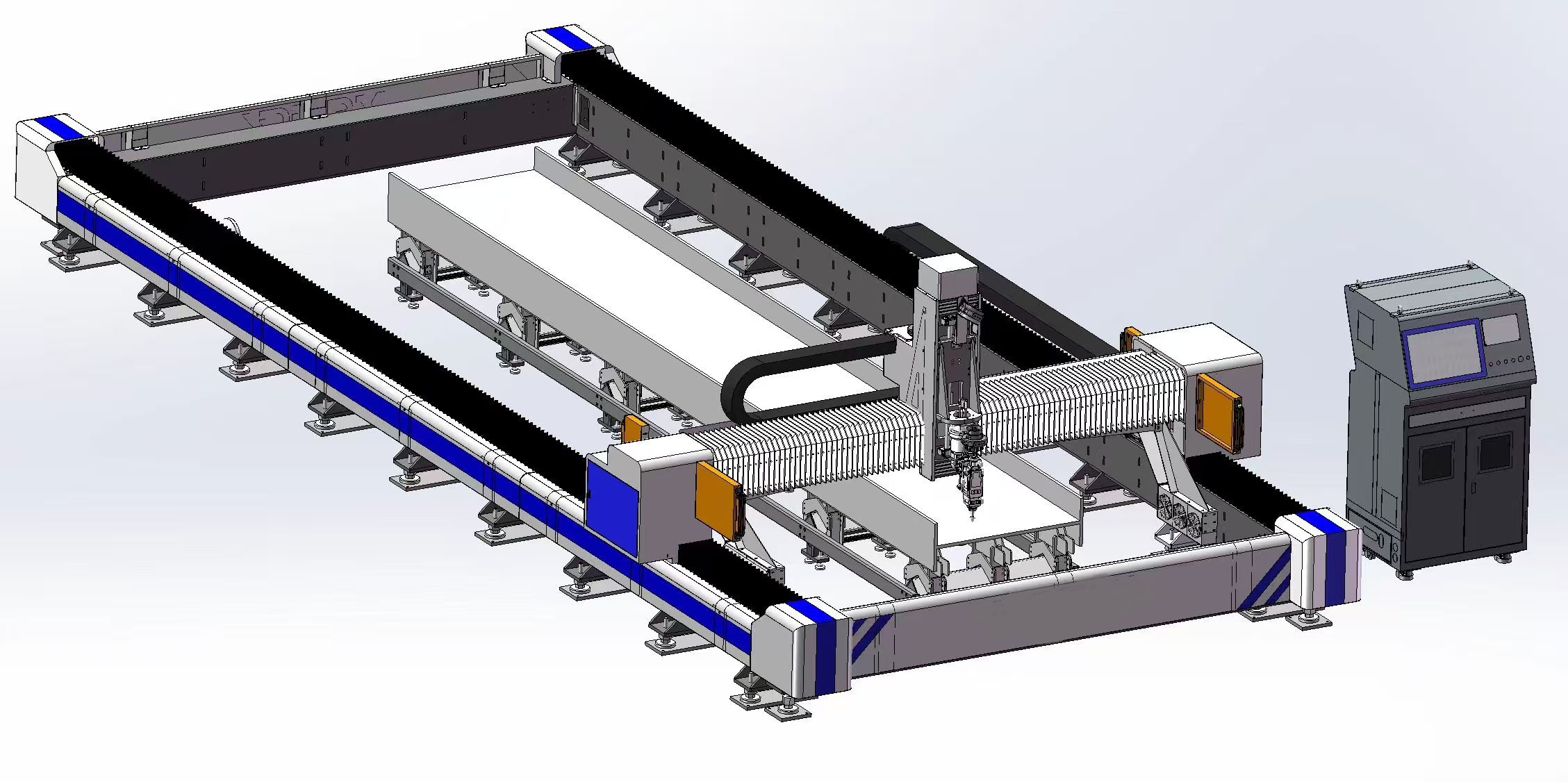
Industrial Application of H-Beam Plasma Cutter
Mechanics of 45-Degree Beveling for Structural Integrity
In structural engineering, the 45-degree bevel is the standard preparation for V-groove and K-groove joints. The primary objective is to allow the welding electrode or wire to reach the root of the joint, facilitating Full Penetration Welding. Manual beveling often results in irregular surfaces that require extensive secondary grinding, which not only increases labor costs but also introduces the risk of hydrogen embrittlement if the surface is not properly cleaned.
The automated H-Beam Plasma Cutter eliminates these variables. By maintaining a constant standoff distance and travel speed, the robotic torch produces a surface finish that often meets the requirements for immediate welding without further processing. For 45-degree bevels on thick-walled H-beams (25mm and above), the machine’s ability to maintain angular precision within +/- 0.5 degrees is vital. This precision ensures that the root gap is uniform, preventing “burn-through” or “lack of fusion” defects during the submerged arc welding (SAW) or flux-cored arc welding (FCAW) processes.
Thermal Management and the Heat-Affected Zone (HAZ)
One of the technical challenges in plasma cutting heavy structural steel is the management of the Heat-Affected Zone (HAZ). The HAZ is the area of the base metal that has not been melted but has had its microstructure and mechanical properties altered by the heat of the cutting process. Excessive heat input can lead to localized hardening or loss of ductility, which is a significant concern in seismic zones like Peru.
Modern plasma systems in Callao utilize high-speed torch movement and optimized gas flow to minimize the duration of thermal exposure. By concentrating the energy in a highly constricted arc, the width of the HAZ is significantly reduced compared to oxy-fuel methods. This ensures that the metallurgical integrity of the H-beam remains intact, particularly at the critical “k-area” (the transition zone between the web and the flange), where stress concentrations are highest.
Integration with BIM and CAD/CAM Workflows
The efficiency of the H-Beam Plasma Cutter is maximized through direct integration with Building Information Modeling (BIM) software. Engineering firms in Callao now utilize TEKLA or SDS/2 files to feed data directly into the cutter’s CAM software. This digital thread ensures that every hole, notch, and 45-degree bevel is executed exactly as designed in the structural model.
This integration facilitates “Just-In-Time” (JIT) manufacturing for global projects. When a structural design is finalized in an office in Houston or London, the fabrication data can be transmitted to a facility in Callao, where the H-beams are processed with millimeter precision. This reduces the reliance on paper drawings and eliminates the human error associated with manual layout and marking.
Economic Impact on Global Supply Chains
From a B2B perspective, the deployment of advanced plasma technology in Peru shifts the value proposition of local fabrication. Historically, complex structural components might have been imported from larger industrial hubs. However, the ability to perform 45-degree Beveling locally at a global standard allows for “near-shoring” of fabrication. This reduces shipping costs for heavy profiles and mitigates the risks associated with international logistics. Furthermore, the speed of automated cutting—often five to eight times faster than manual processes—allows fabricators to meet aggressive project timelines without compromising on weld quality.
Concluding Industry Insight: The Future of Autonomous Fabrication
The integration of the H-Beam Plasma Cutter in Callao is not merely a localized upgrade but a reflection of the broader industry movement toward autonomous steel processing. As we look toward the next decade, the convergence of AI-driven path planning and real-time metallurgical sensing will further refine the cutting process. We are moving toward a “lights-out” fabrication environment where the system can autonomously detect material grade, adjust its own plasma parameters, and verify the bevel angle via 3D vision systems before the part leaves the conveyor. For the global B2B sector, this means that geographical location is becoming less of a barrier to technical excellence. The focus is shifting from “where” a component is made to “how” the data is managed and executed. Precision beveling is the gateway to this future, ensuring that the fundamental building blocks of our infrastructure—the H-beam—are prepared for the highest possible level of structural performance.
Industrial Expertise & Support
Are you looking for high-performance H-Beam Plasma Cutter tailored for the Global market? Our engineering team provides comprehensive solutions for modern manufacturing.





