Industrial Infrastructure and the Requirement for Power Stability in Buenos Aires
The industrial landscape of Buenos Aires, Argentina, serves as a primary hub for South American structural steel fabrication. As the region expands its logistics and energy infrastructure, the demand for precision-engineered structural components, specifically H-beams and I-beams, has reached a critical peak. However, heavy manufacturing facilities in the metropolitan area and surrounding industrial belts often contend with grid volatility. Fluctuations in line voltage can compromise the integrity of high-precision thermal cutting processes. To address this, the deployment of the H-Beam Plasma Cutter equipped with integrated voltage regulation systems has become a technical necessity for maintaining international quality standards.
For global B2B procurement officers and lead engineers, the Buenos Aires case study provides a blueprint for operating sensitive CNC machinery in environments where the electrical utility grid may exhibit inconsistent load profiles. The integration of power conditioning hardware directly into the plasma power source ensures that the arc remains stable, protecting both the workpiece and the consumable components of the torch assembly.
Technical Architecture of Integrated Voltage Regulation
The core challenge in H-beam processing involves maintaining a consistent arc across varying material thicknesses, from the web to the flanges. When external grid voltage drops or spikes occur, a standard plasma system may experience arc extinguished events or excessive dross formation. The advanced H-Beam Plasma Cutter units currently utilized in Argentine fabrication shops employ an Insulated Gate Bipolar Transistor (IGBT) inverter topology. This architecture allows for high-speed switching and rapid response to input power variances.
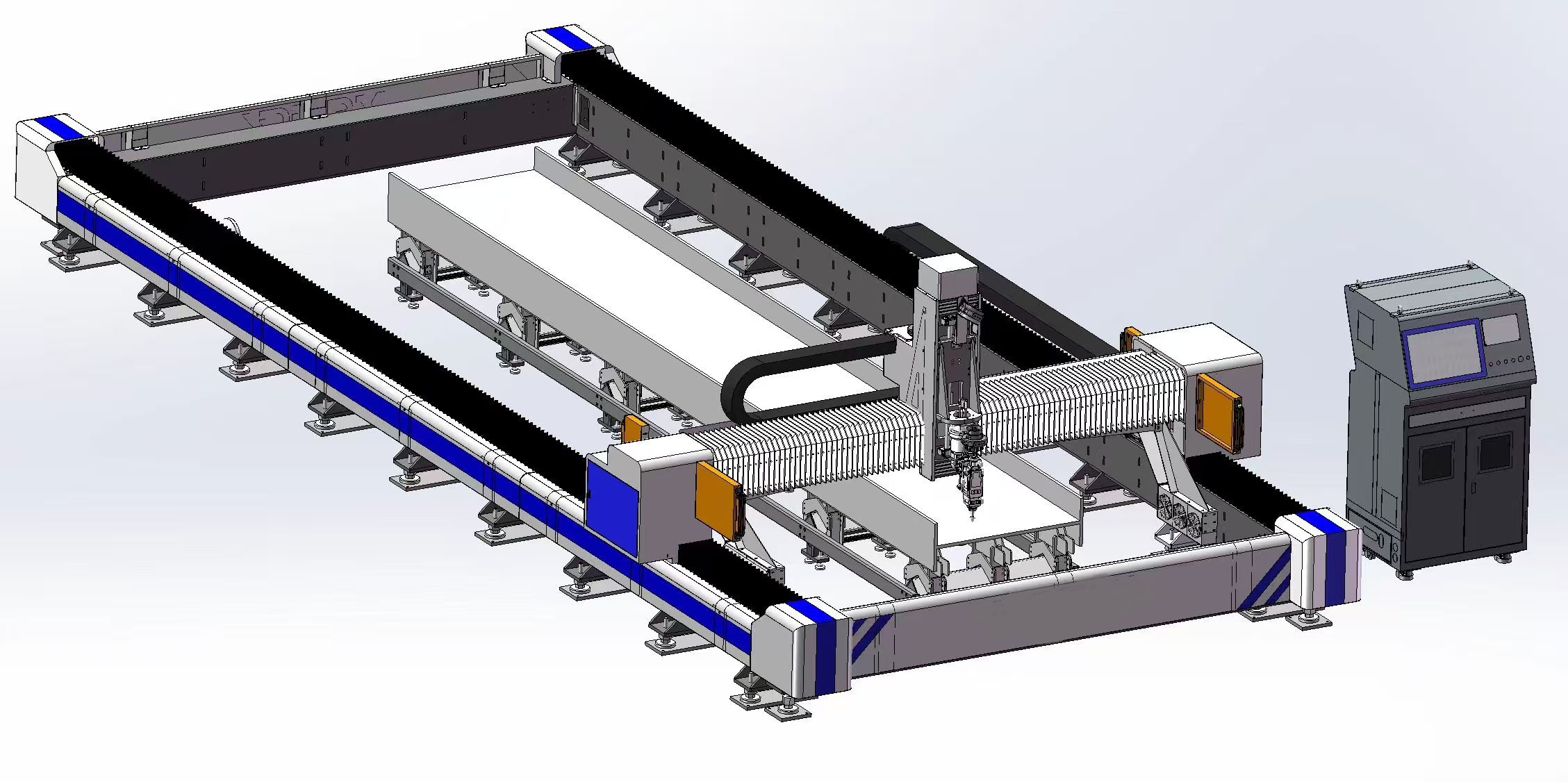
Industrial Application of H-Beam Plasma Cutter
Built-in Automatic Voltage Regulation (AVR) modules function by continuously monitoring the incoming three-phase power. Through a series of feedback loops, the system compensates for voltage sags by adjusting the pulse-width modulation (PWM) frequency. This ensures that the output current delivered to the plasma torch remains within a tolerance of plus or minus 1%, even if the input grid fluctuates by as much as 15%. This level of regulation is vital for 5-axis robotic heads that must maintain precise standoff distances while navigating the complex geometry of an H-beam.
Impact of Grid Stability on Metallurgical Integrity
In structural engineering, the Heat Affected Zone (HAZ) must be minimized to preserve the mechanical properties of the steel. Inconsistent voltage leads to fluctuations in the plasma arc temperature. If the voltage drops, the arc density decreases, leading to a slower travel speed requirement and a wider HAZ. Conversely, a voltage spike can cause over-penetration and significant kerf deviation. By utilizing a system with internal regulation, fabricators in Buenos Aires achieve a uniform kerf width and a smoother surface finish, which often eliminates the need for secondary grinding operations.
The data from high-volume facilities indicates that stabilized voltage directly correlates to the longevity of electrodes and nozzles. When the arc is stable, the Duty Cycle of the machine can be pushed to its theoretical limits—often 100% at maximum amperage—without the risk of thermal runaway in the power supply. This is particularly relevant for the heavy-duty profiles used in Argentine bridge construction and high-rise framing, where beams may exceed 1000mm in height.
Operational Efficiency and Consumable Optimization
From a B2B operational perspective, the total cost of ownership (TCO) of an H-Beam Plasma Cutter is heavily influenced by consumable consumption. In environments with unstable power, the pilot arc often fails to transfer efficiently, or the main arc “stutters,” causing rapid erosion of the hafnium insert in the electrode. Integrated regulation systems facilitate a smoother High-Frequency Start, reducing the electrical stress on the torch components during the initiation phase.
Furthermore, these machines are often equipped with power factor correction (PFC) circuits. In the context of the Buenos Aires industrial grid, where reactive power charges can increase operational costs, PFC ensures that the machinery draws current more efficiently. This results in lower kVA demand from the utility provider, allowing facilities to operate multiple CNC stations simultaneously without exceeding their contracted power limits or triggering circuit protection devices.
Global Market Implications for Robust CNC Design
While the specific challenges of the Buenos Aires grid highlight the need for internal regulation, the implications are global. Manufacturers in developing industrial zones or locations far from main power substations face similar hurdles. The shift toward “grid-agnostic” machinery—equipment that can perform to specification regardless of local power quality—is a dominant trend in the heavy machinery sector. The H-Beam Plasma Cutter models that succeed in the Argentine market are those designed with over-specified electronic components capable of withstanding thermal cycling and electrical noise.
Technical specifications for these units now frequently include wide-range input voltage capabilities (e.g., 380V to 480V) and robust electromagnetic interference (EMI) filtering. This ensures that the high-frequency noise generated by the plasma arc does not feed back into the local network, protecting other sensitive equipment such as PLC controllers and office computers within the same facility.
Industry Insight: The Future of Localized Power Management
The evolution of H-beam processing technology is moving toward a decentralized power management model. Historically, industrial facilities relied on massive, external voltage stabilizers to protect entire factory floors. However, the modern technical consensus favors localized, machine-integrated regulation. This approach reduces the footprint of the installation and provides a more granular level of control over the specific electrical requirements of the plasma physics involved.
As we look toward the next decade of structural steel fabrication, the integration of IoT-enabled power monitoring within the H-Beam Plasma Cutter will become standard. This will allow for real-time data logging of power quality, enabling predictive maintenance schedules based on the electrical “health” of the machine. For global B2B stakeholders, investing in equipment that prioritizes grid stability is no longer an optional upgrade; it is a fundamental strategy for ensuring production continuity and structural reliability in an increasingly volatile energy landscape. The success seen in the rigorous industrial environment of Buenos Aires confirms that internal voltage regulation is the primary safeguard against the hidden costs of power instability.
Industrial Expertise & Support
Are you looking for high-performance H-Beam Plasma Cutter tailored for the Global market? Our engineering team provides comprehensive solutions for modern manufacturing.





