Advanced Structural Fabrication: The Rise of Precision Plasma in Bogotá
The industrial landscape of Bogotá, Colombia, has undergone a significant transition from manual metalworking to high-precision automated fabrication. As a primary hub for the Andean region’s metal-mechanic sector, Bogotá serves as a critical manufacturing base for heavy-duty agricultural machinery. The integration of the H-Beam Plasma Cutter into this ecosystem addresses a fundamental challenge in structural engineering: maintaining the metallurgical integrity of heavy steel profiles while achieving complex geometries. For global stakeholders, understanding how localized manufacturing centers like Bogotá utilize small Heat Affected Zone (HAZ) technology is essential for evaluating the lifecycle and durability of exported agricultural equipment.
Technical Specifications of H-Beam Plasma Processing
An H-Beam Plasma Cutter represents a convergence of multi-axis robotics and high-definition thermal cutting. Unlike traditional plate processing, H-beam fabrication requires the torch to navigate three-dimensional space to execute cuts across the flanges and the web of the beam simultaneously. These machines typically utilize a 6-axis robotic arm capable of executing bolt holes, copes, notches, and weld preparations with a positioning accuracy often within +/- 0.5mm.
The power sources employed in Bogotá’s leading facilities are engineered for high-density plasma arcs. By constricting the plasma arc through specialized nozzle geometry and secondary shielding gases, the system achieves a higher energy density. This concentration of energy allows for faster travel speeds, which is the primary variable in limiting the total heat input into the workpiece. In the context of ASTM A36 or A572 Grade 50 steel—standard materials for agricultural frames—controlling this thermal input is the determining factor in the component’s final mechanical properties.
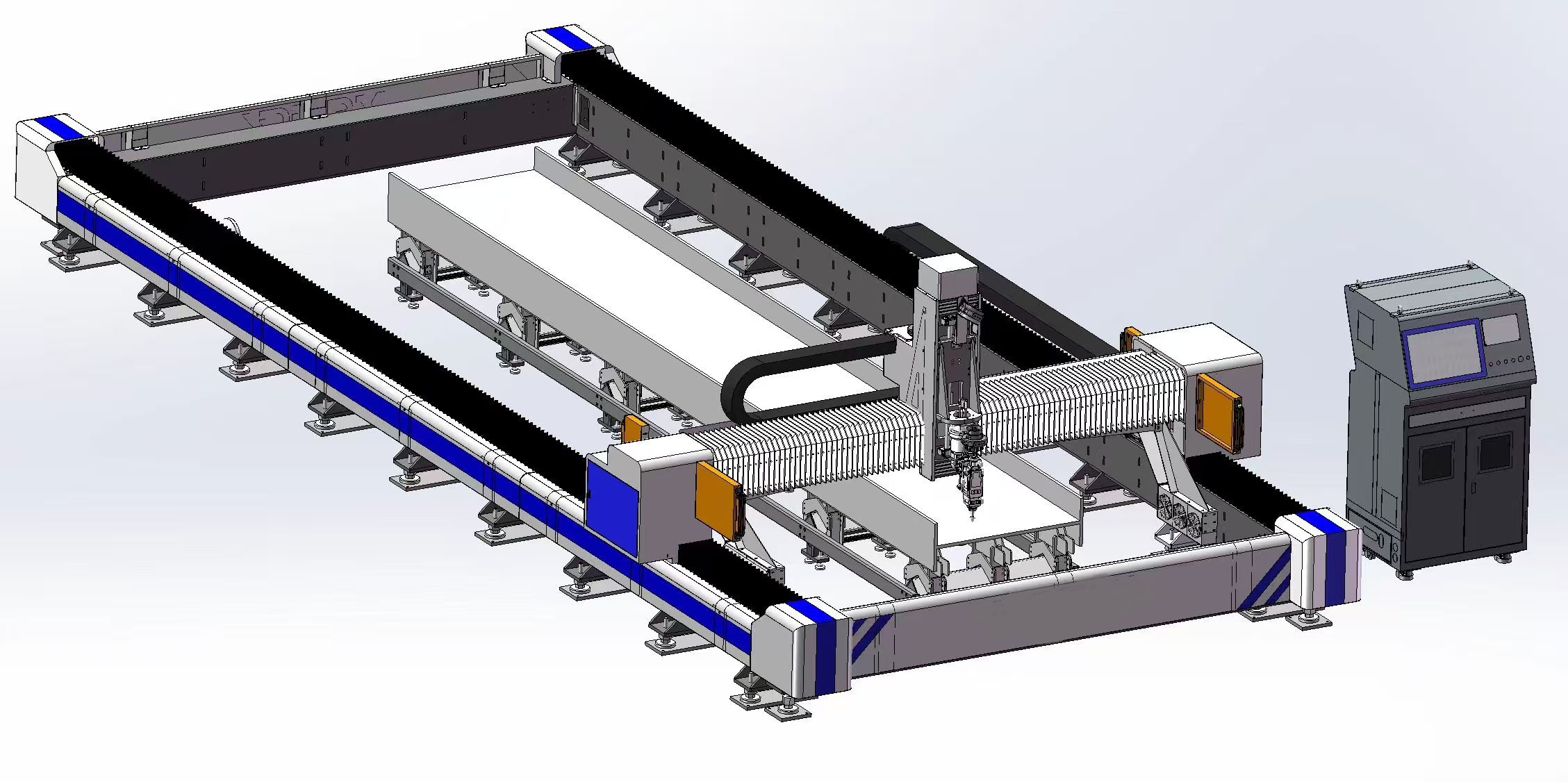
Industrial Application of H-Beam Plasma Cutter
The Science of the Heat Affected Zone (HAZ) in Agri-Machinery
The Heat Affected Zone is the area of the base metal that has not been melted but has had its microstructure and mechanical properties altered by the intense heat of the cutting process. In agricultural machinery, which is subject to constant cyclic loading and high-vibration environments, the HAZ is often the point of structural failure. When conventional oxy-fuel cutting is used, the slow travel speed results in a wide HAZ, leading to grain growth and potential martensitic formation, which increases brittleness.
By utilizing Small HAZ technology via high-definition plasma, Bogotá-based manufacturers can preserve the structural integrity of the H-beam. A narrow HAZ ensures that the area adjacent to the cut retains its original ductility and tensile strength. For equipment such as large-scale harvesters or deep-soil plows, this prevents the initiation of fatigue cracks that typically propagate from the hardened edges of roughly cut structural members. The reduction in thermal distortion also ensures that the beams remain straight, eliminating the need for costly post-process mechanical straightening.
Optimizing Weld Preparation and Joint Longevity
Agricultural machinery requires robust welded joints to withstand the torsional stresses of uneven terrain. The H-Beam Plasma Cutter facilitates precision beveling, which is critical for achieving full-penetration welds. In Bogotá’s fabrication shops, the ability to program complex bevel angles (A, V, Y, and K cuts) directly into the robotic controller allows for a seamless transition from cutting to welding.
Because the plasma process produces a cleaner edge with minimal dross compared to manual methods, the surface chemistry of the cut edge remains conducive to high-quality welding. A small HAZ means there is less carbon precipitation at the grain boundaries, reducing the risk of hydrogen-induced cracking in the weld pool. Consequently, the longevity of the machinery is extended because the primary structural junctions are free from the latent defects associated with inferior thermal cutting techniques.
Economic Impacts on Global Supply Chains
From a B2B perspective, the adoption of this technology in Bogotá offers a strategic advantage for global agricultural brands. By localizing the production of complex structural frames in a high-tech Colombian facility, OEMs (Original Equipment Manufacturers) can reduce shipping costs of raw materials while maintaining the same quality standards found in European or North American plants. The efficiency of the H-Beam Plasma Cutter reduces man-hours by consolidating multiple processes—drilling, sawing, and coping—into a single automated station. This throughput capability allows Bogotá to compete on a global scale, offering shortened lead times for the delivery of heavy machinery components to markets in North and South America.
Integration of CAD/CAM and Digital Twins
The technical sophistication of Bogotá’s manufacturing sector is further evidenced by the integration of advanced software. Modern plasma systems utilize direct BIM (Building Information Modeling) and CAD data to generate cutting paths. This digital workflow ensures that every H-beam produced is a perfect replica of the engineering model. For agricultural machinery, where replacement parts must fit perfectly into existing chassis during field repairs, this level of repeatability is non-negotiable. The software also optimizes nesting on the beam, significantly reducing material waste—a critical factor in maintaining cost-efficiency amid fluctuating global steel prices.
Industry Insight: The Future of Structural Fabrication
The shift toward high-precision, small HAZ plasma cutting in Bogotá is indicative of a broader trend in global manufacturing: the decentralization of high-tech fabrication. As agricultural demands increase due to global population growth, the machinery required to meet these demands must become more durable and less maintenance-intensive. The era of ‘over-engineering’ frames to compensate for poor cutting quality is ending. Instead, the industry is moving toward metallurgical transformation control through automation.
In the coming decade, expect to see Bogotá emerge not just as a regional provider, but as a center of excellence for robotic thermal processing. The focus will shift from simple “shape cutting” to “property management,” where the cutting parameters are dynamically adjusted based on the specific carbon equivalent of the steel batch. For B2B partners, the takeaway is clear: the longevity of agricultural machinery is no longer just about the thickness of the steel, but the precision of the thermal energy used to shape it. Investing in components sourced from facilities utilizing H-beam plasma technology is a prerequisite for any organization prioritizing lifecycle value and structural reliability in the field.
Industrial Expertise & Support
Are you looking for high-performance H-Beam Plasma Cutter tailored for the Global market? Our engineering team provides comprehensive solutions for modern manufacturing.





