Optimizing Structural Steel Fabrication: A Technical Case Study from Rosario, Argentina
The industrial corridor of Rosario, Argentina, represents a significant hub for agricultural machinery manufacturing and structural steel fabrication. Historically, these sectors relied heavily on manual layout, mechanical drilling, and oxy-fuel cutting for processing large-scale structural profiles. However, the integration of a Heavy-Duty Beam Laser into a local fabrication facility has demonstrated a quantifiable shift in operational economics. By transitioning from labor-intensive manual processes to automated thermal cutting, the facility has documented a consistent reduction in overhead totaling $5,000 per month.
This technical analysis examines the specific variables contributing to this cost reduction, focusing on material utilization, man-hour requirements per ton of steel, and the precision afforded by multi-axis fiber laser systems. In a global market where margins in structural steel are increasingly compressed, the Rosario implementation serves as a benchmark for secondary-market industrial modernization.
The Limitations of Manual Layout and Conventional Cutting
Prior to the implementation of automated systems, the facility utilized traditional methods for preparing H-beams and I-beams. This workflow involved manual measurement, chalk-line marking, and the use of magnetic base drills for bolt holes. While functional, this methodology introduced several systemic inefficiencies. Manual marking is subject to human error, often resulting in dimensional variances exceeding 2mm, which necessitates field corrections during assembly.
Furthermore, the use of oxy-fuel or plasma torches for coping and cut-outs creates a significant heat-affected zone (HAZ). This metallurgical alteration often requires secondary grinding to meet structural integrity standards, adding further labor steps. The cumulative time spent on layout, cutting, drilling, and post-processing averaged 4.5 man-hours per ton of processed steel. At current industrial labor rates and consumable costs, this traditional approach presented a ceiling on both throughput and profitability.
Technical Specifications of the Heavy-Duty Beam Laser
The solution implemented in the Rosario facility centers on a high-wattage fiber laser source integrated with a multi-axis robotic or gantry-style delivery system. Unlike flatbed lasers, a Heavy-Duty Beam Laser is engineered to handle the torsional stresses and weight of structural profiles weighing several tons. The system utilizes a 3D cutting head capable of 360-degree rotation around the workpiece, allowing for complex geometries such as miter cuts, notches, and bolt holes to be executed in a single pass.

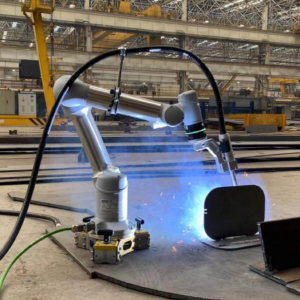
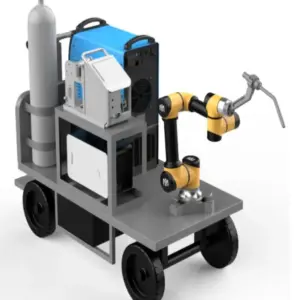
Industrial Application of Heavy-Duty Beam Laser
Key technical parameters of the system include:
- Power Output: 6kW to 12kW fiber laser source.
- Positioning Accuracy: +/- 0.05mm over a 12-meter length.
- Processing Capability: I-beams, H-beams, C-channels, and square tubing up to 1000mm in width.
- Software Integration: Direct CAD/CAM interface for automated nesting and path generation.
By utilizing multi-axis thermal cutting, the machine eliminates the need for separate drilling and marking stations. The laser pierces and cuts holes with a diameter-to-thickness ratio that meets or exceeds AISC (American Institute of Steel Construction) standards, ensuring that the structural integrity of the beam remains uncompromised by excessive heat input.
Quantifying the $5,000 Monthly Operational Savings
The $5,000 monthly saving is not a subjective figure but a result of direct reductions in three primary areas: labor reallocation, consumable reduction, and scrap mitigation. In the Rosario facility, the automation of beam processing allowed for the reassignment of four skilled layout technicians to higher-value assembly roles, effectively reducing the “cost per hole” and “cost per cut” by over 70%.
From a technical standpoint, kerf width optimization plays a critical role in these savings. Traditional plasma cutting produces a wider kerf and significant dross, leading to material waste and the need for abrasive cleaning. The fiber laser’s narrow kerf (typically less than 0.2mm) ensures that material loss is negligible. When calculated across 150 tons of steel per month, the reduction in secondary grinding media (discs, belts) and gas consumables (oxygen/acetylene) accounts for approximately $1,200 of the total monthly savings.
The remaining $3,800 is attributed to the reduction in man-hours. The Heavy-Duty Beam Laser completes in 15 minutes what previously required 3 hours of manual labor. This 12x increase in speed allows the facility to take on higher volumes without increasing headcount, effectively diluting fixed costs across a larger output of finished goods.
Precision Engineering and Downstream Assembly Benefits
Beyond the immediate financial metrics, the technical precision of the laser system impacts the entire project lifecycle. In structural steel fabrication, the “fit-up” phase is often where projects lose profitability due to misaligned bolt holes or improper coping. Because the laser system operates within a tolerance of microns, the beams produced in the Rosario facility arrive at the construction site with perfect dimensional fidelity.
This precision facilitates the use of automated nesting algorithms, which optimize the arrangement of cuts on a single raw beam to minimize “remnant” or scrap material. In manual operations, nesting is often performed conservatively to avoid errors, leading to 5-8% material waste. The automated system reduces this to less than 2%, providing a direct hedge against fluctuating global steel prices.
Integration into the Global Supply Chain
The adoption of such technology in Rosario highlights a broader trend in the global B2B manufacturing landscape. Regional fabricators are no longer competing solely on local labor costs; they are competing on technical capability and lead times. By implementing a Heavy-Duty Beam Laser, the facility has aligned its output with international standards, allowing it to bid on infrastructure projects that require rigorous quality documentation and traceability.
The system’s software logs every cut, providing a digital twin of the processed component. This data-driven approach to fabrication ensures that every beam can be traced back to its original heat number and CAD file, a requirement that is becoming standard in high-stakes civil engineering and industrial construction worldwide.
Industry Insight: The Shift Toward Autonomous Fabrication
The transition observed in Rosario is indicative of a global inflection point in structural engineering. As the cost of fiber laser sources continues to decrease relative to their power output, the economic barrier to entry for automated beam processing is lowering. The primary industry insight derived from this case study is that the value of automation is not found merely in “speed,” but in the total elimination of secondary processes.
For global B2B stakeholders, the lesson is clear: manual labor in structural steel is no longer just a variable cost; it is a technical liability. Facilities that fail to integrate multi-axis laser processing will find themselves unable to match the precision-to-cost ratio offered by automated competitors. The $5,000 monthly saving realized in Argentina is a baseline figure; as these systems become more integrated with AI-driven scheduling and real-time material tracking, the gap between traditional and automated fabrication will widen into a permanent structural divide in the market. Operational excellence now mandates a shift from “tool-based” manufacturing to “system-based” fabrication, where the laser is the core of a fully integrated digital workflow.
Industrial Expertise & Support
Are you looking for high-performance Heavy-Duty Beam Laser tailored for the Global market? Our engineering team provides comprehensive solutions for modern manufacturing.