Introduction: The Industrial Evolution of Rosario
Rosario, Argentina, serves as a critical nexus for the South American agro-industrial and heavy machinery sectors. Historically, the regional manufacturing landscape relied on conventional mechanical fabrication methods for structural steel processing. These legacy processes, while functional, presented significant throughput limitations and high labor costs. The recent integration of a Heavy-Duty Beam Laser into a primary fabrication facility in Rosario marks a shift toward advanced automation. This transition addresses the fundamental challenge of cycle time reduction, moving from a 72-hour multi-stage fabrication window to a streamlined 3-hour automated process. This article examines the technical parameters and operational shifts required to achieve a 95 percent reduction in processing time for large-scale structural components.
The Legacy Bottleneck: 72 Hours of Conventional Fabrication
Before the implementation of automated laser technology, the fabrication of heavy-duty structural beams—such as I-beams, H-beams, and C-channels—involved a fragmented series of manual and semi-automated operations. This workflow typically commenced with manual layout and marking, where technicians translated CAD drawings onto physical steel surfaces. Following layout, the material moved through separate stations for sawing, drilling, and thermal cutting (oxy-fuel or plasma).
Each transition between stations introduced significant downtime. Material handling logistics for beams weighing several tons required overhead crane availability and manual positioning, which frequently resulted in cumulative delays. Furthermore, the mechanical drilling process for high-tensile steel is inherently slow, requiring frequent tool changes and cooling cycles. The aggregate time for preparing a standard batch of structural components, including the necessary deburring and secondary finishing to correct thermal distortion from plasma cutting, consistently reached the 72-hour mark. This timeframe limited the facility’s ability to respond to Just-In-Time (JIT) manufacturing demands and increased the total cost of goods sold due to excessive man-hours.
Technical Specifications of the Heavy-Duty Beam Laser
The solution implemented in the Rosario facility is a multi-axis fiber laser system designed specifically for large-format structural profiles. Unlike flatbed lasers, this system utilizes a rotary chuck and a moving gantry capable of processing 12-meter sections without repositioning. The core of the system is a high-kilowatt fiber resonator that delivers a concentrated energy beam capable of piercing thick-walled structural steel with high precision.

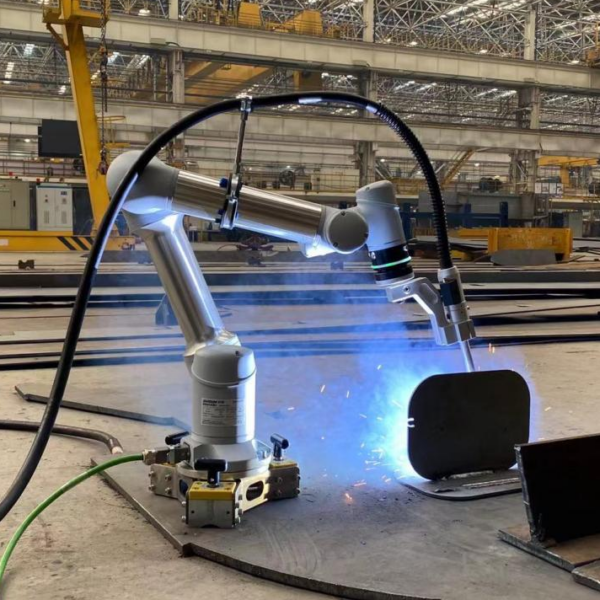
Industrial Application of Heavy-Duty Beam Laser
Key technical features include:
- Multi-axis cutting head with +/- 45-degree beveling capability for weld preparation.
- Automated material detection and compensation for beam camber and twist.
- Integrated 3D Profiling Efficiency through specialized software that synchronizes the laser head movement with the rotation of the workpiece.
- Non-contact height sensing to maintain a constant focal point on irregular surfaces.
Transitioning to the 3-Hour Cycle: The Role of Automation
The reduction of cycle time to 3 hours is not merely the result of faster cutting speeds; it is the result of process consolidation. The Heavy-Duty Beam Laser performs the functions of five separate machines. Sawing, drilling, coping, marking, and beveling are executed in a single continuous operation. By eliminating the need to move the workpiece between different work centers, the facility removes the primary source of non-value-added time.
The 3-hour window includes the time required for Automated Nested Programming. Modern CAD/CAM interfaces allow engineers to import 3D models directly into the laser’s control system. The software optimizes the nesting of parts within a single beam to minimize scrap. Once the program is loaded, the automated loading system feeds the raw beam into the machine, where the laser executes all cuts, holes, and notches in a single pass. The precision of the fiber laser (within +/- 0.2mm) eliminates the need for secondary grinding or deburring, allowing the parts to move directly to the welding assembly stage.
Dimensional Accuracy and Weld Preparation
In heavy Structural Steel Fabrication, the quality of the fit-up determines the speed and integrity of the subsequent welding process. Manual cutting often results in gaps or misalignments that require excessive weld filler and increased labor time. The laser system in Rosario utilizes advanced sensing technology to map the actual dimensions of the beam, which may vary slightly from theoretical mill specifications. The system adjusts the cutting path in real-time to ensure that every notch and hole is perfectly positioned relative to the beam’s actual geometry.
Furthermore, the ability to cut complex bevels for V-groove and J-groove weld preparations directly on the laser eliminates a secondary manual operation. This ensures that when the beams reach the assembly floor, they fit together with high tolerance, reducing the “tack and pull” time significantly. The heat-affected zone (HAZ) produced by a fiber laser is also substantially smaller than that produced by oxy-fuel or plasma cutting, preserving the metallurgical integrity of the structural steel and reducing the risk of brittle fractures in the final product.
Economic Impact on the Rosario Industrial Hub
The adoption of this technology has broader implications for the regional economy in Argentina. By reducing the lead time for structural components, local manufacturers can compete more effectively with international suppliers. The ability to complete in 3 hours what previously took three days allows for a higher volume of projects to be handled within the same physical footprint. This increase in capacity has enabled the Rosario facility to diversify its output, moving from simple agricultural frames to complex infrastructure components for energy and mining sectors.
From a cost perspective, while the initial capital expenditure for a heavy-duty laser system is significant, the return on investment (ROI) is accelerated by the drastic reduction in labor costs and the elimination of consumable tooling, such as drill bits and saw blades. Additionally, the reduction in energy consumption per part—due to the efficiency of fiber laser resonators—contributes to a lower operational overhead.
Industry Insight: The Shift Toward Autonomous Fabrication
The case study of Rosario’s transition from 72 hours to 3 hours reflects a global trend in the B2B manufacturing sector: the move toward fully autonomous structural fabrication. The industry is reaching a point where the physical processing of steel is no longer the primary bottleneck; rather, the bottleneck has shifted to data management and upstream engineering. As Heavy-Duty Beam Laser systems become more integrated with Building Information Modeling (BIM) and Enterprise Resource Planning (ERP) systems, we expect to see a “lights-out” manufacturing environment become the standard for structural steel.
For global stakeholders, the insight is clear: competitive advantage in the next decade will be defined by the ability to compress the “art-to-part” timeline. Facilities that continue to rely on discrete, manual-intensive processes will find themselves unable to meet the rapid delivery requirements of modern infrastructure projects. The convergence of high-power fiber optics, real-time sensory feedback, and intelligent nesting software is not just an incremental improvement; it is a fundamental reconfiguration of the global supply chain for structural materials. Rosario’s success demonstrates that even in established industrial regions, the leap to high-automation yields exponential gains in productivity and precision.
Industrial Expertise & Support
Are you looking for high-performance Heavy-Duty Beam Laser tailored for the Global market? Our engineering team provides comprehensive solutions for modern manufacturing.