Industrial Integration of Heavy-Duty Beam Lasers in Caxias do Sul
Caxias do Sul, located in the state of Rio Grande do Sul, stands as the second-largest metal-mechanic hub in Brazil and one of the most significant industrial clusters in Latin America. The region’s manufacturing sector, dominated by transportation equipment, agricultural machinery, and heavy components, has increasingly transitioned toward high-power fiber laser systems for precision fabrication. As these facilities scale their operations, the deployment of the Heavy-Duty Beam Laser has become a standard for processing thick-plate carbon steel and aluminum alloys. However, the integration of high-kilowatt (kW) laser systems into the regional power infrastructure presents specific engineering challenges, primarily regarding power quality and input consistency.
The operational requirements for a 12kW to 40kW fiber laser system are stringent. These machines demand a constant, high-amperage power supply to maintain the stability of the resonant cavity and the efficiency of the diode banks. In the context of Caxias do Sul’s industrial zones, where the load on the electrical grid fluctuates due to the simultaneous operation of heavy induction motors and arc welding stations, the implementation of built-in voltage regulation is no longer an optional feature but a core technical requirement for operational longevity.
Technical Specifications and Power Demand Profiles
Heavy-duty laser systems utilized in the Brazilian metal-mechanic sector typically utilize ytterbium-doped fiber laser sources. These sources convert electrical energy into optical energy with high wall-plug efficiency, yet they remain highly sensitive to input voltage deviations. A standard industrial laser system requires a three-phase power supply, often at 380V or 440V, with a tolerance threshold of less than five percent. When the input voltage exceeds or falls below these parameters, the power supply unit (PSU) of the laser source undergoes thermal stress, leading to premature degradation of the semiconductor components.
The Heavy-Duty Beam Laser configurations deployed in this region are designed to handle continuous duty cycles. This means the equipment must maintain a consistent beam parameter product (BPP) and M2 factor over several hours of operation. If the grid experiences a voltage sag during a critical piercing or cutting sequence, the laser’s focal point can shift, or the power density can drop, resulting in dross formation or an incomplete cut. This necessitates an integrated approach to power management that operates at the millisecond scale.
Built-in Voltage Regulation for Grid Stability
The primary innovation in modern laser systems exported to or manufactured within the Caxias do Sul cluster is the inclusion of integrated Automatic Voltage Regulation (AVR) systems. Unlike external stabilizers, which add bulk and introduce latency, built-in regulation is synchronized with the laser’s internal control software. These systems utilize solid-state switching or servo-motor controlled transformers to compensate for fluctuations in real-time.
Voltage regulation serves three primary functions in a heavy-duty laser environment:

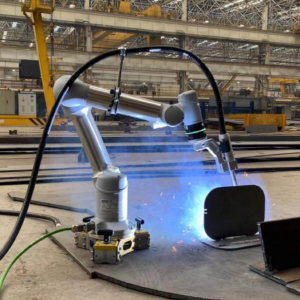
Industrial Application of Heavy-Duty Beam Laser
1. Transient Suppression: High-power industrial grids are prone to transient voltage spikes caused by the switching of large inductive loads. Built-in regulators utilize metal-oxide varistors (MOVs) and high-capacity capacitors to shunt these spikes before they reach the sensitive laser diodes.
2. Sag Compensation: During peak industrial hours in Caxias do Sul, the localized grid may experience “brownouts” or sags. The integrated regulation system can boost the voltage to the required nominal level, ensuring that the laser source receives a steady stream of power, thereby preventing unplanned resonator shutdowns.
3. Phase Balancing: In many industrial facilities, the three-phase load is not perfectly balanced. Integrated regulators monitor each phase independently, adjusting the output to ensure that the laser’s power supply receives a balanced load, which is critical for the longevity of the cooling systems and internal pumps.
Mitigating Harmonic Distortion in Complex Power Environments
A significant concern in the metal-mechanic industry is Harmonic Distortion, often introduced by variable frequency drives (VFDs) and other non-linear loads. In a dense industrial environment like Caxias do Sul, the cumulative effect of these harmonics can distort the sine wave of the electrical supply. For a Heavy-Duty Beam Laser, this distortion results in electrical noise that can interfere with the high-speed communication protocols between the CNC controller and the laser head.
The latest generation of built-in voltage regulators incorporates active filtering. By analyzing the harmonic content of the incoming power, the system can inject compensating currents to neutralize the distortion. This ensures that the electromagnetic interference (EMI) levels remain within the limits defined by international standards such as IEC 61000. For the end-user, this translates to a more reliable cutting process and a significant reduction in “ghost errors” within the CNC interface.
Operational Reliability and Maintenance Reduction
From a B2B perspective, the Total Cost of Ownership (TCO) of a heavy-duty laser is heavily influenced by maintenance intervals and component replacement costs. The laser diode modules are the most expensive consumable in the system. By ensuring that these modules operate within a stabilized electrical environment, the lifespan of the laser source can be extended by up to 30 percent. In Caxias do Sul, where logistics for specialized optical components can be affected by import regulations and lead times, extending the life of existing hardware is a critical competitive advantage.
Furthermore, the integration of a Phase-Locked Loop (PLL) within the voltage regulation circuit allows the laser to synchronize its internal operations with the grid frequency. This precision ensures that the digital-to-analog converters (DACs) controlling the laser pulse modulation operate without jitter, providing a cleaner edge finish on high-thickness materials. This level of technical synergy between the power supply and the optical output is what defines the current generation of heavy-duty fabrication tools.
Concluding Industry Insight: The Future of Resilient Manufacturing
As global supply chains demand higher precision and faster turnaround times, the reliance on stable industrial infrastructure becomes a bottleneck. The case of Caxias do Sul illustrates a broader global trend: the decoupling of high-tech machinery performance from local grid instabilities. By embedding sophisticated voltage regulation and harmonic filtering directly into the chassis of the Heavy-Duty Beam Laser, manufacturers are creating “grid-agnostic” equipment capable of delivering Tier-1 aerospace and automotive quality in any industrial environment.
Moving forward, the industry will likely see a shift toward “Smart Power” modules that use predictive analytics to anticipate grid failures before they occur. For industrial hubs in developing or rapidly expanding regions, this built-in resilience is the key to maintaining a competitive edge in the global B2B marketplace. The integration of power electronics with optical physics is no longer a luxury—it is the foundational requirement for the next era of heavy-duty industrial manufacturing.
Industrial Expertise & Support
Are you looking for high-performance Heavy-Duty Beam Laser tailored for the Global market? Our engineering team provides comprehensive solutions for modern manufacturing.