Advanced Structural Fabrication: The Role of the H-Beam Plasma Cutter in Valencia’s Industrial Sector
The industrial landscape of Valencia, Venezuela, remains a critical hub for heavy manufacturing and structural engineering within the South American region. As global demands for infrastructure intensify, the transition from manual layout and mechanical drilling to automated thermal cutting has become a technical necessity. Central to this evolution is the deployment of the H-Beam Plasma Cutter, a specialized CNC system designed to handle the complex geometries of structural steel profiles. In high-output environments, the primary engineering challenge is maintaining the equilibrium between processing speed and dimensional accuracy. This is particularly relevant when dealing with heavy-duty H-beams, I-beams, and channels that require multi-axis intersections for bolting and welding preparation.
The integration of advanced plasma technology in Valencia serves as a benchmark for regional fabrication standards. By replacing traditional methods with high-precision automated systems, facilities can significantly reduce the margin of error in beam-to-beam connections. The technical focus of modern fabrication has shifted toward the mechanical stability of the workpiece during the cutting cycle, leading to the development of sophisticated multi-chuck gripping systems that ensure the structural integrity of the profile is maintained throughout the entire length of the process.
The Engineering Advantage of 4-Chuck Kinematic Stability
In conventional 2-chuck or 3-chuck systems, the “dead zone” or the unusable tailing of the beam often results in significant material waste. Furthermore, as the beam extends through the cutting envelope, the lack of support can lead to vibration and torsional deflection, which compromises the precision of the plasma arc. The implementation of 4-Chuck Kinematic Synchronization addresses these mechanical limitations. This configuration utilizes four independent yet synchronized chucks that travel along the machine bed, providing continuous support to the workpiece.
The 4-chuck system functions by maintaining a minimum of three points of contact at any given time during the feeding and cutting phases. As the leading edge of the beam enters the cutting zone, the first and second chucks provide the primary torque and positioning. As the process progresses, the third and fourth chucks engage to support the trailing end. This eliminates the “cantilever effect” where the weight of the overhanging beam causes a microscopic dip, which would otherwise result in an angled or inaccurate cut. For heavy structural steel, where beam weights can exceed several tons, this level of mechanical support is vital for maintaining a tolerance of +/- 0.5mm over a 12-meter span.
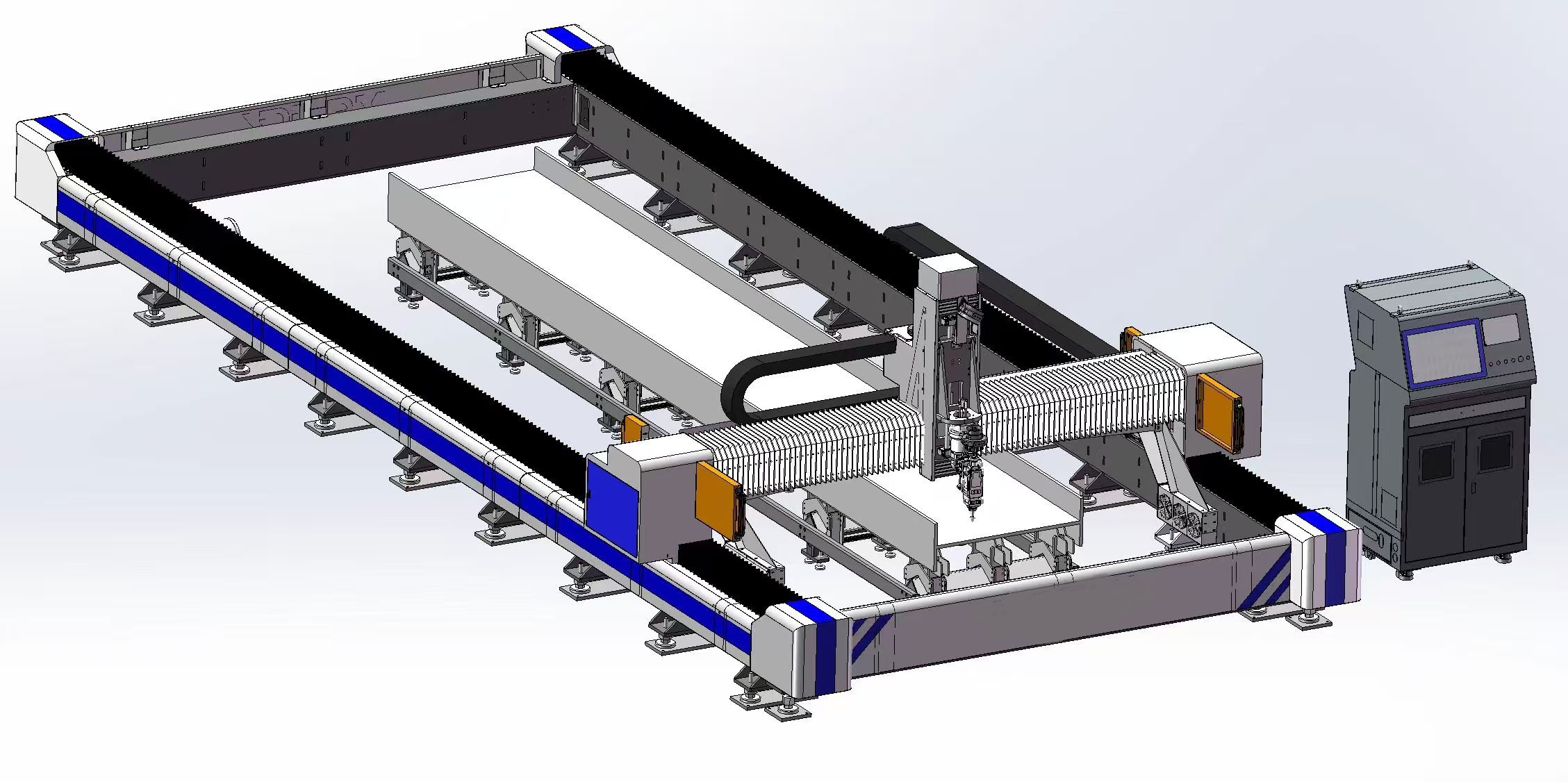
Industrial Application of H-Beam Plasma Cutter
Technical Specifications and Plasma Arc Precision
The efficacy of the H-Beam Plasma Cutter is defined by its ability to execute complex 3D profiles, including miter cuts, coping, and bolt hole perforations. Modern systems utilized in the Valencia industrial zone typically feature an 8-axis or 9-axis robotic arm or a specialized gantry system. This allows the plasma torch to rotate and tilt, facilitating the creation of weld preparations (K, V, X, and Y-shaped bevels) without requiring secondary processing.
Key technical parameters for these systems include:
1. Web Height Capacity: Ranging from 100mm to 1200mm.
2. Flange Width: Up to 600mm.
3. Positioning Accuracy: Integrated encoders ensure linear precision within 0.02mm.
4. Plasma Power Source: High-definition plasma units (ranging from 130A to 400A) capable of piercing heavy-wall thicknesses up to 50mm.
Crucial to the operation is Plasma Arc Voltage Control (AVC). As the torch moves across the web and flanges of an H-beam, the distance between the nozzle and the metal surface must remain constant to ensure a uniform kerf width. The AVC system monitors the electrical arc voltage and makes real-time micro-adjustments to the torch height. This is essential when processing beams that may have slight factory deformations or “camber,” ensuring that the programmed geometry is perfectly translated onto the physical steel.
Material Optimization and Zero-Tailing Technology
In the context of Structural Steel Fabrication, material cost represents the largest variable in project overhead. Traditional plasma cutters often leave a “scrap” section of 500mm to 1000mm at the end of each beam because the chucks cannot safely hold the remaining short piece while the torch is active. The 4-chuck architecture enables “zero-tailing” or ultra-short tailing capabilities. By passing the beam from the rear chucks to the forward chucks within the cutting cabinet, the machine can process the beam to its absolute terminus.
This capability is managed through advanced CNC nesting software. The software calculates the optimal arrangement of parts on a single raw beam, minimizing the gaps between cuts. When combined with the 4-chuck stability, the software can execute cuts closer to the gripping points without risking a collision, effectively increasing the material utilization rate by 3% to 5%. In large-scale infrastructure projects involving thousands of tons of steel, these incremental savings translate into substantial capital preservation.
Software Integration and BIM Workflow
The operation of the H-beam plasma cutter in Valencia is increasingly integrated into the Building Information Modeling (BIM) workflow. Technical data is exported from structural design software such as Tekla Structures or Autodesk Revit in the form of DSTV or STEP files. These files contain not only the dimensional data but also the metadata for every hole, notch, and bevel required for the assembly.
The CNC controller on the plasma cutter parses this data, automatically generating the toolpaths. This digital thread from design to fabrication eliminates manual data entry errors. Furthermore, the 4-chuck system’s onboard sensors verify the actual dimensions of the loaded beam against the digital model. If the physical beam width deviates from the specification, the system automatically recalibrates the toolpath to ensure the bolt holes remain centered on the flange, a critical requirement for site-fitment during the erection phase of the project.
Industry Insight: The Future of Automated Structural Steel Processing
The global shift toward “smart manufacturing” is redefining the requirements for structural steel fabrication. As seen in the industrial applications in Valencia, the move toward 4-chuck stabilization is not merely an incremental upgrade but a fundamental shift in how heavy profiles are handled. The industry is moving toward fully autonomous “lights-out” processing where the H-beam plasma cutter is integrated with automated loading and unloading conveyors, creating a continuous flow of finished components.
Looking forward, the integration of Artificial Intelligence (AI) in plasma cutting will likely focus on real-time consumable monitoring and predictive maintenance. By analyzing the spectral data of the plasma arc and the vibration patterns of the 4-chuck movement, systems will be able to predict nozzle failure or mechanical misalignment before they result in rejected parts. For fabricators in Venezuela and the wider international market, investing in high-stability, multi-chuck platforms is the primary strategy for meeting the rigorous quality standards of the energy, mining, and high-rise construction sectors. The precision offered by these systems ensures that the final structures are safer, more cost-effective, and faster to assemble, reinforcing the vital role of advanced CNC technology in modern civil engineering.
Industrial Expertise & Support
Are you looking for high-performance H-Beam Plasma Cutter tailored for the Global market? Our engineering team provides comprehensive solutions for modern manufacturing.





