Integration of H-Beam Plasma Cutter Technology in the São Paulo Industrial Corridor
The industrial landscape of São Paulo, Brazil, serves as the primary engineering and fabrication hub for the South American mining sector. As mining operations in regions like Minas Gerais and Pará demand increasingly complex structural components and wear-resistant liners, the adoption of the H-Beam Plasma Cutter has become a critical factor in maintaining supply chain efficiency. This technology represents a transition from manual layout and mechanical drilling to automated, multi-axis thermal cutting, specifically optimized for the high-strength alloys required in heavy-duty extraction environments.
In the context of Brazilian mining, downtime is measured in significant capital loss. Therefore, the ability to rapidly customize wear-plates and structural supports within the São Paulo logistics loop reduces the reliance on long-lead overseas imports. The technical implementation of high-definition plasma systems allows for the processing of structural profiles and flat plates with a level of precision that meets international ISO 9001 standards, ensuring that components integrated into crushers, conveyors, and sifting plants fit with zero-tolerance margins during field installation.
Technical Specifications and Kinematic Versatility
The modern H-Beam Plasma Cutter utilized in São Paulo facilities typically employs an 8-axis robotic configuration or a specialized gantry system designed to navigate the complex geometry of structural steel. Unlike traditional flatbed plasma tables, these systems are equipped with rotating heads that allow for 360-degree access to the workpiece. This is essential for the mining industry, where H-beams often require complex cope cuts, bolt holes, and weld preparations (K-cuts, Y-cuts, and V-cuts) on both the flanges and the web simultaneously.
The integration of a High-Definition Plasma Power Supply is the core of this hardware. These units utilize narrow-orifice nozzle technology to constrict the plasma arc, resulting in a higher energy density. This leads to a significantly reduced Heat Affected Zone (HAZ), which is vital when working with quenched and tempered steels. In mining applications, excessive heat can compromise the metallurgical properties of the wear-plate, leading to premature cracking or reduced Brinell hardness. By maintaining a localized thermal footprint, the plasma cutter preserves the integrity of the base metal while achieving cutting speeds that exceed oxy-fuel alternatives by a factor of three to five.
Customization of Wear-Plates for Abrasive Environments
Wear-plates, often composed of AR400, AR500, or specialized manganese steels, are the primary defense against abrasion in mining chutes and hoppers. Customizing these plates involves intricate geometries to fit specific equipment linings. The H-Beam Plasma Cutter systems in São Paulo are frequently adapted with hybrid beds to handle these heavy plates alongside structural beams. The CNC motion control systems manage the kerf compensation automatically, ensuring that the inner and outer diameters of bolt holes remain cylindrical rather than tapered—a common issue in lower-tier plasma systems.
Precision in hole cutting is particularly important for the “plug welding” or “bolted” attachment methods used in mining. If the hole geometry is inconsistent, the mechanical stress distribution across the wear-plate becomes uneven, leading to localized failure. The use of specialized gas mixtures, such as Oxygen for carbon steels or H35 (a mixture of Hydrogen and Argon) for stainless steels and high-alloy plates, allows São Paulo fabricators to produce dross-free edges that require no secondary grinding. This “cut-to-ship” capability is what defines the rapid customization model.
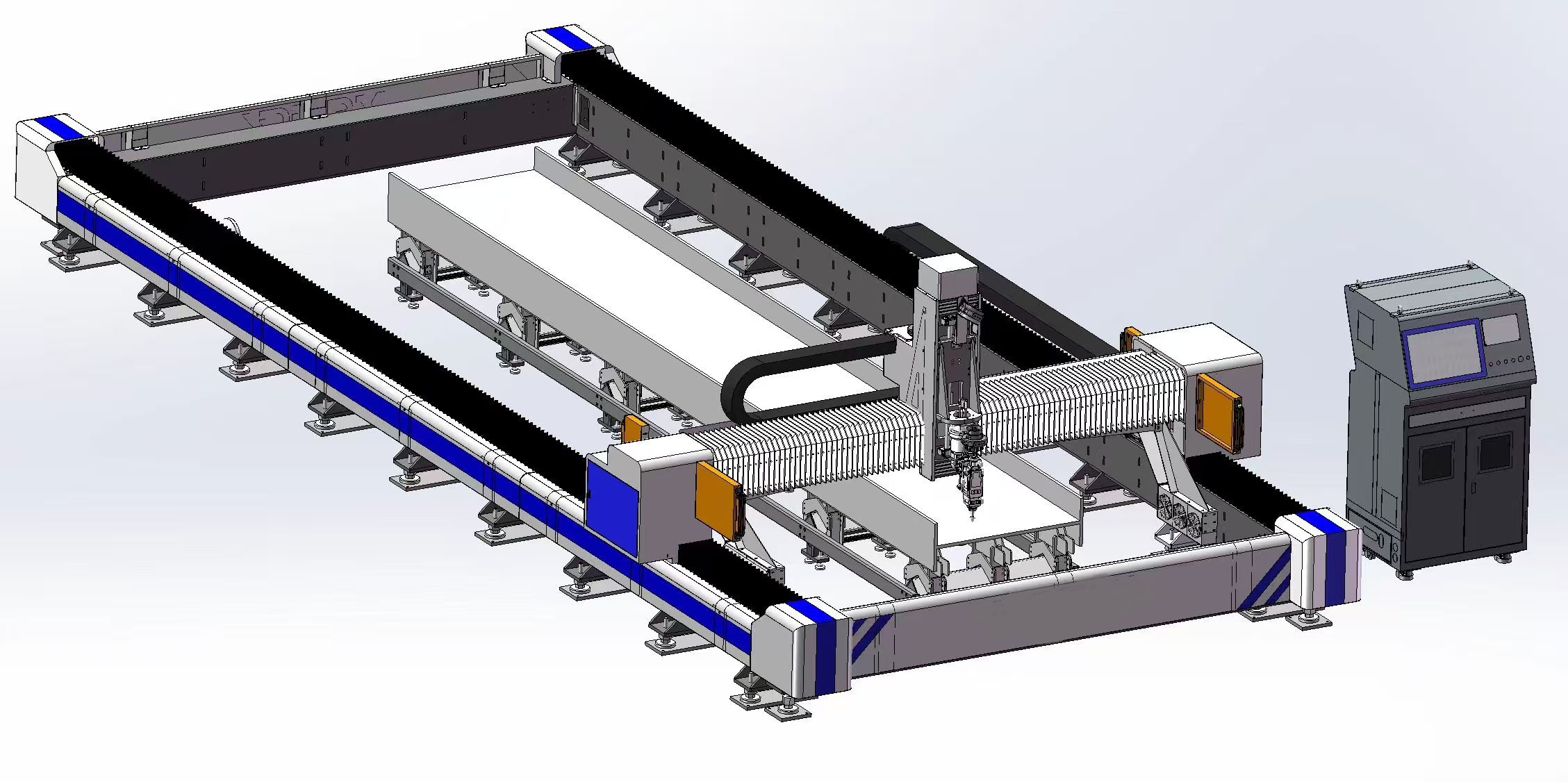
Industrial Application of H-Beam Plasma Cutter
Optimizing Material Yield and CAD/CAM Integration
Material costs for high-grade wear-resistant alloys are a significant portion of the fabrication budget. Advanced nesting software integrated with the CNC Motion Control system allows for maximum plate utilization. In São Paulo’s high-volume shops, these software packages take 3D models from platforms like Tekla or SolidWorks and convert them directly into G-code. This digital thread eliminates manual marking errors and ensures that the “As-Built” component matches the “As-Designed” engineering specifications.
Furthermore, the ability to perform marking and cutting in a single pass is a technical advantage. The plasma arc can be modulated to a lower amperage to “etch” part numbers, bend lines, or welding instructions directly onto the steel. This traceability is crucial for mining companies that manage thousands of unique wear-parts across multiple sites. It ensures that when a liner fails in a remote site in the Amazon basin, the replacement part fabricated in São Paulo is perfectly indexed for installation.
Logistical Advantages of the São Paulo Industrial Hub
São Paulo’s infrastructure provides a unique advantage for the deployment of these technical solutions. The proximity to major steel mills like Usiminas and Gerdau ensures a steady supply of raw materials, while the dense network of specialized gas suppliers provides the high-purity Nitrogen, Oxygen, and Argon required for high-definition plasma cutting. The technical workforce in the region is also highly trained in robotic programming and maintenance, reducing the mean time to repair (MTTR) for the cutting systems themselves.
By centralizing high-tech fabrication in São Paulo, mining firms can leverage “Just-In-Time” (JIT) manufacturing principles. Instead of maintaining massive inventories of wear-plates at the mine site—which ties up capital and exposes the steel to environmental degradation—parts can be cut to order and transported via the established rail and road networks to the mining frontiers. The H-Beam Plasma Cutter acts as the bottleneck-breaker in this workflow, providing the speed and accuracy that manual methods simply cannot replicate.
Industry Insight: The Shift Toward Automated Structural Integrity
The transition toward automated plasma cutting in the Brazilian mining sector reflects a broader global trend in B2B heavy manufacturing: the move from “component fabrication” to “integrated structural solutions.” As mining operations push into deeper and more remote deposits, the equipment is subjected to higher pressures and more abrasive materials. The margin for error in structural fabrication is narrowing.
The industry insight for the coming decade suggests that the role of the H-Beam Plasma Cutter will evolve beyond simple geometry. We are seeing the rise of “smart” fabrication where the cutting data is fed back into a digital twin of the mining operation. This allows for predictive maintenance schedules based on the known metallurgical properties and precision of the installed wear-parts. For fabricators in São Paulo, staying competitive means not only owning the hardware but mastering the data-driven workflows that ensure structural integrity. The future of mining support lies in the intersection of high-energy physics—the plasma arc—and sophisticated robotic kinematics, ensuring that the backbone of the extraction industry remains resilient, efficient, and locally sourced.
Industrial Expertise & Support
Are you looking for high-performance H-Beam Plasma Cutter tailored for the Global market? Our engineering team provides comprehensive solutions for modern manufacturing.





