Introduction: The Industrial Shift in São Paulo’s Structural Steel Sector
São Paulo serves as the primary industrial engine of South America, hosting a dense concentration of metallurgical facilities and civil engineering firms. As global demand for structural steel increases, the transition from manual fabrication to automated systems has become a logistical necessity. Specifically, the implementation of the H-Beam Plasma Cutter equipped with energy-efficient fiber source technology represents a significant shift in how heavy-duty profiles are processed. This technology addresses the dual challenges of high energy costs in the Brazilian utility market and the requirement for high-precision tolerances in international construction standards. By integrating advanced power electronics with multi-axis robotics, manufacturers in the São Paulo region are optimizing throughput while reducing the carbon footprint of structural component production.
Technical Architecture of Fiber-Enhanced Plasma Systems
The core of the modern H-beam processing unit lies in its power delivery system. Traditional plasma cutters relied on transformer-based power supplies, which exhibited significant energy loss through heat dissipation and poor power factor ratings. The introduction of Fiber Laser Source technology principles—specifically high-frequency inverter circuits and fiber-optic data transmission for torch control—has redefined efficiency. These systems utilize a high-density energy stream to ionize gas, creating a plasma arc that remains stable even during complex transitions across the flanges and webs of an H-beam.
The energy-efficient fiber source minimizes “wall-plug” power consumption by utilizing a resonant inverter topology. This allows the system to maintain a high duty cycle without the exponential increase in thermal load typical of older units. In the context of São Paulo’s industrial zones, where peak-hour electricity tariffs are substantial, the ability to maintain a 100 percent duty cycle at lower amperage draws provides a measurable competitive advantage in operational expenditures (OPEX).
Precision Engineering and Multi-Axis Kinematics
Processing an H-beam requires the management of three-dimensional geometries that standard flat-bed cutters cannot accommodate. The Multi-Axis CNC Robotics integrated into these cutters allow the plasma torch to rotate and tilt around the workpiece. This capability is essential for creating weld preparations, bolt holes, and coping cuts in a single pass. The fiber-based control system ensures that the motion interpolation between the robotic arm and the plasma power source is synchronized at millisecond intervals.
This synchronization is critical for maintaining a consistent Heat-Affected Zone (HAZ). In structural engineering, an oversized HAZ can lead to metallurgical embrittlement, potentially compromising the integrity of the beam under load. The energy-efficient fiber source provides a more constricted and focused arc, which results in a narrower Kerf Width Optimization. By concentrating the thermal energy into a smaller area, the system ensures that the structural properties of the ASTM A36 or high-strength low-alloy (HSLA) steels commonly used in Brazilian infrastructure remain intact.
Thermal Management and Consumable Longevity
A significant portion of the maintenance cost in plasma cutting is attributed to the wear of electrodes and nozzles. Energy-efficient fiber sources utilize sophisticated “soft-start” sequences and precise gas flow modulation. By controlling the ramp-up of current, the system reduces the thermal shock to the copper and hafnium components within the torch head. Technical data indicates that units operating with high-frequency fiber-source control see a 30 to 40 percent increase in consumable life compared to standard high-definition plasma systems. This reduction in downtime for part replacement is a critical metric for high-volume fabrication shops in São Paulo’s ABC industrial region.
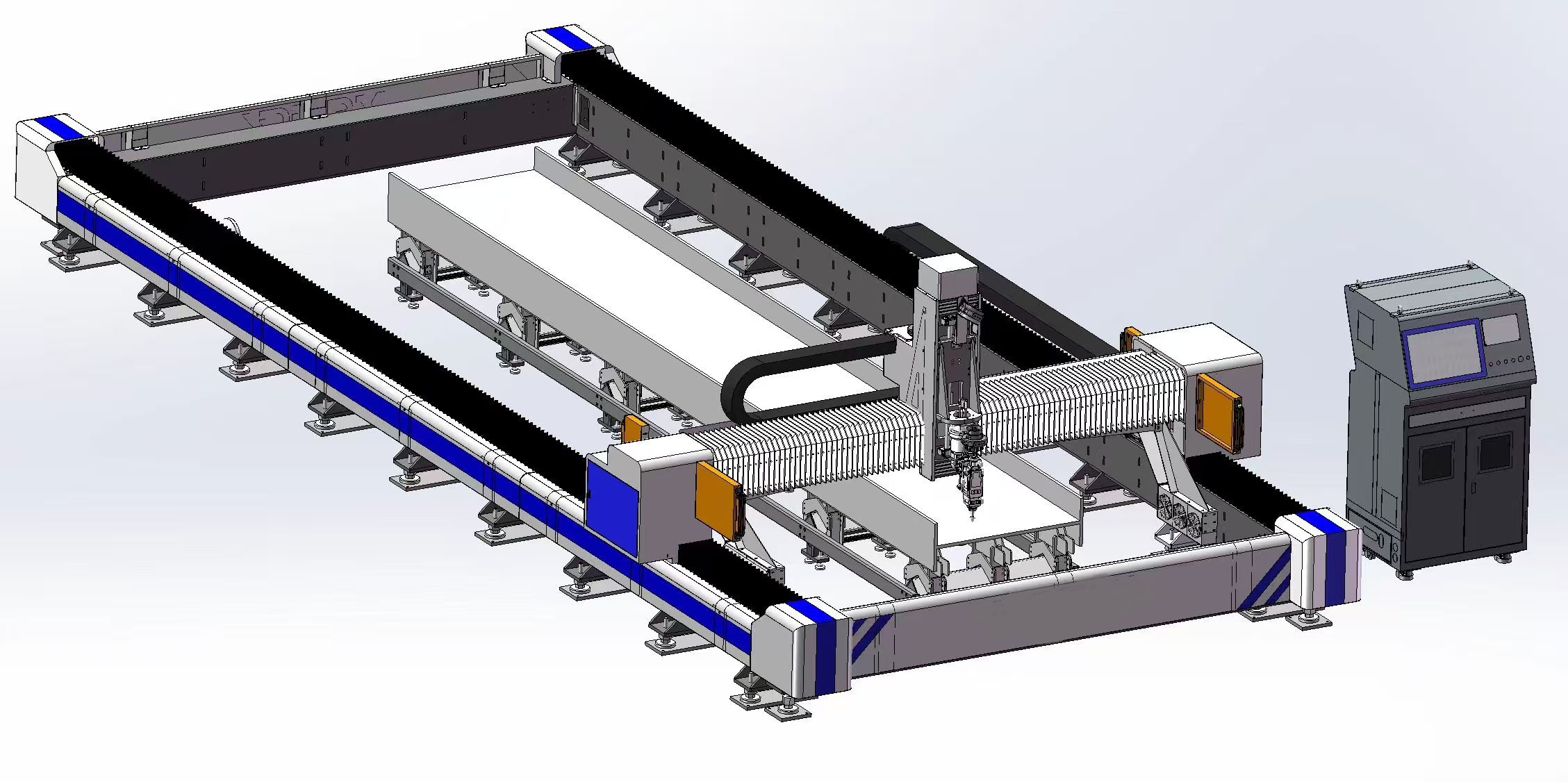
Industrial Application of H-Beam Plasma Cutter
Data Integration and Industry 4.0 Compliance
The modern H-beam cutter is no longer a standalone tool but a node within a larger digital ecosystem. Most units deployed in the São Paulo market feature Ethernet/IP or EtherCAT connectivity, allowing for real-time monitoring of gas pressures, current stability, and cutting speeds. This data is fed into Building Information Modeling (BIM) software, ensuring that the physical beam produced matches the digital twin used in the architectural phase.
The use of fiber technology in the control circuitry also eliminates electromagnetic interference (EMI), which was a common failure point in older plasma systems. In a high-density manufacturing environment, where multiple high-voltage machines operate in proximity, the signal integrity provided by fiber-optic communication ensures that the CNC commands are executed without jitter or positioning errors. This leads to a repeatable accuracy of +/- 0.5mm over a 12-meter beam length, exceeding the requirements for most global construction codes.
Environmental and Economic Considerations in Brazil
Brazil’s industrial sector is under increasing pressure to adhere to ESG (Environmental, Social, and Governance) criteria. The energy efficiency of the fiber source technology directly contributes to these goals. By reducing the total kVA required for operation, facilities can lower their carbon emissions associated with electricity consumption. Furthermore, the precision of the cuts reduces the volume of secondary grinding and finishing required. Since secondary processing is often a manual, labor-intensive, and energy-consuming task, the “cut-to-fit” accuracy of the H-beam plasma system streamlines the entire production chain.
From an economic perspective, the localized support in São Paulo for these advanced systems has matured. The presence of specialized technicians capable of calibrating fiber-enhanced power sources ensures that the technological barrier to entry is lowered for medium-sized enterprises. The return on investment (ROI) is typically realized through a combination of reduced scrap rates, lower energy bills, and the ability to bid on complex international projects that demand high-precision structural components.
Concluding Industry Insight
The convergence of energy-efficient fiber sources and automated 3D plasma cutting marks a definitive end to the era of manual structural steel layout and fabrication. As São Paulo continues to position itself as a global hub for manufacturing excellence, the adoption of the H-Beam Plasma Cutter is not merely an incremental upgrade but a fundamental shift in metallurgical processing. The industry insight for the coming decade suggests that the integration of artificial intelligence with these fiber-controlled plasma systems will further automate the nesting and pathing processes, virtually eliminating human error. For global stakeholders, the Brazilian market now represents a sophisticated testing ground for how high-efficiency power electronics can be successfully scaled in a demanding, high-volume industrial environment. The future of structural fabrication lies in the ability to balance extreme power with microscopic precision, a balance that is currently being perfected in the workshops of São Paulo.
Industrial Expertise & Support
Are you looking for high-performance H-Beam Plasma Cutter tailored for the Global market? Our engineering team provides comprehensive solutions for modern manufacturing.





