Optimizing Structural Steel Fabrication: The H-Beam Plasma Cutter in Santa Cruz, Bolivia
The industrial landscape of Santa Cruz, Bolivia, has undergone a significant transformation in its approach to structural steel processing. As the primary economic engine of the region, Santa Cruz supports extensive infrastructure, agribusiness, and energy projects that demand high-precision steel components. Central to this evolution is the implementation of the H-Beam Plasma Cutter, a specialized CNC system designed to replace traditional manual layout and mechanical drilling methods. This technical analysis examines the integration of zero-tailing technology and its impact on material utilization rates, specifically reaching the 95% threshold in high-output environments.
In conventional H-beam processing, material waste is a primary driver of operational costs. Standard cutting machines often leave significant “tails” or scrap ends due to the physical limitations of the clamping and feeding mechanisms. However, the deployment of advanced plasma systems in the Bolivian market addresses these inefficiencies through sophisticated mechanical engineering and software integration. By focusing on the intersection of throughput and precision, fabricators in Santa Cruz are setting new benchmarks for the South American construction sector.
Zero-Tailing Technology: Mechanical Architecture and Feed Logic
The core of the 95% material utilization claim lies in Zero-tailing technology. Traditional CNC plasma lines require a minimum distance between the chuck and the cutting head to maintain stability. This distance typically results in a 500mm to 1000mm remnant that cannot be processed. The zero-tailing systems utilized in Santa Cruz employ a dual-chuck or multi-point clamping configuration that allows the beam to be fed through the cutting envelope with minimal mechanical dead zones.
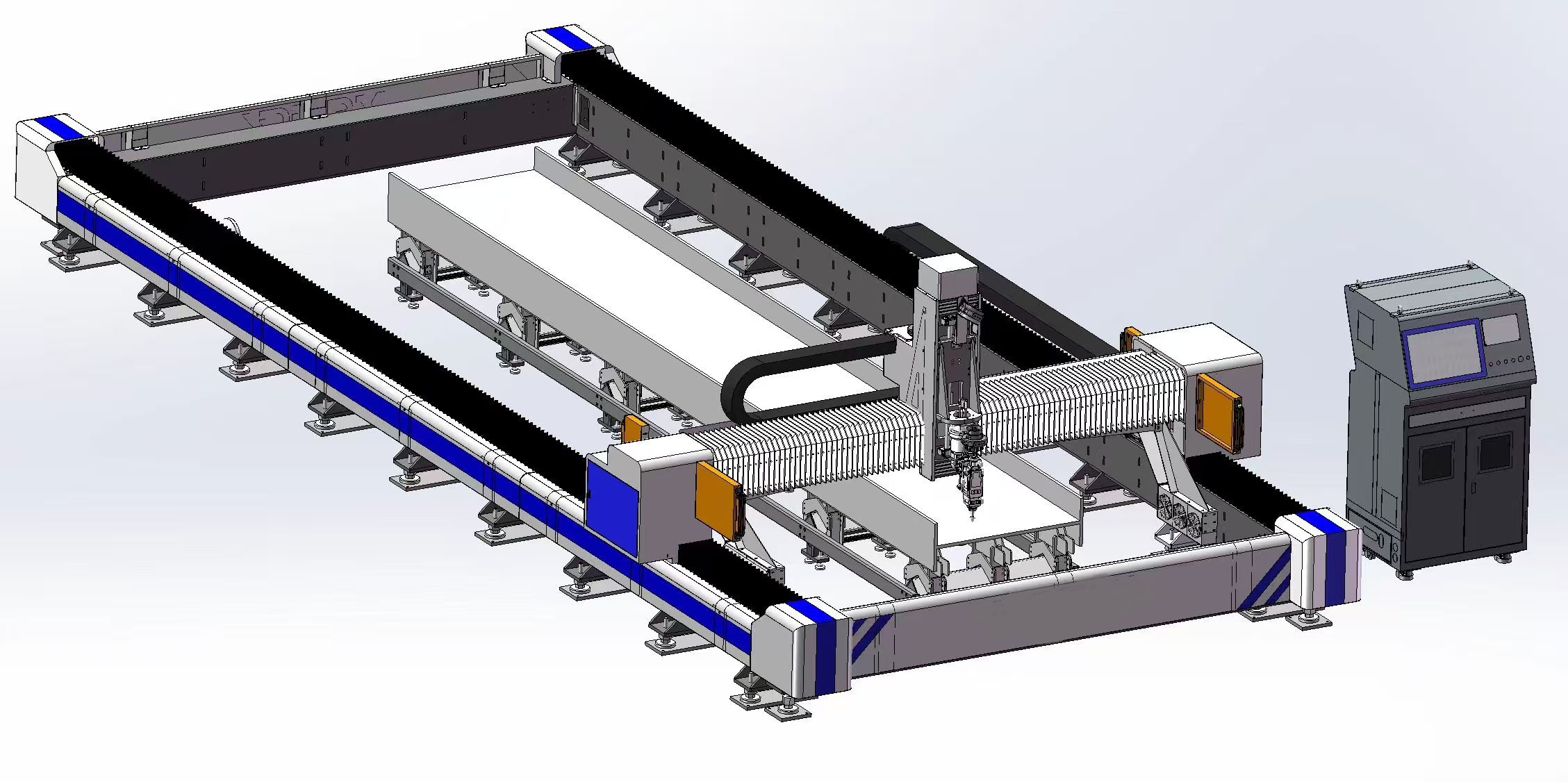
Industrial Application of H-Beam Plasma Cutter
This architecture utilizes a secondary support system that engages the beam as it exits the primary drive rollers. By maintaining constant tension and alignment, the plasma torch can execute cuts within millimeters of the beam’s trailing edge. From a technical standpoint, this is achieved through synchronized servo-motor control and real-time feedback loops that adjust for beam camber and sweep. When the material is utilized to this extent, the cost-per-ton of processed steel drops significantly, providing a competitive edge in large-scale bidding for bridge components and industrial warehouses.
The Role of the 6-Axis Robotic Arm in Complex Geometry
To achieve the versatility required for modern architectural designs, the H-Beam Plasma Cutter is frequently equipped with a 6-axis robotic arm. Unlike standard 3-axis systems that are limited to perpendicular cuts, the 6-axis configuration allows for full spatial rotation. This capability is essential for processing cope cuts, miter cuts, and bolt holes across all three faces of the H-beam (the web and both flanges) in a single pass.
The robotic interface utilizes high-definition plasma power sources to maintain a stable arc voltage. This stability is critical when the torch head transitions from the flange to the web, where the material thickness or the angle of incidence may change. The software calculates the optimal torch height and speed to ensure the kerf width remains consistent. This precision eliminates the need for secondary grinding or edge preparation, directly reducing the labor hours required for assembly and welding.
Nesting Software Optimization and Data Integration
The efficiency of the hardware is fundamentally tied to the nesting software optimization protocols. In the Santa Cruz industrial context, engineers utilize specialized CAD/CAM suites that integrate directly with Tekla, Revit, or AutoCAD. These software packages analyze the entire project’s Bill of Materials (BOM) and arrange the required parts on the raw H-beam lengths to minimize gaps.
Advanced nesting algorithms consider the kerf (the width of the material removed by the plasma arc) and the lead-in/lead-out requirements for each cut. By overlapping cut paths where possible and utilizing “common line cutting,” the software maximizes the number of parts extracted from a single beam. Furthermore, the software generates a digital twin of the beam, allowing operators to simulate the cutting process to identify potential collisions or sequence errors before the first arc is struck. This data-driven approach ensures that the 95% utilization rate is a repeatable metric rather than an occasional peak.
Throughput and Precision Metrics in the Bolivian Market
The adoption of these systems in Santa Cruz has led to quantifiable improvements in throughput. Manual processing of a standard H-beam—including measuring, marking, cutting, and drilling—can take several hours per unit. In contrast, a CNC plasma system can complete a complex sequence of cuts and holes in under fifteen minutes. This speed does not come at the expense of accuracy; typical tolerances for these machines are within plus or minus 0.5mm over the length of the beam.
In the high-humidity and variable temperature conditions of Santa Cruz, the thermal stability of the machine frame is a critical technical consideration. High-end cutters incorporate reinforced gantry structures and precision-ground linear rails to prevent thermal expansion from affecting the cut quality. This ensures that the structural integrity of the H-beam is maintained, as the plasma process minimizes the Heat Affected Zone (HAZ) compared to traditional oxy-fuel cutting.
Economic Impact: ROI and Sustainable Fabrication
For B2B stakeholders, the primary justification for investing in high-utilization plasma technology is the Return on Investment (ROI). When material utilization increases from 85% to 95%, the 10% saving in raw material costs can equate to hundreds of thousands of dollars annually for high-volume fabricators. In Bolivia, where imported steel prices are subject to international market fluctuations and logistics costs, maximizing the yield of every ton of steel is a strategic necessity.
Beyond direct cost savings, the reduction in scrap contributes to a more sustainable manufacturing model. Less waste means lower energy consumption for recycling and reduced logistics overhead for scrap removal. This aligns with global trends toward “Green Construction,” where the carbon footprint of a project is scrutinized from the fabrication stage through to completion.
Concluding Industry Insight: The Future of Automated Steel Processing
The integration of the H-Beam Plasma Cutter with zero-tailing technology in Santa Cruz, Bolivia, represents more than just a local upgrade; it is a microcosm of the global shift toward autonomous steel fabrication. As the industry moves toward Industry 4.0 standards, the reliance on manual layout will continue to diminish. The future of structural steel lies in fully integrated ecosystems where BIM data flows directly to the shop floor, and machines self-optimize based on real-time material sensors.
We anticipate that the next phase of evolution will involve the integration of Artificial Intelligence (AI) to further refine nesting patterns and predictive maintenance. For fabricators in emerging industrial hubs like Santa Cruz, the early adoption of these high-efficiency systems provides a significant barrier to entry for competitors and establishes a foundation for participating in complex, international-scale infrastructure projects. Precision, material conservation, and digital integration are no longer optional features but are the essential pillars of modern structural engineering.
Industrial Expertise & Support
Are you looking for high-performance H-Beam Plasma Cutter tailored for the Global market? Our engineering team provides comprehensive solutions for modern manufacturing.





