Strategic Implementation of the H-Beam Plasma Cutter in Quito’s Structural Steel Sector
The industrial landscape of Quito, Ecuador, has undergone a significant transformation in its approach to structural steel fabrication. As the capital city serves as a central hub for Andean infrastructure projects, the demand for precision-engineered structural components has necessitated the adoption of advanced automated solutions. The H-Beam Plasma Cutter has emerged as the definitive technological standard for processing complex profiles, including H-beams, I-beams, and channels. By integrating high-performance power sources from manufacturers such as IPG and Raycus, fabricators in the region are achieving unprecedented levels of throughput while ensuring long-term asset viability.
In the context of global B2B procurement, the geographical location of Quito presents unique logistical and operational considerations. The high altitude and specific environmental conditions of the Inter-Andean Valley require machinery with robust thermal management and stable power delivery systems. The transition from manual layout and mechanical drilling to automated thermal cutting represents a shift toward higher precision and reduced labor overhead, directly impacting the bottom line of large-scale construction and mining infrastructure projects.
Technical Integration of IPG and Raycus Power Sources
The core of any high-performance structural cutting system lies in its power oscillation and delivery mechanism. While traditional plasma systems have dominated the market, the integration of IPG fiber source integration and Raycus technology into structural cutting lines has redefined precision standards. These sources are recognized globally for their electro-optical conversion efficiency and beam stability, which are critical when navigating the thick cross-sections of heavy structural steel.
IPG Photonics, a leader in high-power fiber technology, provides sources that offer a significant reduction in maintenance requirements compared to legacy CO2 or low-end plasma units. For fabricators in Quito, this translates to higher uptime in a region where specialized technical support may involve longer lead times. Raycus, conversely, offers a high-performance-to-cost ratio, delivering reliable beam quality that meets international standards for edge perpendicularity and dross-free finishes. Both power sources ensure that the H-Beam Plasma Cutter maintains a consistent kerf width, which is essential for the subsequent assembly and welding of structural joints.
Multi-Axis Robotic Trajectory and Precision Engineering
To process H-beams effectively, the machinery must utilize sophisticated CNC robotic trajectory control systems. Unlike flat-plate cutting, H-beam processing involves a three-dimensional environment where the cutting torch must maintain a constant standoff distance across the flange and web surfaces. Modern systems in Quito utilize 6-axis or 7-axis robotic arms that allow for complex beveling, bolt hole piercing, and coping cuts in a single pass.
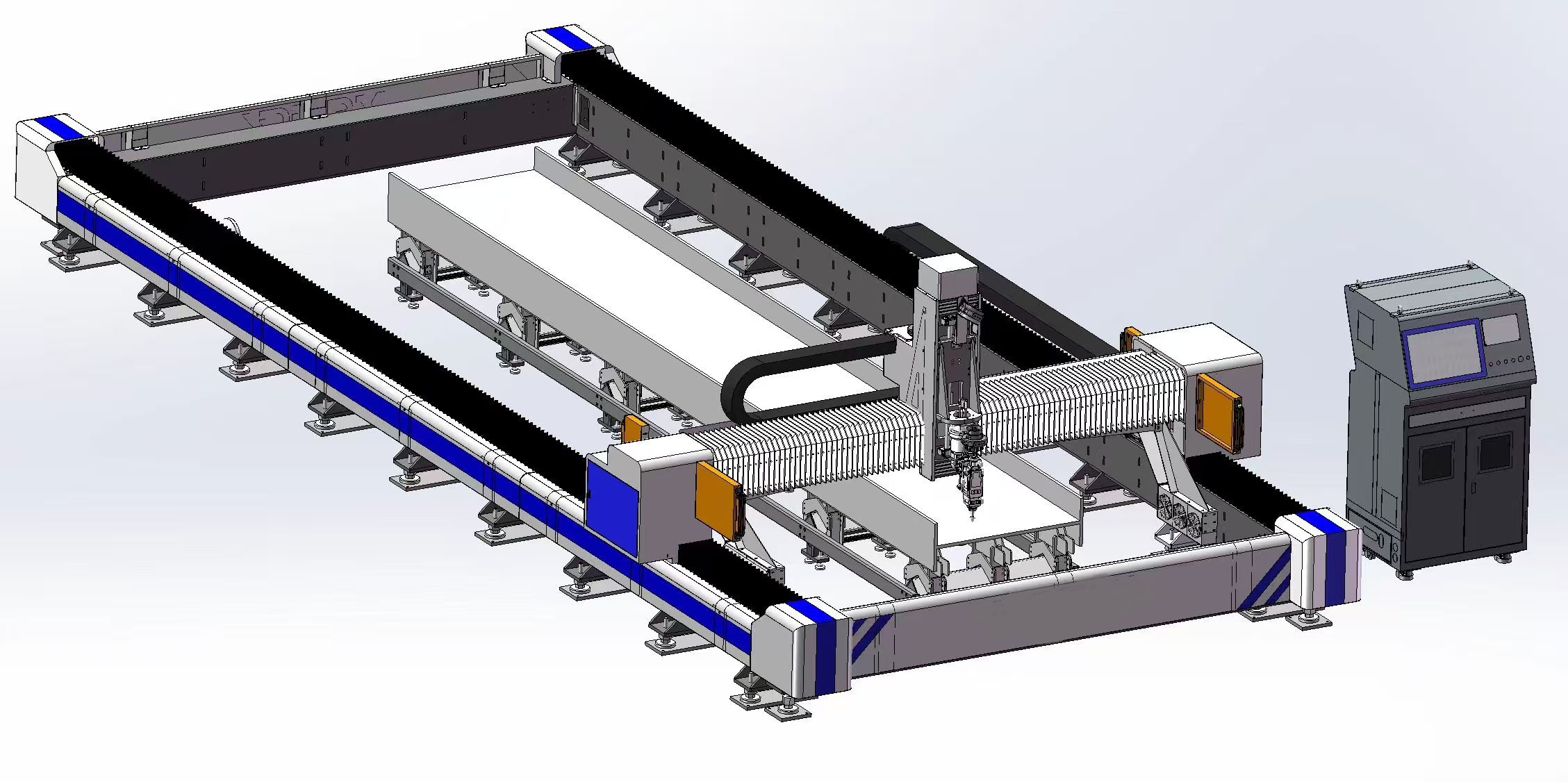
Industrial Application of H-Beam Plasma Cutter
The technical advantage of these systems is found in their ability to compensate for material deviations. Structural steel beams often exhibit slight curvatures or mill tolerances; advanced laser sensing and mechanical probing integrated into the H-Beam Plasma Cutter allow the CNC controller to adjust the cutting path in real-time. This level of automation eliminates the need for manual marking and secondary grinding, ensuring that every beam produced in the Quito facility meets the rigorous AISC (American Institute of Steel Construction) or equivalent European standards.
Thermal Management and Altitude Considerations
Operating high-precision thermal cutting equipment at Quito’s elevation (approximately 2,850 meters) requires specific engineering adjustments. The lower atmospheric pressure affects gas ionization and cooling efficiency. Systems equipped with IPG or Raycus sources are often paired with oversized industrial chillers and specialized gas pressure regulators to maintain optimal plasma arc stability. By stabilizing the cutting environment, fabricators can achieve a high-quality surface finish that is often difficult to replicate with lower-tier equipment in high-altitude conditions.
Residual Value Analysis and Asset Longevity
From a capital expenditure (CAPEX) perspective, the residual value of industrial machinery is a primary concern for B2B investors. An H-Beam Plasma Cutter equipped with world-class components like IPG or Raycus sources retains a significantly higher market value over a five-to-ten-year horizon compared to generic alternatives. This high residual value is attributed to three main factors: component ubiquity, brand reputation, and structural durability.
Firstly, the global availability of spare parts for IPG and Raycus systems ensures that the machine remains serviceable regardless of the secondary market location. Secondly, the structural frames of these high-end cutters are typically stress-relieved and precision-machined, preventing the geometric warping that plagues cheaper models. Finally, the software compatibility with industry-standard Tekla or SDS/2 BIM (Building Information Modeling) platforms ensures the machine remains relevant as digital workflows continue to evolve. In the Quito market, where equipment is often resold into neighboring regions like Peru or Colombia, having a machine with documented high-end components is a safeguard for the initial investment.
Operational Efficiency and Structural Steel Optimization
The implementation of automated H-beam cutting directly addresses the challenges of structural steel optimization. By utilizing nesting software specifically designed for profiles, fabricators can minimize “drop” or scrap material. The precision of the plasma arc, particularly when powered by a stable Raycus or IPG source, allows for tighter nesting of parts and more complex geometries that would be impossible with mechanical sawing.
Furthermore, the integration of features such as automated part marking (using the plasma torch at a lower amperage) allows for seamless downstream assembly. In Quito’s fast-paced construction environment, where bridge sections and high-rise frames must be assembled with zero-tolerance for error, the ability to produce “ready-to-weld” components is a significant competitive advantage. This reduces the total man-hours per ton of steel processed, allowing local firms to compete effectively on international tenders.
Concluding Industry Insight
The global structural steel industry is moving toward a model of “connected fabrication,” where the physical cutting machine is a node in a larger data-driven ecosystem. In regions like Quito, Ecuador, the adoption of the H-Beam Plasma Cutter with high-tier power sources is not merely an upgrade in cutting speed; it is a strategic alignment with international manufacturing standards. As the Andean region continues to invest in infrastructure, the emphasis will shift from simple throughput to the total cost of ownership (TCO) and the ability to integrate with BIM workflows.
The long-term value of these machines lies in their adaptability. As software algorithms improve and the demand for more complex architectural geometries increases, the hardware foundation provided by IPG and Raycus sources ensures that the equipment can be updated and recalibrated rather than replaced. For the global B2B buyer, investing in high-specification machinery in emerging industrial hubs like Quito represents a sophisticated approach to risk mitigation, ensuring that the asset remains a high-value contributor to the production line for its entire operational lifecycle.
Industrial Expertise & Support
Are you looking for high-performance H-Beam Plasma Cutter tailored for the Global market? Our engineering team provides comprehensive solutions for modern manufacturing.





