Optimization of Structural Steel Fabrication: The Rise of H-Beam Plasma Cutting in Quito
The industrial landscape of Quito, Ecuador, has undergone a significant transformation in its approach to structural steel fabrication. As a regional hub for Andean infrastructure projects, the demand for precision-engineered H-beams has necessitated a shift from manual mechanical processes to automated thermal cutting solutions. The integration of the H-Beam Plasma Cutter into local manufacturing workflows represents a strategic move toward high-throughput production. By utilizing advanced Fiber Source Technology, fabricators are now able to achieve tolerances that were previously unattainable with conventional oxy-fuel or mechanical sawing methods.
This transition is not merely a matter of speed; it is an evolution of metallurgical precision. In the high-altitude environment of Quito, where atmospheric pressure affects thermal dissipation, the stability of the plasma arc and the efficiency of the power source are critical variables. The adoption of fiber-based power delivery systems has addressed many of the inconsistencies inherent in older gas-discharge plasma systems, providing a stable, concentrated energy stream capable of penetrating thick-walled structural members with minimal heat-affected zones (HAZ).
Technical Architecture of Fiber-Integrated Plasma Systems
The core of the modern H-beam processing unit lies in its ability to manage multi-axis movement across complex geometries. Unlike flat-bed plasma tables, the H-Beam Plasma Cutter utilizes a robotic arm or a multi-axis gantry system to navigate the flanges and webs of structural steel. The integration of Fiber Source Technology within these systems allows for a more compact internal architecture. Fiber sources utilize solid-state diodes to pump energy into an optical fiber doped with rare-earth elements, resulting in a beam quality that is significantly higher than CO2 or traditional high-frequency plasma starts.
From a technical standpoint, the fiber source provides a high power density. When this is coupled with a 6-axis robotic manipulator, the system can perform complex beveling, bolt-hole circularity optimization, and cope cuts in a single pass. This eliminates the need for secondary processing. The Inverse Kinematics involved in the software control ensures that the torch maintains a constant standoff distance, even when transitioning from the flange to the web of the H-beam, where structural variations and rolling mill tolerances often cause deviations in material dimensions.
Energy Efficiency and Wall-Plug Efficiency Metrics
In the context of Quito’s industrial energy grid, operational cost reduction is a primary driver for equipment selection. Traditional plasma cutting systems are notorious for high energy consumption and low electrical-to-optical conversion rates. However, fiber-based technology offers a superior Wall-Plug Efficiency, often exceeding 30% to 40%. In comparison, older technologies often struggle to reach 10% efficiency. This reduction in power consumption translates directly to lower KVA requirements for the facility, allowing manufacturers to scale their operations without overhauling their existing electrical infrastructure.
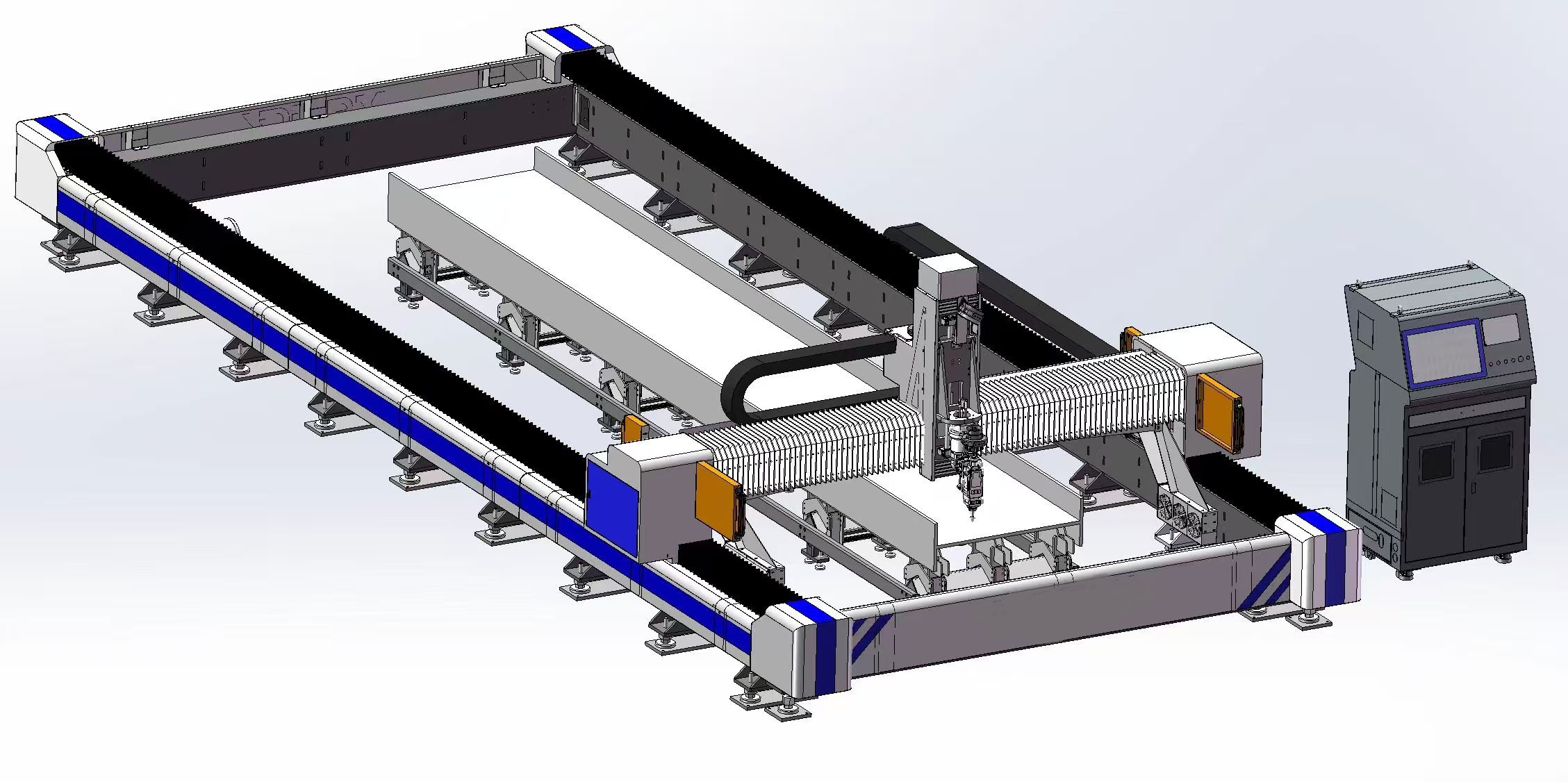
Industrial Application of H-Beam Plasma Cutter
The energy efficiency of the fiber source is also reflected in its cooling requirements. Because the system generates less waste heat during the energy conversion process, the chilling units required to maintain the plasma torch and power supply are smaller and consume less power. For a B2B operation in Ecuador, where industrial electricity tariffs and sustainability mandates are increasingly scrutinized, the move to fiber-integrated plasma cutting provides a quantifiable reduction in the carbon footprint per ton of fabricated steel.
Precision Engineering and Kerf Management
The quality of a cut on an H-beam is defined by its perpendicularity and the smoothness of the surface finish. The H-Beam Plasma Cutter leverages high-definition plasma technology to narrow the kerf width. Kerf Compensation algorithms within the CNC controller adjust the torch path in real-time to account for the width of the plasma arc, ensuring that the final dimensions of the beam meet strict AISC (American Institute of Steel Construction) standards. This is particularly vital for seismic-resistant structures being built in the Andean region, where the integrity of every connection point is paramount.
Furthermore, the fiber source contributes to a more stable arc voltage. This stability reduces dross accumulation on the underside of the flanges. In a high-volume production environment, the reduction in manual grinding time leads to a significant increase in total shop throughput. The technical data suggests that fiber-integrated systems can increase cutting speeds on 12mm to 25mm structural steel by up to 25% compared to traditional air-plasma systems, while simultaneously improving the angularity of the cut edge.
Software Integration and BIM Compatibility
Modern H-beam fabrication in Quito is no longer a localized, isolated process. It is part of a global digital workflow. The plasma systems are designed to interface directly with Building Information Modeling (BIM) software and CAD/CAM platforms such as Tekla or Autodesk Revit. The technical files (typically .DSTV or .STEP) are imported directly into the machine’s controller, which then automatically generates the toolpaths for all necessary holes, notches, and marks.
This digital continuity ensures that the physical H-beam produced in the Quito facility is an exact replica of the digital twin designed by structural engineers. The ability of the fiber-source plasma cutter to execute layout marking—using the same torch at a lower power setting—allows for the automated placement of welding lines and part numbers. This reduces human error during the assembly phase and ensures that the structural integrity of the final build is maintained according to the original engineering specifications.
Maintenance and Operational Longevity
From an operational maintenance perspective, fiber-based plasma systems offer distinct advantages over their predecessors. The absence of moving parts within the fiber source itself—unlike the blowers and turbines found in some high-power gas lasers—reduces the frequency of scheduled maintenance intervals. In the specific industrial environment of Quito, where dust and altitude can affect machinery, the sealed nature of fiber optics provides a robust solution that protects the internal components from environmental contaminants.
The consumables used in the plasma torch (nozzles, electrodes, and swirl rings) also benefit from the precise power control of the fiber source. By managing the ramp-up and ramp-down of the current with millisecond precision, the system minimizes the thermal shock to the electrode, thereby extending the life of the consumables. For a global B2B buyer, this translates to a lower Total Cost of Ownership (TCO) and higher machine uptime.
Industry Insight: The Future of Automated Structural Fabrication
The integration of energy-efficient fiber technology into H-beam plasma cutting is not a temporary trend but a fundamental shift in the global manufacturing paradigm. As industrial centers like Quito continue to modernize, the focus will move beyond basic automation toward intelligent, data-driven fabrication. We are seeing the beginning of a cycle where machine learning algorithms will analyze the acoustic and light signatures of the plasma arc in real-time to adjust cutting parameters for varying steel grades and surface conditions.
For the global structural steel market, the lesson from the Andean industrial sector is clear: efficiency is no longer optional. The combination of high-precision robotic movement and high-efficiency fiber energy sources is setting a new benchmark for what is possible in structural engineering. As carbon taxes and energy costs continue to rise globally, the transition to these high-efficiency systems will become the baseline requirement for any fabrication facility aiming to remain competitive in an increasingly demanding international market. The success of these installations in Quito serves as a technical validation that geography is no longer a barrier to adopting the highest standards of manufacturing technology.
Industrial Expertise & Support
Are you looking for high-performance H-Beam Plasma Cutter tailored for the Global market? Our engineering team provides comprehensive solutions for modern manufacturing.





