The Integration of H-Beam Plasma Cutting Technology in Montevideo’s Industrial Sector
The industrial landscape of Montevideo, Uruguay, has undergone a significant transformation as the region positions itself as a strategic logistics and manufacturing hub for the Southern Cone. Central to this evolution is the deployment of high-precision thermal cutting systems, specifically the H-Beam Plasma Cutter. This technology is no longer a standalone mechanical process but a critical node in a digitally connected ecosystem. For global stakeholders, understanding the convergence of hardware precision with Enterprise Resource Planning (ERP) and nesting software is essential for maintaining competitive throughput in structural steel fabrication.
Montevideo’s port facilities and its proximity to major infrastructure projects in the Mercosur region demand a high degree of technical proficiency. The shift from manual layout and mechanical drilling to automated plasma profiling represents a fundamental change in how structural members are processed. This article examines the technical architecture of these systems, focusing on the digital handshake between the shop floor and administrative management layers.
Technical Architecture of the Modern H-Beam Plasma Cutter
The H-Beam Plasma Cutter utilized in high-output environments typically employs a multi-axis robotic configuration. Unlike traditional 2D plate cutters, H-beam systems must account for the complex geometry of structural sections, including flanges and webs. These machines utilize a 6-axis robotic arm capable of 360-degree rotation, allowing for precise beveling, bolt-hole piercing, and miter cutting in a single pass.
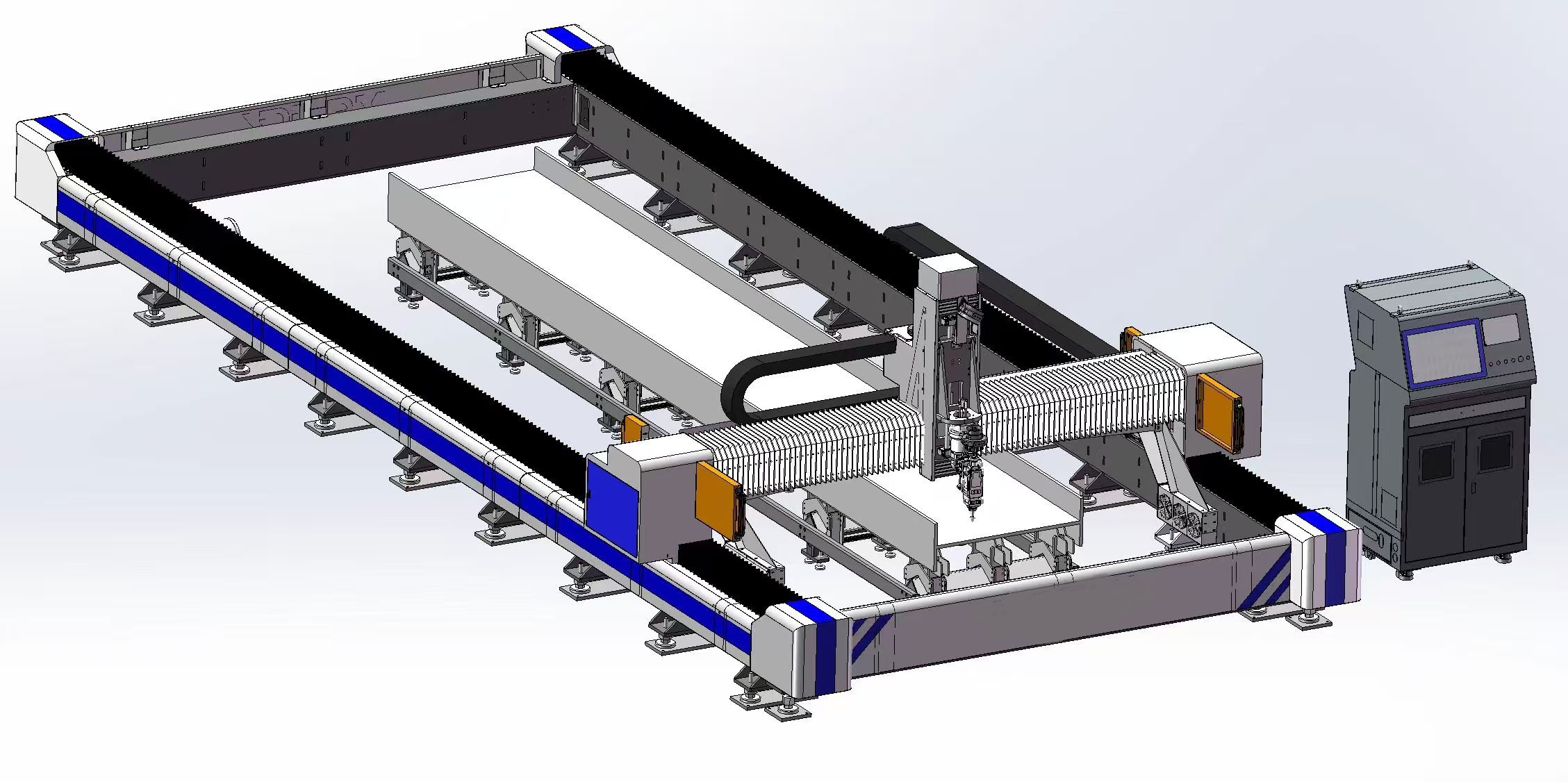
Industrial Application of H-Beam Plasma Cutter
The plasma power source is a critical component, often utilizing high-definition oxygen or nitrogen-shielded arcs to achieve a narrow kerf and minimal heat-affected zone (HAZ). In Montevideo’s fabrication shops, the focus is on achieving tolerances within +/- 0.5mm, which is necessary for the modular assembly techniques currently favored in international bridge building and skyscraper construction. The robotic kinematics are controlled by high-speed processors that translate digital design files into real-time torch positioning, ensuring that the structural integrity of the H-beam is maintained throughout the thermal process.
ERP Integration: Synchronizing Production with Enterprise Logic
The true efficiency of an H-Beam Plasma Cutter is realized when it is fully integrated with an ERP system. In the context of Montevideo’s expanding industrial zones, ERP connectivity allows for the seamless flow of data from the initial bid phase to final delivery. This integration is facilitated through an Application Programming Interface (API) that bridges the gap between the machine’s control unit and the company’s central database.
When a structural project is initiated, the ERP system generates a Bill of Materials (BOM) that is transmitted directly to the production queue. This eliminates manual data entry errors and ensures that the specific metallurgical properties of the steel in inventory are matched with the cutting parameters of the plasma system. Furthermore, real-time feedback loops allow the ERP to track the status of every beam. As the H-Beam Plasma Cutter completes a profile, the system automatically updates inventory levels, logs gas and consumable consumption, and records the exact time taken for the operation. This level of data granularity enables precise cost accounting and deterministic scheduling, which are vital for large-scale global contracts.
Nesting Software and Kinematic Path Optimization
Material utilization is a primary driver of profitability in steel fabrication. Advanced nesting software specifically designed for structural profiles is employed to minimize scrap and optimize the cutting sequence. For H-beams, nesting is significantly more complex than for flat plates, as it must account for the three-dimensional constraints of the beam and the reach of the robotic arm.
The software utilizes Kinematic Path Optimization to calculate the most efficient movement of the torch. This involves predicting potential collisions with the beam’s flanges and optimizing the lead-in and lead-out points to prevent dross accumulation. In Montevideo, fabricators are increasingly using software that supports DSTV and IFC file formats, which are the industry standards for Building Information Modeling (BIM). This ensures that the digital twin of the structure created by engineers is translated with 100 percent accuracy to the physical beam. The nesting algorithms also prioritize common-line cutting where possible, reducing the number of pierces and extending the life of the plasma electrodes and nozzles.
Connectivity Protocols and Data Security
The digital connectivity of an H-Beam Plasma Cutter relies on robust industrial communication protocols. In modern Uruguayan facilities, Ethernet/IP or Modbus TCP/IP are standard for internal networking, allowing the machine to communicate with peripheral sensors and material handling systems. For external connectivity—such as remote diagnostics from a manufacturer in Europe or North America—secure VPN tunnels or MQTT protocols are utilized.
This connectivity enables predictive maintenance. By analyzing the voltage and current fluctuations during the plasma arc, the software can predict the failure of a component before it occurs, allowing for scheduled maintenance that avoids unplanned downtime. In a global supply chain, where Montevideo-based fabricators may be providing components for projects in distant geographies, the ability to guarantee uptime through digital monitoring is a significant commercial advantage. Furthermore, Computer-Aided Manufacturing (CAM) systems now incorporate cloud-based storage, allowing for version control of cutting programs to ensure that the latest engineering revisions are always the ones being executed on the shop floor.
Montevideo as a Hub for Advanced Fabrication Technology
The adoption of these technologies in Montevideo is supported by a growing infrastructure of technical education and fiber-optic connectivity. The city’s status as a free trade zone hub encourages the import of high-end CNC machinery, while local engineering firms provide the necessary software customization for ERP integration. The synergy between the H-Beam Plasma Cutter hardware and the digital management layers allows local firms to compete on a global scale, offering the precision required by the energy, mining, and maritime sectors.
The transition to a fully digital workflow also addresses the labor challenges inherent in traditional fabrication. By automating the most complex aspects of the cutting process, companies can reallocate their skilled workforce to higher-value tasks such as complex welding and quality assurance. The result is a more resilient and scalable manufacturing model that can respond rapidly to the fluctuations of the global steel market.
Concluding Industry Insight
The integration of the H-Beam Plasma Cutter into a digitally connected ERP and nesting environment is not merely a localized trend in Montevideo but a blueprint for the future of global structural steel fabrication. As the industry moves toward Industry 4.0 standards, the distinction between “software” and “machinery” will continue to blur. The most successful fabricators will be those who view their cutting systems as data-generating assets rather than simple tools. In the coming decade, we expect to see the introduction of machine learning algorithms that can autonomously adjust cutting parameters based on real-time sensor data, further reducing the margin for error and pushing the boundaries of structural design. For the global B2B market, the lesson is clear: investment in high-end hardware must be matched by an equivalent investment in digital connectivity and software integration to realize the full potential of modern manufacturing technology.
Industrial Expertise & Support
Are you looking for high-performance H-Beam Plasma Cutter tailored for the Global market? Our engineering team provides comprehensive solutions for modern manufacturing.





