Precision Structural Fabrication: The Role of the H-Beam Plasma Cutter in Guayaquil’s Industrial Sector
The industrial landscape of Guayaquil, Ecuador, serves as a critical nexus for maritime logistics and heavy manufacturing in the Andean region. As infrastructure projects demand higher structural integrity and faster assembly timelines, the transition from traditional mechanical sawing to automated thermal cutting has become a technical necessity. Central to this evolution is the implementation of the H-Beam Plasma Cutter, a system engineered to handle the complex geometries of structural steel with high-velocity ionized gas. In the context of Guayaquil’s expanding port facilities and urban high-rise developments, the ability to execute 45-degree bevels with sub-millimeter precision is the primary factor in achieving seamless welding and structural compliance with international standards such as AWS D1.1.
Technical Parameters of 45-Degree Beveling for Structural Integrity
Beveling is the process of preparing the edges of a metal part to create a specific groove geometry for welding. In H-beam fabrication, a 45-degree bevel is frequently required to facilitate full penetration welds, particularly in moment connections where the beam must transfer significant loads to a column. The H-Beam Plasma Cutter utilizes multi-axis robotic kinematics to maintain a consistent torch angle relative to the flange and web surfaces. Unlike manual oxy-fuel cutting, which often results in irregular thermal distortion, high-definition plasma systems regulate the arc voltage and gas flow to produce a clean, uniform surface.
The 45-degree angle is strategically selected to optimize the volume of weld metal required while ensuring that the root of the joint is accessible to the welding electrode. When the plasma arc strikes the workpiece, it must maintain a constant standoff distance. In Guayaquil’s humid coastal environment, the stabilization of the plasma arc is further managed through advanced air filtration and cooling systems, preventing the contamination of the cut surface with moisture or particulates that could lead to porosity in the subsequent weld phase.
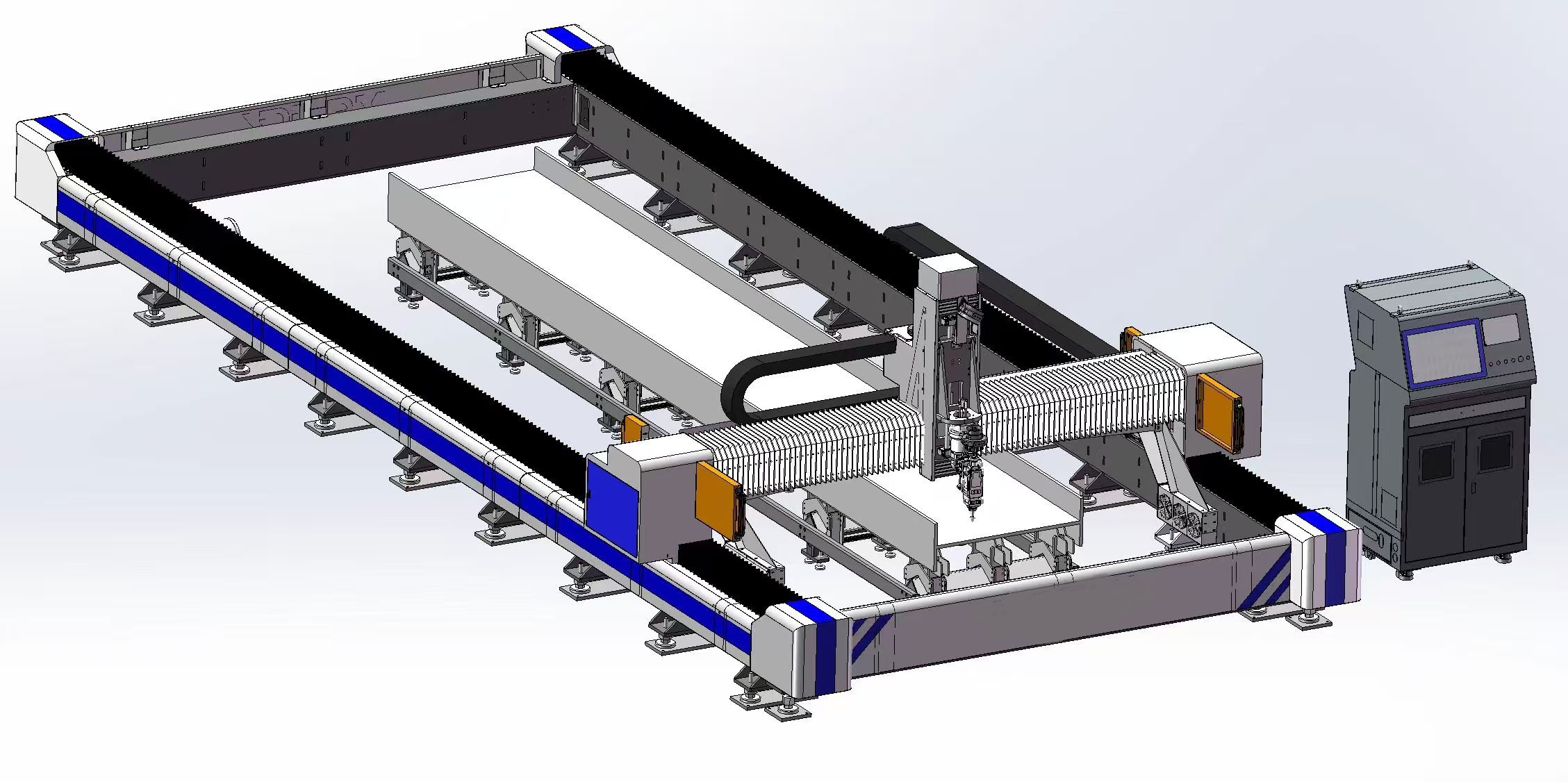
Industrial Application of H-Beam Plasma Cutter
The Mechanics of Multi-Axis Robotic Kinematics
To achieve a seamless 45-degree bevel across the varying thicknesses of an H-beam, the plasma system must operate on at least five axes of motion. This allows the torch to rotate and tilt while traversing the length of the beam. The technical challenge lies in the transition between the flange and the web. The multi-axis robotic kinematics of the cutter allow for the continuous adjustment of the torch head to compensate for the radius of the beam’s inner corner. This ensures that the bevel remains consistent even as the geometry shifts from a horizontal to a vertical plane.
In the fabrication shops of Guayaquil, these machines are often integrated with CNC (Computer Numerical Control) software that interprets Tekla or AutoCAD files directly. This digital-to-physical workflow eliminates manual marking and layout errors. The precision of the robotic arm ensures that the 45-degree cut is not only accurate in its angle but also in its longitudinal placement, which is critical for the modular assembly of large-scale steel structures where tolerances are strictly governed by engineering specifications.
Thermal Management and the Heat Affected Zone (HAZ)
One of the primary technical advantages of using a plasma cutter over oxy-fuel methods is the reduction of the Heat Affected Zone (HAZ). The HAZ is the area of the base metal that has not been melted but has had its microstructure and mechanical properties altered by the heat of the cutting process. Excessive heat can lead to grain growth, which reduces the toughness and ductility of the steel, potentially leading to brittle fractures in the weld area.
Modern plasma cutters in the Guayaquil market utilize high-definition technology that focuses the arc into a narrower column. This increased energy density allows for faster cutting speeds, which in turn minimizes the duration of heat exposure to the surrounding metal. By maintaining a narrow HAZ, the metallurgical integrity of the H-beam is preserved, ensuring that the 45-degree bevel provides a stable foundation for high-strength welding. This is particularly vital in seismic zones like Ecuador, where structural ductility is a non-negotiable safety requirement.
Optimizing Weld Preparation for Seamless Integration
The term ‘seamless welding’ in structural engineering refers to a joint that achieves complete fusion between the base metals with minimal defects. The quality of the plasma cut directly dictates the efficiency of the welding process. A 45-degree bevel produced by a high-precision plasma cutter requires minimal post-cut grinding. The surface finish of the cut is often smooth enough to proceed directly to the fit-up stage.
In Guayaquil’s heavy industry, where throughput is a key performance indicator, the elimination of secondary processing steps represents a significant reduction in man-hours. Furthermore, the accuracy of the bevel ensures a consistent root gap during fit-up. If the bevel angle fluctuates, the welder must compensate by varying the heat input or the travel speed, which increases the risk of slag inclusions or lack of fusion. The standardized output of the plasma system ensures that robotic or manual welding can be executed with predictable parameters and high repeatability.
Logistical Advantages of Localized Fabrication in Guayaquil
Guayaquil’s status as a port city provides a unique logistical advantage for firms utilizing advanced H-beam processing. Raw structural steel sections imported from global mills can be processed locally before being shipped to construction sites across South America. By performing the 45-degree beveling and complex hole-drilling in a controlled facility in Guayaquil, contractors can reduce the weight of the steel for transport and ensure that all components arrive on-site ready for immediate erection.
The integration of the H-Beam Plasma Cutter into the local supply chain also allows for ‘just-in-time’ fabrication. This reduces the need for extensive on-site storage and minimizes the risk of corrosion, which is a constant concern in the humid Ecuadorian climate. By processing the steel in a facility equipped with high-end plasma technology, the final product meets the stringent quality assurance requirements of international EPC (Engineering, Procurement, and Construction) firms operating in the region.
Concluding Industry Insight: The Shift Toward Automated Structural Fabrication
The global structural steel industry is currently undergoing a paradigm shift characterized by the convergence of digital design and automated manufacturing. The adoption of 45-degree beveling via plasma technology in Guayaquil is not merely a localized trend but a reflection of a broader move toward ‘BIM-to-Machine’ workflows. As Building Information Modeling (BIM) becomes the standard for large-scale infrastructure, the demand for fabrication equipment that can interpret complex datasets will continue to rise.
The industry insight for the coming decade points toward the total automation of the fabrication shop. We are moving beyond simple cutting toward systems that can perform marking, drilling, and beveling in a single pass. For the Guayaquil market, this means that the competitive edge will belong to those who invest in high-precision thermal cutting systems that minimize human intervention. The ability to produce a 45-degree bevel that facilitates seamless welding is the baseline; the future lies in the integration of these machines into a fully transparent, data-driven production environment where every cut is logged, verified, and optimized for structural performance. As global steel prices fluctuate, the reduction in material waste and the increase in fabrication speed provided by these plasma systems will be the defining factors in project profitability and structural safety.
Industrial Expertise & Support
Are you looking for high-performance H-Beam Plasma Cutter tailored for the Global market? Our engineering team provides comprehensive solutions for modern manufacturing.





