Introduction: The Industrial Evolution of Structural Steel in Curitiba
Curitiba, Brazil, has long maintained its reputation as a primary industrial hub, particularly within the automotive and structural engineering sectors. However, the global demand for shorter lead times and higher precision has placed immense pressure on local fabrication facilities. Traditional methods of processing structural steel—specifically H-beams—often involve fragmented workflows that result in significant production bottlenecks. This article examines a specific technical implementation in a Curitiba-based facility where the adoption of an H-Beam Plasma Cutter transformed a standard 72-hour production cycle into a streamlined 3-hour operation. By analyzing the shift from manual layout and mechanical drilling to automated robotic thermal cutting, we can quantify the efficiency gains essential for modern B2B infrastructure projects.
The Legacy Bottleneck: Analyzing the 72-Hour Cycle
Before the integration of advanced automation, the fabrication of complex structural members relied on a linear, multi-station approach. This legacy process was characterized by several high-friction stages:
- Manual Layout and Marking: Engineers and technicians spent approximately 12 to 16 hours translating 2D drawings onto physical steel surfaces. This stage was prone to human error, requiring frequent double-checks and manual measurements.
- Mechanical Sawing and Drilling: Using traditional band saws and radial arm drills, the cutting and hole-making process for a standard batch of H-beams consumed nearly 24 hours. The physical movement of heavy beams between separate machines added significant logistical overhead.
- Coping and Notching: Complex geometries, such as weld prep bevels and structural copes, were performed using manual oxy-fuel torches. This required an additional 20 hours of labor, including the necessary grinding to achieve acceptable surface finishes.
- Quality Assurance and Rectification: Given the manual nature of the work, a final 12-hour window was typically reserved for correcting misaligned holes or out-of-tolerance cuts.
This 72-hour cycle restricted the facility’s throughput, making it difficult to compete for large-scale international contracts that demand rapid delivery and millimeter-level precision.
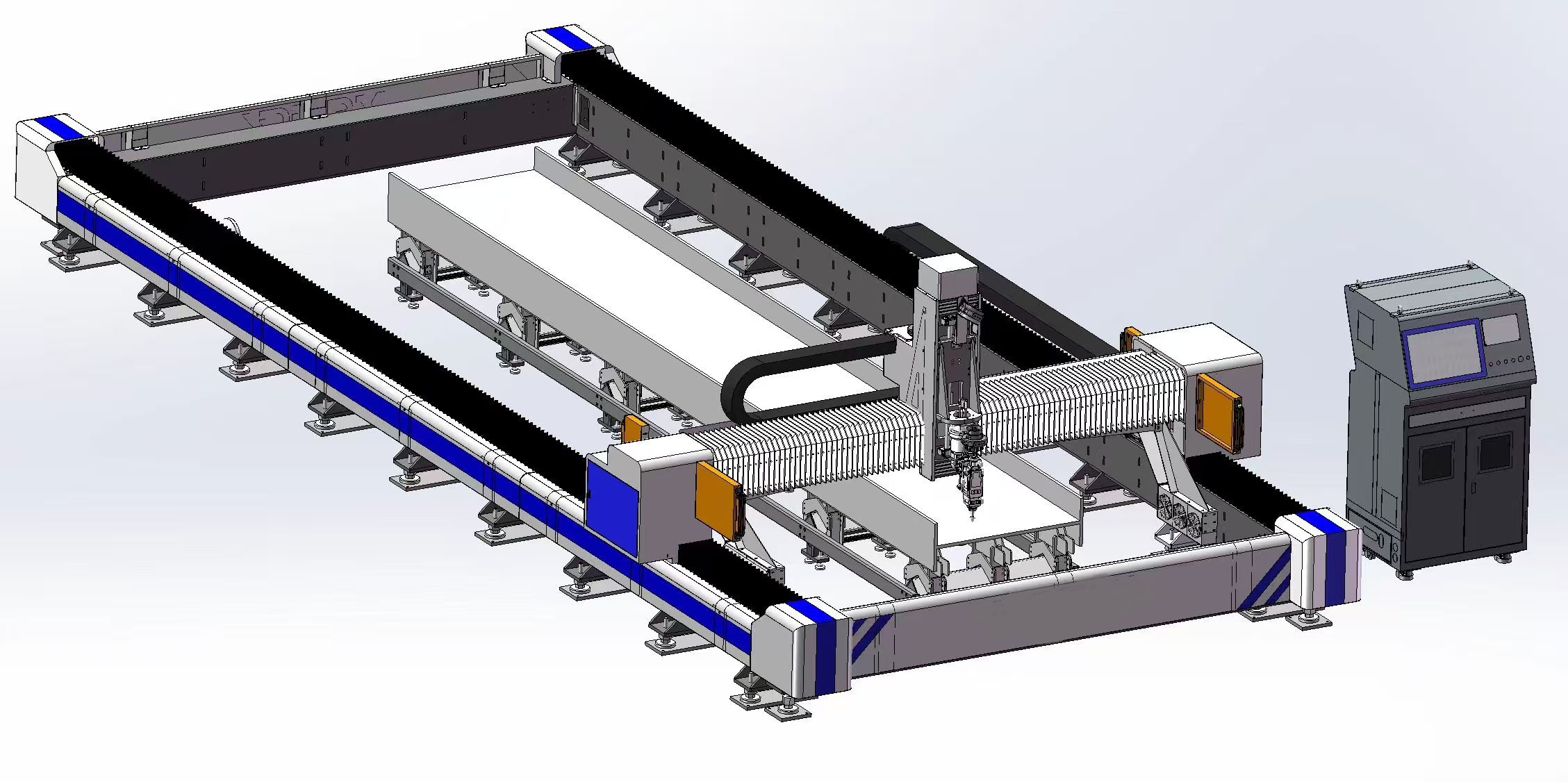
Industrial Application of H-Beam Plasma Cutter
Technical Specifications of the H-Beam Plasma Cutter
The transition to a 3-hour cycle was facilitated by the installation of a high-definition robotic 6-axis motion system equipped with a plasma power source. Unlike traditional CNC machines that operate on limited planes, this system utilizes a multi-axis robotic arm capable of reaching all four sides of an H-beam, including the interior of the flanges and the web, in a single pass.
The system utilizes CAD/CAM integration to bypass the manual layout phase entirely. Engineering files (typically in .DSTV or .STEP format) are exported directly from the design office to the machine’s controller. The software automatically calculates the optimal cutting path, accounting for kerf width and material thickness. A critical component of this hardware is the laser scanning array, which measures the actual dimensions of the raw steel beam. Since structural steel often possesses slight deviations or “mill tolerances” in its straightness or flange angle, the laser scanner adjusts the cutting program in real-time to ensure every hole and cope is placed relative to the actual center-line of the beam rather than a theoretical model.
Achieving the 3-Hour Cycle: Process Consolidation
The reduction in cycle time from 72 hours to 3 hours is not merely the result of faster cutting speeds; it is the result of process consolidation. The H-Beam Plasma Cutter performs five distinct operations simultaneously:
1. Automated Measuring and Probing
Upon loading the beam onto the conveyor, the system performs a 3D scan of the profile. This eliminates the 16-hour manual marking phase. The machine identifies the beam’s start point and adjusts the digital twin to match the physical workpiece.
2. High-Speed Plasma Drilling and Bolt-Hole Optimization
Rather than using mechanical bits that require lubrication and frequent replacement, the plasma torch pierces and cuts bolt holes using plasma arc voltage control to maintain a consistent torch-to-workpiece distance. This ensures that holes are perfectly cylindrical with minimal taper, meeting the stringent requirements for high-strength structural bolting.
3. Integrated Coping and Beveling
Complex cutouts required for interlocking steel frames are executed with the robotic arm’s 360-degree range of motion. Beveling for weld preparations is performed in the same sequence, eliminating the need for secondary grinding or manual torch work. This consolidation reduces the handling time from hours to minutes.
4. Layout Marking for Secondary Attachments
The plasma system can be configured to “scribe” or mark the beam with part numbers and the exact locations for secondary attachments like gusset plates or stiffeners. This provides a roadmap for the welders in the next stage of production, further reducing downstream labor requirements.
Operational Impact and Data-Driven Results
In the Curitiba facility, the implementation of this technology resulted in a measurable shift in operational KPIs. By moving to a 3-hour cycle, the facility achieved a 2,300% increase in throughput capacity for H-beam processing. Furthermore, the accuracy of the finished components improved from a +/- 3.0mm tolerance to +/- 0.5mm.
From a B2B perspective, the reduction in labor hours per ton of steel processed significantly lowered the overhead costs. The ability to process a full batch of beams in a single morning shift—which previously required three full days—allowed the company to take on “just-in-time” delivery contracts for infrastructure projects in the mining and energy sectors. The reduction in material waste was also documented; the nested software optimization ensured that “drops” or scrap pieces were minimized, improving the overall material utilization rate by approximately 12%.
Maintenance and Consumable Management
Maintaining a 3-hour cycle requires a rigorous approach to consumable management. High-definition plasma cutting involves electrodes and nozzles that must be replaced at specific intervals to maintain arc stability. The Curitiba facility implemented a predictive maintenance schedule based on the number of pierces and arc-on time. By using high-quality consumables and ensuring the compressed air supply was filtered for moisture and oil, the facility maximized the lifespan of the torch components, preventing unscheduled downtime that could disrupt the newly optimized workflow.
Concluding Industry Insight: The Future of Automated Fabrication
The case study in Curitiba serves as a microcosm for the global structural steel industry. The transition from 72 hours to 3 hours demonstrates that the primary barrier to efficiency is not the speed of the tool, but the fragmentation of the process. In the current B2B landscape, the “all-in-one” processing philosophy is becoming the standard. Facilities that continue to rely on manual layout and discrete machining stations will find themselves increasingly marginalized by competitors who can offer precision-cut, ready-to-assemble components with minimal lead times.
As we look toward the future, the integration of Artificial Intelligence (AI) in nesting algorithms and the potential for fully autonomous material handling will likely reduce these cycle times even further. For fabricators in emerging industrial hubs, the investment in high-degree-of-freedom robotic plasma systems is no longer an optional upgrade; it is a fundamental requirement for maintaining relevance in a high-velocity global supply chain. The success in Curitiba proves that even in regions with established traditional manufacturing roots, the adoption of specialized automation can redefine the limits of industrial productivity.
Industrial Expertise & Support
Are you looking for high-performance H-Beam Plasma Cutter tailored for the Global market? Our engineering team provides comprehensive solutions for modern manufacturing.





