Precision Metal Fabrication in the Biobío Region: The Role of H-Beam Plasma Technology
Concepción, Chile, serves as a critical industrial nexus, particularly for the Biobío Region’s expansive forestry and manufacturing sectors. As the demand for sophisticated infrastructure in the furniture export market intensifies, the technical requirements for structural steel fabrication have shifted toward higher precision and reduced post-processing. Central to this evolution is the implementation of the H-Beam Plasma Cutter, a specialized CNC-driven system designed to handle complex structural profiles with dimensional accuracy that satisfies international export standards.
For furniture exporters operating out of South America, the structural integrity and aesthetic finish of metal components—such as industrial shelving, furniture frames, and warehouse racking—are non-negotiable. The transition from traditional mechanical sawing or manual oxy-fuel cutting to high-definition plasma technology has enabled local fabricators in Concepción to eliminate the common bottleneck of secondary finishing. By achieving a burr-free edge directly from the machine, manufacturers can move components immediately to the assembly or powder-coating stages, significantly optimizing the supply chain for global distribution.
Technical Parameters of High-Definition Plasma Cutting on Structural Steel
The efficiency of an H-Beam Plasma Cutter is defined by its ability to manage the physics of a constricted ionized gas arc. In the context of Concepción’s industrial facilities, these machines typically employ high-definition (HD) power sources that utilize a ventilated nozzle design. This design constricts the plasma arc, increasing energy density and ensuring a narrower Kerf compensation. When cutting H-beams, which feature varying thicknesses between the web and the flanges, the system’s ability to modulate amperage and gas flow in real-time is essential.
The elimination of dross—the solidified oxidized metal that forms on the bottom edge of a cut—is a primary objective. This is achieved through precise control of the cutting speed and the selection of appropriate shielding gases. For furniture-grade steel, a mixture of Oxygen (O2) for carbon steel or Nitrogen (N2) for stainless steel components ensures that the chemical reaction at the point of contact does not result in heavy slag. The result is a surface finish that meets the ISO 9013 standard for thermal cutting, characterized by minimal angularity and a smooth perpendicular edge.
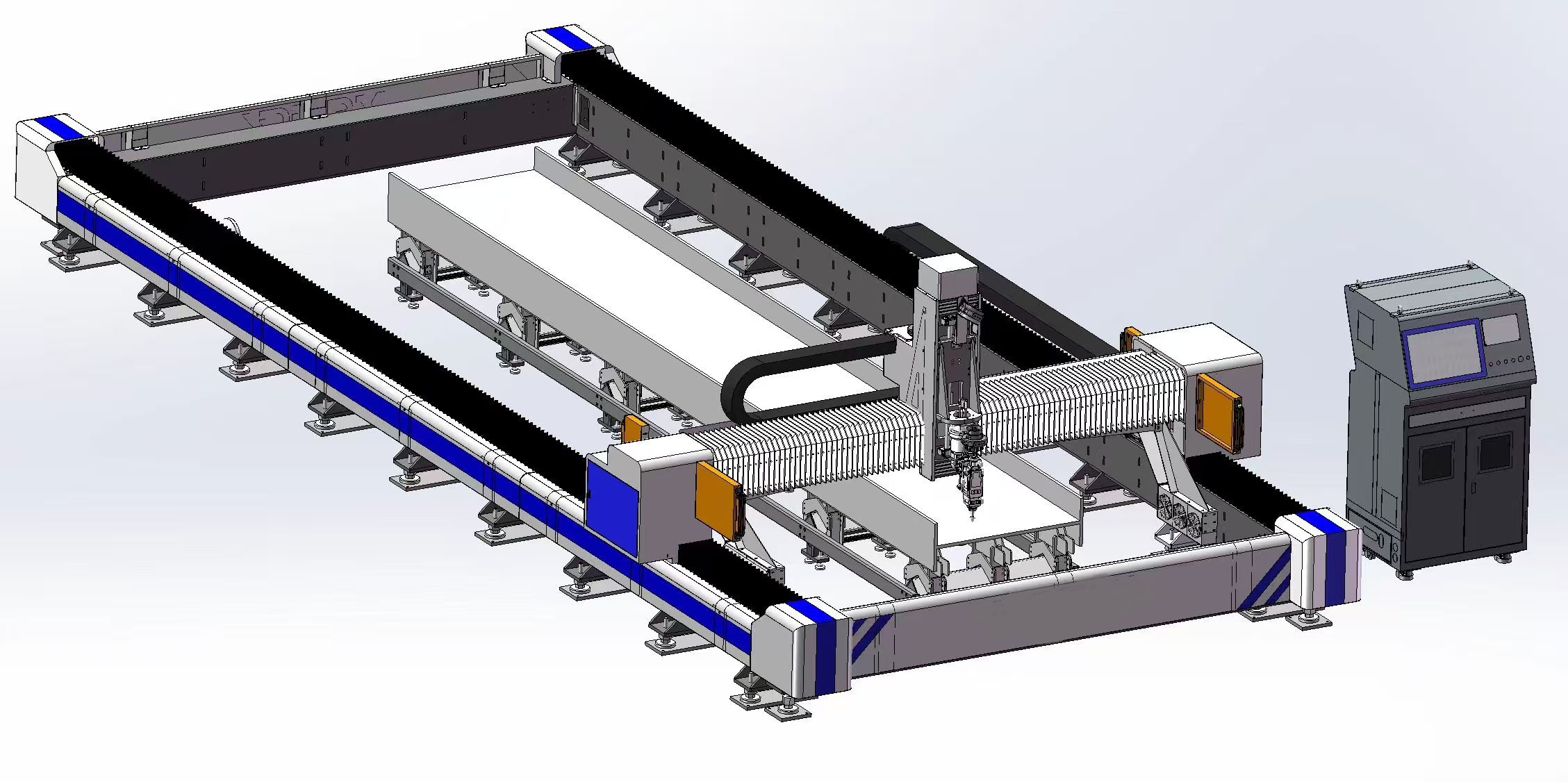
Industrial Application of H-Beam Plasma Cutter
Robotic 5-Axis Maneuverability and Geometric Complexity
Unlike standard plate cutters, H-beam systems in Concepción often utilize a 5-axis or 6-axis robotic arm. This allows the torch to rotate and tilt, facilitating the cutting of bolt holes, copes, and notches on all four sides of the beam without the need to flip the workpiece. In furniture manufacturing, where structural frames may require complex interlocking joints or mitered cuts for aesthetic transitions, this multi-axis capability is vital. The software integration (typically via BIM or CAD/CAM platforms) ensures that the digital model is translated into precise torch movements, maintaining tolerances within +/- 0.5mm.
This level of precision is particularly relevant for the furniture export sector, where components are often shipped as “flat-pack” or modular units. If the structural steel elements of a high-end industrial furniture set are not cut with absolute precision, the assembly process at the destination—whether in North America, Europe, or Asia—will fail. The H-Beam Plasma Cutter ensures that every hole alignment and flange cut is consistent across large production runs, reducing the risk of rejected shipments and warranty claims.
Minimizing the Heat-Affected Zone (HAZ) for Structural Integrity
A critical technical concern in thermal cutting is the Heat-Affected Zone (HAZ). When steel is subjected to the intense heat of a plasma arc, the metallurgical properties of the area surrounding the cut can change, potentially leading to increased brittleness or susceptibility to stress fractures. In furniture design, where slim profiles are often required to support significant weight, maintaining the base metal’s ductility is paramount.
Advanced plasma systems in Concepción mitigate HAZ through high-speed processing and optimized cooling cycles. By increasing the travel speed of the torch, the duration of heat exposure is minimized. Furthermore, the use of water-mist secondary shielding or specific gas compositions can further narrow the zone of thermal influence. This ensures that the H-beams retain their rated load-bearing capacities, which is a fundamental requirement for obtaining international safety certifications for exported furniture products.
Operational Efficiency and Cost-to-Quality Ratio
From a B2B perspective, the investment in high-end plasma technology in Concepción is driven by the total cost of ownership and the reduction of labor-intensive tasks. Manual grinding to remove burrs is not only time-consuming but also introduces variability in the finish. By utilizing a Dross-free cutting process, manufacturers reduce their “Cost Per Part” by eliminating the need for secondary abrasive cleaning. This allows Concepción-based exporters to remain competitive in a global market where labor costs and lead times are under constant scrutiny.
Moreover, the integration of automated material handling—where H-beams are fed into the cutting cell via conveyors and measured by laser sensors—minimizes human error. These systems automatically detect the actual dimensions of the beam, accounting for any slight mill tolerances or deviations in the raw material. The plasma cutter then adjusts its path accordingly, ensuring that the final product is perfectly square and ready for immediate integration into furniture assemblies.
Logistical Advantages of Concepción for Global Exporters
The geographical location of Concepción, with its proximity to the ports of Talcahuano and San Vicente, provides a strategic advantage for the export of heavy-duty steel furniture and industrial components. The ability to process raw steel into finished, burr-free components within the same region where they are loaded onto container ships reduces internal logistics costs. Local fabricators who utilize H-beam plasma technology can offer “Just-In-Time” manufacturing services to international clients, providing a level of responsiveness that is often difficult to achieve with trans-continental supply chains.
The synergy between the local forestry industry—which provides the wood elements for hybrid furniture—and the advanced metal fabrication sector creates a unique value proposition. Exporters can source high-quality Chilean timber and marry it with precision-cut steel frames, all within a 50-mile radius. This localized ecosystem, supported by high-definition plasma cutting, positions Concepción as a high-tech hub for durable, export-ready furniture solutions.
Concluding Industry Insight: The Shift Toward Integrated Fabrication
The global manufacturing landscape is moving toward a model of “Integrated Fabrication,” where the boundaries between raw material processing and final assembly are increasingly blurred. In the structural steel and furniture sectors, the H-Beam Plasma Cutter is no longer viewed merely as a tool for separation, but as a foundational component of digital manufacturing. The ability to produce burr-free, high-tolerance parts in a single pass is the baseline for participating in the global B2B economy.
As we look toward the next decade, the focus will likely shift toward the further integration of Artificial Intelligence (AI) in plasma cutting parameters, allowing machines to self-correct for nozzle wear and material inconsistencies in real-time. For exporters in Concepción, staying at the forefront of this technological curve is not just about quality—it is about maintaining a competitive edge in a market that increasingly values speed, precision, and the total elimination of waste. The future of furniture exports lies in the marriage of robust structural design and the surgical precision of high-definition thermal cutting.
Industrial Expertise & Support
Are you looking for high-performance H-Beam Plasma Cutter tailored for the Global market? Our engineering team provides comprehensive solutions for modern manufacturing.





