Industrial Context: Structural Steel Fabrication in the Caracas Corridor
The industrial landscape of Caracas, Venezuela, has long been a hub for heavy infrastructure and petrochemical engineering. As the demand for structural steel precision increases globally, the deployment of advanced 3D profiling technology has become a necessity for local fabricators aiming to compete on an international scale. The H-Beam Plasma Cutter represents the pinnacle of this technological shift, providing automated solutions for complex geometries in structural members. By integrating high-stability power sources from manufacturers like IPG and Raycus, these machines are not merely tools for production but are strategic assets with high residual value. This article examines the technical parameters, the economic justification of power source selection, and the specific logistical advantages of operating these systems within the Venezuelan industrial sector.
Technical Specifications and System Architecture
Modern H-beam processing requires a multi-axis approach to handle the diverse requirements of structural engineering, including bolt holes, coping, notches, and weld preparations. A standard high-performance system utilized in the Caracas region typically features a 6-axis or 7-axis robotic configuration. This allows the plasma torch to maintain a perpendicular or specified bevel angle relative to the flange and web surfaces of the H-beam, I-beam, or channel.
The core of the system is the CNC 6-Axis Robotic Arm, which facilitates 360-degree rotation around the workpiece. This eliminates the need for manual flipping of heavy steel profiles, which can weigh several tons. The integration of DSTV File Integration protocols allows the machine to read CAD/CAM data directly from structural detailing software such as Tekla Structures or AutoCAD. This direct data transfer minimizes human error and ensures that the physical output matches the digital twin with tolerances often exceeding +/- 0.5mm over the length of a 12-meter beam.
The Strategic Importance of IPG and Raycus Sources
While traditional plasma power units remain prevalent, the industry in Caracas is seeing a significant shift toward high-precision oscillators. The inclusion of IPG and Raycus sources—traditionally associated with fiber laser technology—is now being adapted for hybrid plasma-laser systems or high-definition plasma units that utilize similar solid-state cooling and power modulation technologies.
IPG Photonics sources are recognized globally for their wall-plug efficiency and modular design. In the context of an H-beam cutter, an IPG source ensures that the energy density remains consistent throughout the duty cycle. This is critical in the Caracas climate, where fluctuations in ambient temperature and humidity can affect the stability of lesser power units. Raycus sources offer a competitive alternative, providing high-power stability and a robust architecture that is easier to service locally. The use of these specific sources directly impacts the kerf width and the heat-affected zone (HAZ). A narrower HAZ means that the structural integrity of the H-beam is preserved, and secondary grinding processes are significantly reduced or eliminated.
Residual Value and Asset Depreciation in the Global Market
For B2B investors and large-scale contractors in Venezuela, the “Total Cost of Ownership” (TCO) is a primary metric. High-end machinery often faces steep depreciation if the components are proprietary or obscure. However, an H-Beam Plasma Cutter equipped with IPG or Raycus components maintains a high residual value for several reasons:
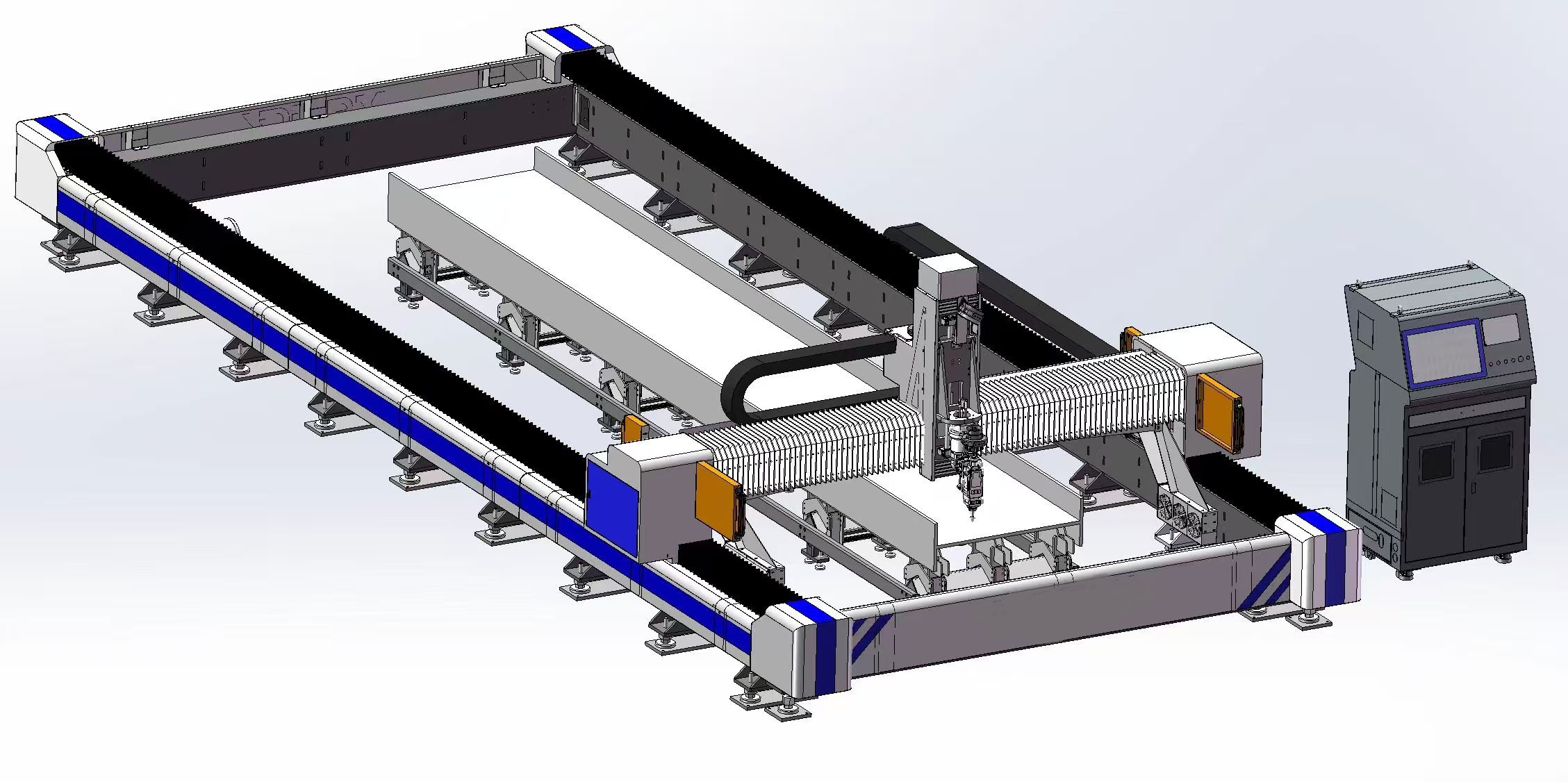
Industrial Application of H-Beam Plasma Cutter
First, the global ubiquity of these power sources ensures that spare parts and technical support are available in any international market. If a facility in Caracas decides to upgrade or liquidate its assets, a machine with a Raycus or IPG source is significantly more attractive to buyers in North America, Europe, or Asia than one with a generic, unbranded source.
Second, the durability of solid-state components far exceeds that of older transformer-based plasma units. The MTBF (Mean Time Between Failure) for these sources is often rated at over 100,000 hours. This longevity ensures that the machine remains a productive asset long after the initial capital expenditure has been amortized. In the volatile economic environment of South America, investing in hardware with a high secondary market demand acts as a hedge against local currency fluctuations.
Operational Efficiency in the Venezuelan Energy Sector
The primary application for H-beam cutting in the Caracas region is the support of PDVSA-related infrastructure and the construction of massive industrial warehouses. These projects require the processing of heavy-wall thickness profiles. A high-definition Plasma Power Modulation system allows for clean cuts on flanges exceeding 40mm in thickness.
Furthermore, the automation of the “layout” process—where the machine marks the beam for subsequent welding of stiffeners and base plates—saves hundreds of man-hours. In a traditional shop, layout is done with tape measures and soapstone. In an automated Caracas facility, the plasma source can be dialed down to a marking amperage, etching the layout directly onto the steel based on the 3D model. This ensures that the downstream assembly is perfectly accurate, reducing the “re-work” rate to nearly zero.
Logistical Advantages of the Caracas Hub
Caracas serves as the logistical gateway for the Orinoco Belt and coastal refineries. By housing high-value fabrication equipment locally, companies reduce their reliance on imported pre-cut steel. Importing raw H-beams and processing them locally using a high-precision plasma system allows for just-in-time (JIT) delivery to construction sites. This reduces the carbon footprint associated with shipping processed steel and allows for immediate design changes on-site. The ability to perform 3D Bevel Cutting locally means that complex pipe-to-beam connections can be fabricated in hours rather than weeks, providing a massive competitive advantage in tender bidding for regional infrastructure projects.
Concluding Industry Insight: The Shift Toward Autonomous Fabrication
The global structural steel industry is moving toward a “lights-out” manufacturing model where the role of the operator shifts from manual labor to system oversight. In Caracas, the adoption of H-beam plasma cutters with IPG and Raycus sources is a clear indicator of this maturation. The convergence of high-definition thermal cutting with robotic precision is no longer an optional luxury; it is the baseline for participation in modern heavy industry.
As we look toward the next decade, the integration of Artificial Intelligence in path-planning and real-time kerf compensation will further enhance the value of these machines. For Venezuelan enterprises, the strategic acquisition of such technology provides a dual benefit: it optimizes current production throughput for the domestic energy sector while securing an asset that holds its value in the globalized used-machinery market. The focus on high-quality power sources is the definitive factor that separates sustainable industrial investment from short-term operational spending.
Industrial Expertise & Support
Are you looking for high-performance H-Beam Plasma Cutter tailored for the Global market? Our engineering team provides comprehensive solutions for modern manufacturing.





