Precision Structural Fabrication: The Rise of Advanced Plasma Systems in Cali, Colombia
The industrial landscape of Cali, Colombia, has undergone a significant transformation, evolving from traditional manufacturing into a sophisticated hub for structural steel fabrication. As infrastructure projects across South America demand higher load-bearing capacities and stricter adherence to international safety codes, the reliance on manual preparation methods has become obsolete. At the center of this technological shift is the H-Beam Plasma Cutter, a robotic CNC system engineered to handle the complexities of heavy-section steel profiles. The integration of these systems in the Valle del Cauca region signifies a move toward high-velocity production environments where precision is non-negotiable.
In structural engineering, the integrity of a joint is primarily determined by the quality of the weld preparation. For H-beams, which serve as the primary load-bearing members in skyscrapers, bridges, and industrial warehouses, achieving a seamless weld requires more than just a clean cut. It demands precise geometric beveling. The adoption of automated plasma technology in Cali allows local fabricators to meet global standards, such as those set by the American Welding Society (AWS), by automating the 45-degree beveling process, which is essential for complete joint penetration (CJP).
Technical Dynamics of the H-Beam Plasma Cutter
The H-Beam Plasma Cutter utilized in modern Cali facilities is typically a multi-axis robotic system. Unlike traditional 2D plate cutters, these machines operate on a 5-axis or 6-axis coordinate system, allowing the plasma torch to rotate and tilt around the stationary or through-fed beam. This spatial flexibility is critical when dealing with H-beams, as the torch must navigate the transition between the flange and the web without losing arc stability.
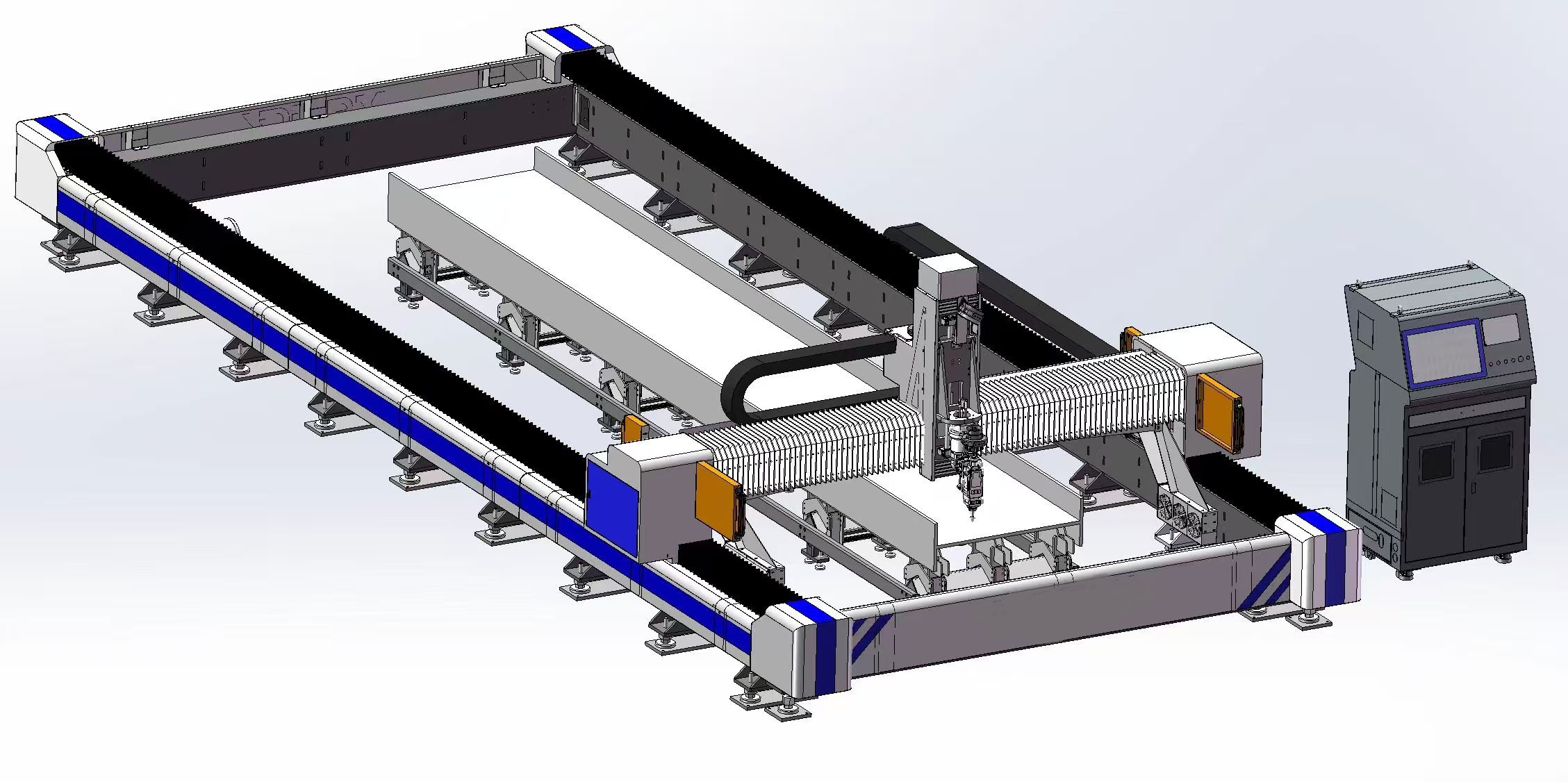
Industrial Application of H-Beam Plasma Cutter
These systems utilize high-definition plasma power sources that constrict the plasma arc through a narrow nozzle, increasing energy density. This results in a narrower kerf and a significantly reduced Heat-Affected Zone (HAZ). For fabricators in Cali, minimizing the HAZ is vital to maintaining the metallurgical properties of the steel. Excessive heat input can lead to grain growth and localized softening, which compromises the structural reliability of the beam under cyclic loading. By utilizing high-speed robotic movements and optimized gas flow, these plasma cutters ensure that the structural integrity of the A36 or A572 grade steel commonly used in the region remains intact.
The Criticality of 45-Degree Beveling for Weld Geometry
In the context of heavy-duty welding, a square edge is rarely sufficient. To achieve a “seamless” weld—one where the filler metal fully integrates with the base material—a V-groove or Y-groove preparation is required. The 45-degree beveling process creates the necessary volume for the weld bead to penetrate the full thickness of the flange. When two H-beams are joined at a 45-degree angle or when a web is joined to a flange, the precision of the bevel determines the gap consistency.
The robotic plasma systems in Cali utilize advanced sensors to detect deviations in the beam’s dimensions. Steel profiles, particularly those produced in large batches, often suffer from slight “camber” or “sweep” (warping). A standard CNC program would fail to account for these variances, leading to inconsistent bevel angles. However, modern H-beam cutters employ laser scanning or touch-probe sensing to map the actual surface of the steel in real-time. The software then adjusts the torch trajectory to ensure that the 45-degree angle remains constant relative to the actual surface of the beam, rather than the theoretical model. This level of accuracy is what allows for the “seamless” fit-up required for high-grade robotic welding cells.
Operational Efficiency and Throughput in Cali’s Industrial Sector
The economic justification for implementing an H-Beam Plasma Cutter in Cali’s industrial parks revolves around the reduction of secondary processes. In manual fabrication, a beam would be cut to length, then moved to a separate station where a technician would use a hand-held oxy-fuel torch to grind or cut the bevels. This manual method is prone to human error, resulting in uneven surfaces that require extensive grinding before welding can commence.
Automated plasma systems consolidate these steps into a single pass. The machine performs the length cut, the 45-degree bevel, and even bolt-hole piercing or marking for assembly in one continuous cycle. For a large-scale project in Colombia, such as a bridge or a high-rise structure, this consolidation can reduce the fabrication timeline by 40% to 60%. Furthermore, the precision of the plasma cut produces a surface finish that often meets ISO 9013 Range 3 or 4 standards, meaning the edge is ready for welding immediately after cutting, with zero to minimal post-processing required.
Software Integration: From BIM to Plasma Torch
A technical advantage often overlooked is the digital workflow. Fabricators in Cali are increasingly adopting Building Information Modeling (BIM) software such as Tekla Structures or SDS/2. The H-Beam Plasma Cutter interfaces directly with these platforms via DSTV or STEP files. This digital continuity ensures that the complex geometries required for 45-degree miter cuts or “rat hole” cuts (weld access holes) are translated perfectly from the engineer’s design to the physical steel.
This integration eliminates the risk of transcription errors associated with manual layout. In a 45-degree beveling operation, the software calculates the exact torch offset required to compensate for the kerf width, ensuring that the final dimensions of the beveled part are accurate within tolerances of +/- 0.5mm. This precision is the foundation of Full Penetration Welding, as it ensures the root gap is uniform across the entire joint, preventing weld defects such as porosity or lack of fusion.
Concluding Industry Insight: The Future of Nearshoring and Automation
The adoption of H-Beam Plasma Cutter technology in Cali, Colombia, is not merely a localized trend but a strategic response to the global “nearshoring” movement. As North American and European firms look to diversify their supply chains, South American fabricators are positioning themselves as high-tech alternatives to traditional low-cost manufacturing hubs. To compete, these facilities must offer more than just lower labor costs; they must offer technical parity with global standards.
The move toward 45-degree automated beveling represents a critical step in this evolution. By removing the variability of manual labor and replacing it with the repeatable precision of robotic plasma systems, Cali-based firms can guarantee the structural performance of their components. In the coming decade, we expect to see an increased convergence of AI-driven path planning and plasma technology, where machines will not only execute cuts but also self-optimize for gas consumption and consumable life. For the global B2B sector, the message is clear: the technical capability to produce seamless, weld-ready structural steel is no longer confined to the traditional industrial powerhouses; it is thriving in the emerging tech-corridors of Latin America.
Industrial Expertise & Support
Are you looking for high-performance H-Beam Plasma Cutter tailored for the Global market? Our engineering team provides comprehensive solutions for modern manufacturing.





