Accelerating Structural Steel Fabrication: The 48-Hour Proficiency Standard in Cali, Colombia
The industrial landscape of Cali, Colombia, is currently witnessing a significant shift in structural steel processing capabilities. As South American infrastructure projects demand higher precision and faster turnaround times, the integration of automated CNC systems has become a prerequisite for competitive bidding. Central to this transition is the deployment of the H-Beam Plasma Cutter, a system engineered to handle complex geometries with minimal manual intervention. Traditionally, transitioning a fabrication shop from manual layout and torch cutting to automated robotic processing required weeks of specialized training. However, the introduction of AI-integrated Human-Machine Interfaces (HMI) has compressed this learning curve to a documented 48-hour window.
This technical analysis examines the convergence of 6-Axis Robotic Kinematics and intuitive software architectures. By focusing on a recent implementation in the Valle del Cauca region, we can quantify how AI-driven parameter adjustment and real-time error correction allow operators with basic mechanical backgrounds to achieve aerospace-grade tolerances in structural steel profiles within two working days.
The Architecture of the AI-Integrated HMI
The core of the reduced learning curve lies in the abstraction of complex G-code and robotic path planning. Traditional plasma systems required operators to possess a deep understanding of Cartesian coordinates and vector mathematics to program complex cuts such as rat holes, coping, and miter joints. The AI HMI utilizes a visual-first approach where the H-Beam Plasma Cutter interprets IFC or DSTV files directly from Tekla or Revit environments.
The AI layer functions as a predictive intermediary. When a 3D model is uploaded, the system automatically calculates the optimal torch angle, travel speed, and amperage based on the detected material thickness and flange-to-web transitions. This eliminates the need for the operator to manually input “feed and speed” data, which is often the primary source of error in CNC operations. In Cali’s industrial sectors, where the labor market is transitioning from manual skill sets to digital oversight, this abstraction is the critical factor in rapid deployment.
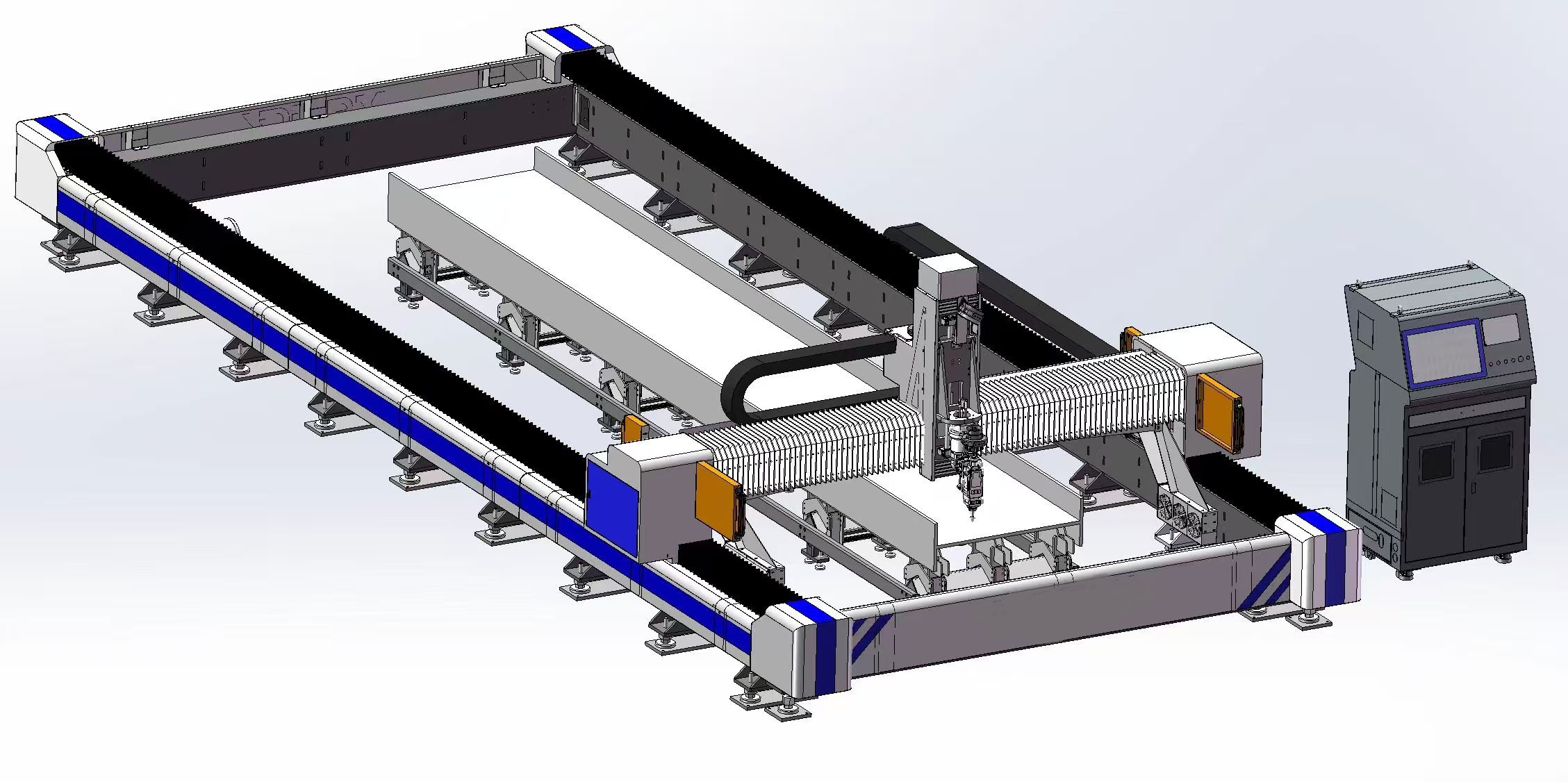
Industrial Application of H-Beam Plasma Cutter
Day 1: System Orientation and Data Ingestion
The first 24 hours of the operator learning curve focus on the physical-to-digital interface. Operators are trained on the sequence of material loading and the calibration of the laser sensing array. Unlike older generations of plasma cutters that relied on mechanical touch-probing, the modern H-Beam Plasma Cutter utilizes high-speed laser scanners to map the actual dimensions of the beam. This is vital because structural steel often possesses mill tolerances—slight bows or twists—that can deviate from the theoretical CAD model.
During the initial eight hours, the operator learns to navigate the HMI’s library of pre-defined cut profiles. The AI assists by flagging potential collisions between the torch head and the workpiece before the plasma arc is struck. By the end of the first day, the operator is capable of executing standard bolt hole patterns and straight flange cuts. The technical focus here is on “Dry Run” simulations, where the AI visualizes the Real-time Path Correction on the screen, allowing the operator to verify the cutting sequence without consuming material.
Day 2: Advanced Geometries and Optimization
The second day of training shifts from basic operation to efficiency and troubleshooting. The curriculum covers complex 4-side processing, including the execution of bevels for weld preparation. Because the AI HMI handles the Nesting Optimization Algorithms, the operator learns how to maximize material utilization. The software automatically arranges parts on a single length of beam to minimize scrap, a process that previously required hours of manual calculation.
By the afternoon of Day 2, training focuses on the “Feedback Loop.” The system’s sensors monitor the voltage and gas pressure in real-time. If the AI detects dross buildup or an inconsistent arc, it provides the operator with specific corrective actions through the HMI. This predictive maintenance aspect ensures that the operator does not need to be a maintenance engineer to keep the machine running at peak efficiency. The shift from “how to cut” to “how to optimize” is completed within the 16th hour of hands-on time.
Technical Specifications and Environmental Adaptability
In the specific context of Cali, Colombia, environmental factors such as humidity and power grid fluctuations can impact plasma stability. The H-Beam Plasma Cutter units deployed here are equipped with localized voltage stabilizers and advanced air filtration units. The AI HMI includes a “Climate Compensation” module that adjusts the arc voltage based on ambient air density and moisture levels, ensuring that the kerf width remains consistent regardless of external conditions.
From a technical data standpoint, the 6-axis robotic arm offers a repeatability of +/- 0.1mm. When integrated with the AI HMI, the system achieves a 95% reduction in layout time. In a standard 12-meter H-beam, manual layout for complex copes and holes might take a skilled fabricator 3 to 4 hours. The automated system completes the same task, including loading and unloading, in under 15 minutes. This throughput increase is the primary driver for the 18-month ROI typically seen in the Colombian market.
Economic Implications for Global Supply Chains
The ability to train an operator in 48 hours has profound implications for global B2B operations. It decouples the growth of a fabrication business from the scarcity of highly specialized CNC programmers. In regions like Cali, which serve as logistical hubs for both domestic and export markets, this allows for rapid scaling. When a large-scale project is secured, a firm can commission a new H-Beam Plasma Cutter and have a productive workforce ready by the time the first shipment of steel arrives.
Furthermore, the data logging capabilities of the AI HMI allow for total transparency in production. Every cut, every second of arc-on time, and every millimeter of gas consumed is recorded. This data is transmitted to the cloud, allowing management to analyze production costs with 99% accuracy. For global partners, this level of data-driven manufacturing provides the assurance that quality standards are being met consistently, regardless of the geographic location of the facility.
Concluding Industry Insight
The evolution of H-beam processing from a labor-intensive craft to a data-driven automated process is no longer a future projection; it is a current reality. The success of AI-integrated HMI systems in Cali, Colombia, demonstrates that the “skills gap” in manufacturing is a bridgeable chasm. As we look toward the next decade of structural steel fabrication, the competitive advantage will not be held by those with the largest manual workforce, but by those who can most rapidly integrate human operators with autonomous robotic systems. The democratization of high-precision cutting technology means that the geographic location of a fabrication shop is becoming secondary to its digital infrastructure. For the global B2B market, this signals a future where decentralized, high-efficiency production hubs can be established anywhere in the world, provided they leverage the 48-hour learning curve of AI-assisted manufacturing.
Industrial Expertise & Support
Are you looking for high-performance H-Beam Plasma Cutter tailored for the Global market? Our engineering team provides comprehensive solutions for modern manufacturing.





