Introduction: The Industrial Evolution of the Pampa Region
Buenos Aires, Argentina, has long served as the primary industrial gateway for the Southern Cone’s agricultural sector. As global demand for high-capacity agricultural machinery—such as heavy-duty planters, harvesters, and grain transport systems—increases, the manufacturing requirements for structural steel have shifted toward higher precision and enhanced metallurgical integrity. Central to this shift is the deployment of the H-Beam Plasma Cutter. This technology has become a cornerstone in the production of chassis and frames that must withstand the rigorous mechanical stresses of the Argentine Pampa. By focusing on the minimization of the Heat Affected Zone (HAZ), manufacturers in the Buenos Aires industrial corridor are significantly extending the operational lifespan of agricultural equipment destined for both domestic and international markets.
Structural Requirements of Modern Agricultural Machinery
Agricultural equipment operates in high-vibration environments, often under significant load-bearing conditions and corrosive soil exposure. The structural frames of these machines typically utilize H-beams and I-beams to provide the necessary rigidity-to-weight ratio. Traditional mechanical sawing and manual oxy-fuel cutting often result in dimensional inaccuracies or excessive thermal input, which can compromise the structural integrity of the steel. In the context of Buenos Aires’ manufacturing hubs, the transition to automated plasma cutting addresses the need for complex geometries, including bolt holes, copes, and weld preparations, executed with sub-millimeter precision.
The Technical Advantage of 5-Axis Plasma Systems
Modern H-beam processing in the region utilizes multi-axis robotic heads that allow for 360-degree rotation around the workpiece. This capability enables the H-Beam Plasma Cutter to perform intricate cuts on the web and flanges of the beam in a single pass. From a technical standpoint, this eliminates the need for multiple setups, reducing the cumulative margin of error. The integration of High-Definition Plasma technology allows for a constricted arc, which increases energy density. This results in faster cutting speeds and a narrower kerf, which are essential for maintaining the tight tolerances required for automated assembly lines.
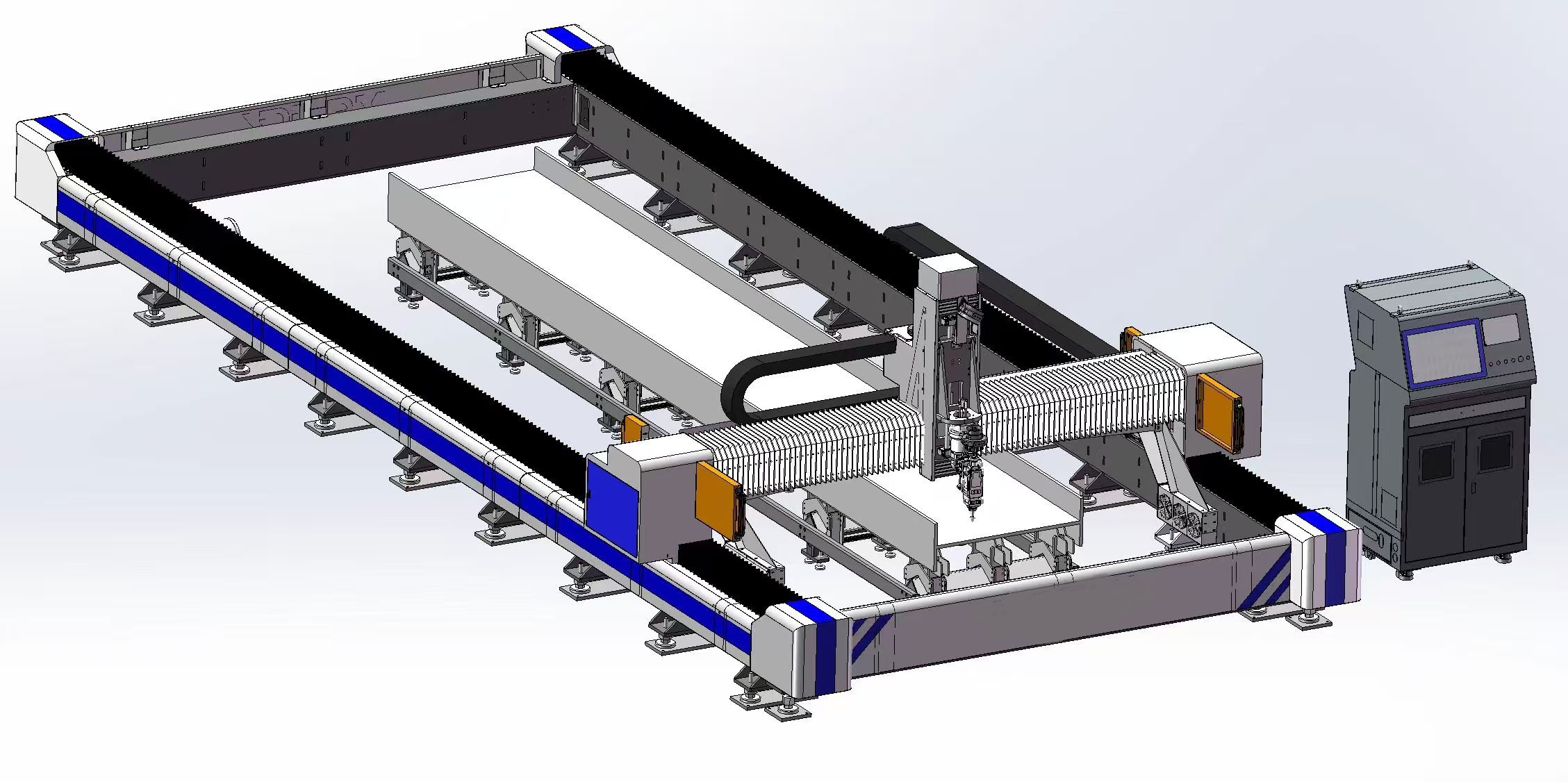
Industrial Application of H-Beam Plasma Cutter
Analyzing the Heat Affected Zone (HAZ) in Structural Steel
The Heat Affected Zone (HAZ) is the area of the base metal that has not been melted but has had its microstructure and mechanical properties altered by the intense heat of the cutting process. In high-carbon or alloy steels frequently used in agri-machinery, an oversized HAZ can lead to localized hardening, increased brittleness, and a higher susceptibility to stress-corrosion cracking. For manufacturers in Buenos Aires, controlling the HAZ is not merely a quality preference but a structural necessity.
Metallurgical Implications of Thermal Cutting
When a plasma torch traverses a steel beam, the rapid heating and subsequent cooling cycle can lead to the formation of martensite at the cut edge. Martensite is significantly harder and more brittle than the surrounding ferrite-pearlite matrix. If the HAZ is too large, the risk of fatigue failure under cyclic loading—common in field operations—increases exponentially. By utilizing small HAZ technology, which involves optimized gas mixtures and high-velocity plasma arcs, the thermal input is concentrated. This concentration ensures that the cooling rate is controlled, thereby limiting the depth of the transformed microstructure and preserving the Structural Integrity of the H-beam.
Operational Efficiency in the Buenos Aires Industrial Corridor
The adoption of advanced plasma cutting in Buenos Aires provides a distinct competitive advantage in the global supply chain. The efficiency of an H-Beam Plasma Cutter is measured not just in centimeters per minute, but in the reduction of secondary processes. Traditional methods often require post-cut grinding to remove dross or to remediate the hardened edges within the HAZ before welding can occur. High-definition plasma systems produce a surface finish that is often weld-ready, directly impacting the throughput of the fabrication facility.
Integration with CAD/CAM and BIM Software
The technical ecosystem in Argentina’s capital increasingly relies on the seamless flow of data from design to execution. H-Beam Plasma Cutter systems are typically integrated with Building Information Modeling (BIM) and specialized CAD/CAM software. This allows for the direct nesting of parts onto structural members, minimizing material waste—a critical factor given the fluctuating costs of raw steel. The precision of these cuts ensures that during the assembly of large-scale grain silos or complex harvester frames, the fit-up is exact, which reduces residual stresses during the welding phase.
Impact on Agri-Machinery Longevity
The longevity of agricultural machinery is a primary metric for Return on Investment (ROI) for global end-users. A frame that utilizes H-beams processed with minimal thermal distortion will exhibit superior resistance to the torsional forces encountered in uneven terrain. Because the small HAZ technology preserves the original tensile strength and ductility of the steel at the connection points, the overall frame becomes more resilient to crack initiation and propagation. This is particularly vital for equipment that must operate for decades in the demanding environments of the Southern Hemisphere.
Concluding Industry Insight
The industrial landscape of Buenos Aires is demonstrating that the future of heavy machinery manufacturing lies in the intersection of high-energy physics and structural engineering. The move toward H-Beam Plasma Cutter technology represents a departure from “bulk fabrication” toward “precision metallurgy.” As the global agricultural sector demands larger, more complex, and more durable machinery, the ability to control the microscopic properties of steel at the macro-cutting stage will be the defining factor of market leadership. The focus on small HAZ technology is not just a technical refinement; it is a strategic commitment to the structural reliability of the global food production infrastructure. Manufacturers who prioritize these metallurgical parameters today are setting the standard for the next generation of industrial durability.
Industrial Expertise & Support
Are you looking for high-performance H-Beam Plasma Cutter tailored for the Global market? Our engineering team provides comprehensive solutions for modern manufacturing.





