Introduction to Structural Steel Processing in Bogotá
The industrial landscape of Bogotá, Colombia, has undergone a significant transformation, driven by the increasing demand for complex infrastructure and high-rise commercial developments. As the logistical heart of the Andean region, Bogotá serves as a critical hub for structural steel fabrication. The transition from manual layout and mechanical sawing to automated thermal cutting is dictated by the requirement for higher throughput and tighter dimensional tolerances. At the center of this transition is the H-Beam Plasma Cutter, a specialized CNC system designed to handle the multi-axial demands of structural profiles including H-beams, I-beams, and channels. This technical analysis explores the integration of 4-chuck stability systems and their impact on the structural integrity and production efficiency of heavy steel components in the Colombian market.
The Mechanics of 4-Chuck Stability
Traditional beam processing often utilizes a two-chuck or three-chuck configuration. However, when dealing with heavy-duty structural steel that exceeds lengths of 12 meters and weights of several tons, mechanical deflection becomes a primary concern. The 4-chuck system addresses this by providing continuous support throughout the entire cutting cycle. In this configuration, two chucks act as the primary feeding and rotating units, while the auxiliary chucks provide stabilizing counter-pressure and material guiding.
This 4-Chuck Stability mechanism ensures that the longitudinal axis of the H-beam remains perfectly aligned with the plasma torch’s coordinate system. By eliminating “tailing” or material sag at the end of the stock, the system achieves a zero-waste cutting capability. For fabricators in Bogotá, where material costs are influenced by international shipping and fluctuating steel prices, the ability to utilize the entire length of a beam without leaving unusable remnants provides a direct advantage in project bidding and cost management.
Precision Engineering and Dimensional Accuracy
In structural engineering, specifically under the NSR-10 (Norma Sismo Resistente) standards prevalent in Colombia, the precision of bolt holes and cope cuts is non-negotiable. A 4-chuck H-Beam Plasma Cutter utilizes sophisticated CNC algorithms to compensate for the inherent irregularities found in hot-rolled steel. H-beams are rarely perfectly straight; they often possess slight bows or twists from the mill.
The 4-chuck system uses laser detection and mechanical sensors to map the beam’s actual profile in real-time. The software then adjusts the cutting path to ensure that every flange and web penetration is positioned relative to the beam’s center of gravity rather than its theoretical geometry. Technical data indicates that 4-chuck systems maintain a positioning accuracy of ±0.2mm over a 10-meter span, significantly outperforming the ±1.5mm tolerance typically found in manual or 2-chuck alternatives.
Thermal Dynamics and Plasma Source Integration
The efficiency of an H-Beam Plasma Cutter is heavily dependent on the power source and the management of the Heat Affected Zone (HAZ). For heavy structural steel, high-definition plasma sources—typically ranging from 200 to 400 amps—are required to penetrate thicknesses of up to 50mm on the flange. The 4-chuck system facilitates optimal torch positioning, maintaining a constant standoff distance via voltage control sensors.
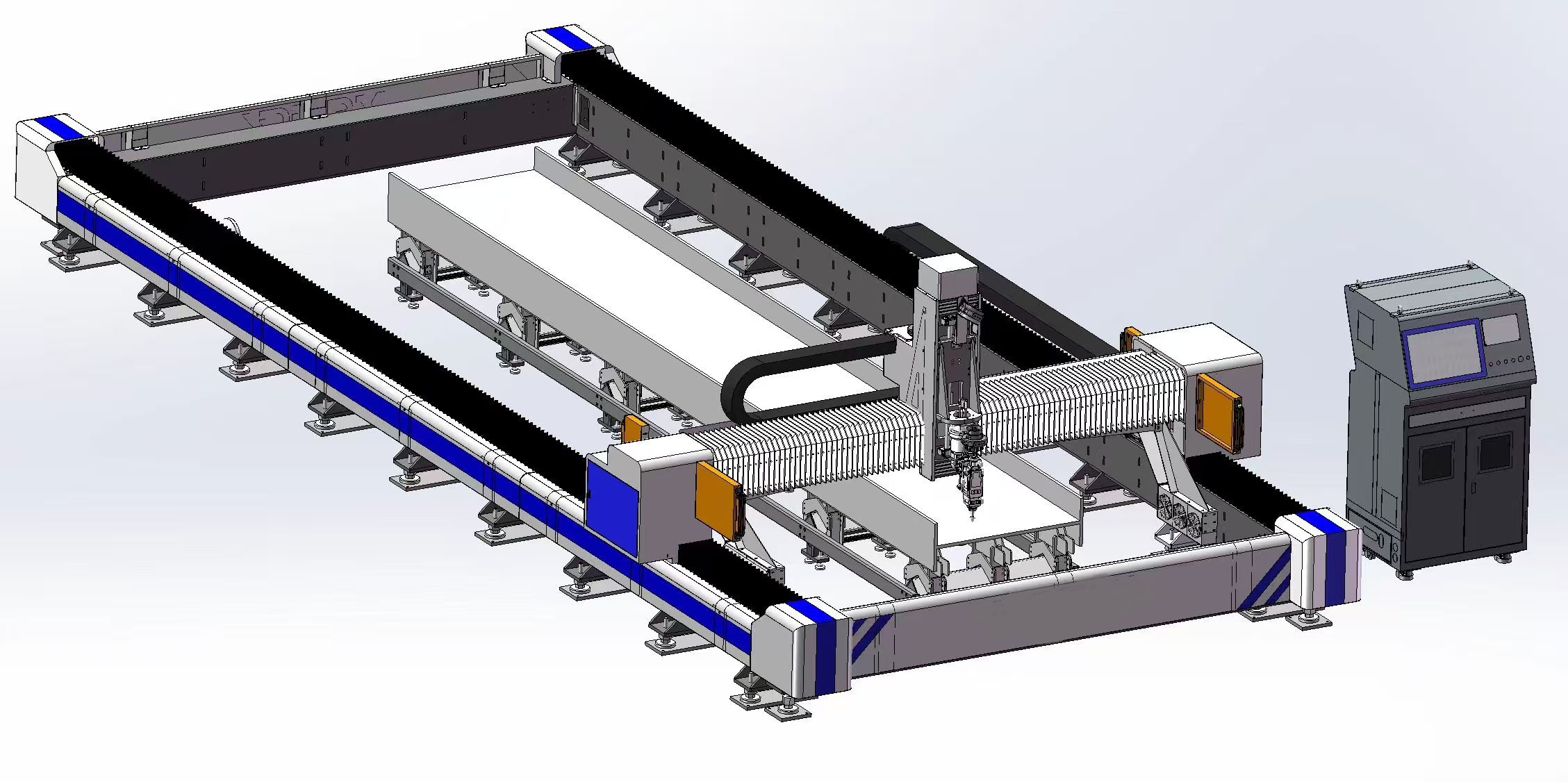
Industrial Application of H-Beam Plasma Cutter
By maintaining a precise 90-degree or specified bevel angle (up to 45 degrees for weld preparation), the system ensures that the thermal energy is concentrated. This concentration minimizes the HAZ, preserving the metallurgical properties of the ASTM A36 or A572 Grade 50 steel commonly used in Bogotá’s construction sector. Minimizing the HAZ is critical for structural members subject to fatigue and seismic loading, as excessive heat can lead to embrittlement and potential failure points at the connection nodes.
Operational Throughput in the Bogotá Industrial Corridor
The industrial zones of Fontibón and Puente Aranda require high-volume output to meet the timelines of national infrastructure projects. The 4-chuck H-Beam Plasma Cutter streamlines the workflow by integrating multiple processes into a single workstation. Tasks that previously required separate stations—such as measuring, marking, drilling, coping, and beveling—are executed in a single pass.
Data from local fabrication facilities suggests that the implementation of automated 4-chuck plasma cutting reduces labor hours per ton by approximately 60% to 75%. Furthermore, the integration of TEKLA or AutoCAD software allows for direct “BIM to Machine” workflows. This digital continuity eliminates manual data entry errors and ensures that the physical component matches the structural model with absolute fidelity, a requirement that is becoming standard in international Structural Steel Fabrication contracts.
Maintenance and Environmental Considerations
Operating heavy machinery in the high-altitude environment of Bogotá (2,640 meters above sea level) presents unique challenges, particularly regarding cooling systems and air density for plasma gas ionization. The 4-chuck systems are engineered with robust dust extraction and filtration units to manage the high volume of particulate matter generated during the thermal cutting of heavy sections.
The mechanical longevity of the 4-chuck design is superior to lighter configurations because the load is distributed across more contact points. This reduces the wear on individual bearings and drive motors. For B2B stakeholders, this translates to a lower Total Cost of Ownership (TCO) and extended intervals between scheduled maintenance, ensuring that production lines remain operational during peak project cycles.
Concluding Industry Insight
As the global construction industry moves toward modular and prefabricated steel structures, the demand for precision-cut components will only intensify. In regions like Bogotá, the adoption of 4-chuck CNC Plasma Cutting Technology represents more than just an incremental upgrade in machinery; it signifies a shift toward data-driven manufacturing. The ability to guarantee the stability of heavy profiles during the cutting process is the foundational requirement for the next generation of smart factories.
The future of structural steel processing lies in the intersection of mechanical stability and digital integration. Fabricators who invest in 4-chuck stability systems are not merely purchasing a cutter; they are implementing a quality control standard that mitigates the risks associated with structural failure and project delays. As urban density increases and seismic regulations become more stringent, the technical superiority of the 4-chuck H-Beam Plasma Cutter will become the benchmark for excellence in the global structural steel market.
Industrial Expertise & Support
Are you looking for high-performance H-Beam Plasma Cutter tailored for the Global market? Our engineering team provides comprehensive solutions for modern manufacturing.





