Industrial Synthesis: The Role of Antofagasta in High-Precision Structural Fabrication
Antofagasta, Chile, has traditionally been recognized as a global epicenter for copper mining operations. However, the region is currently undergoing a secondary industrial evolution, transitioning into a sophisticated hub for heavy machinery manufacturing and structural steel processing. At the center of this transition is the deployment of advanced thermal cutting technologies designed to meet the rigorous demands of the South American agricultural and mining sectors. The integration of the H-Beam Plasma Cutter into local fabrication workflows represents a significant leap in metallurgical precision, specifically addressing the critical requirement for minimizing the Heat Affected Zone (HAZ) in structural components.
For the agricultural machinery industry, longevity is not merely a marketing metric but a function of structural integrity under cyclic loading. Equipment such as heavy-duty harvesters, seeders, and transport frames are subjected to extreme mechanical stresses and corrosive environments. The move toward localized, high-tech fabrication in Antofagasta allows for the production of chassis and frames that exhibit superior fatigue resistance, primarily through the control of thermal inputs during the manufacturing phase.
The Technical Impact of the Heat Affected Zone on Structural Steel
The Heat Affected Zone is the area of base metal which has not been melted, but whose mechanical properties and microstructure have been altered by the heat of cutting or welding. In traditional oxy-fuel cutting, the HAZ can be extensive, often leading to a significant reduction in the yield strength and toughness of the H-beam. When fabricating agricultural machinery, a wide HAZ becomes a localized point of failure. The thermal cycle causes metallurgical transformation, often resulting in increased hardness and brittleness, which facilitates crack initiation during field operations.
Modern plasma cutting systems utilized in Antofagasta employ high-definition (HD) plasma technology. These systems utilize a constricted arc with a higher energy density than standard plasma or oxy-fuel. By increasing the cutting speed and narrowing the plasma arc, the total heat input into the H-beam is drastically reduced. This results in an HAZ that is up to 50 percent smaller than that produced by conventional methods. For structural steel grades like ASTM A36 or high-strength low-alloy (HSLA) steels commonly used in agri-machinery, maintaining a narrow HAZ ensures that the original grain structure of the steel remains largely intact, preserving the design-specified tensile strength and ductility.
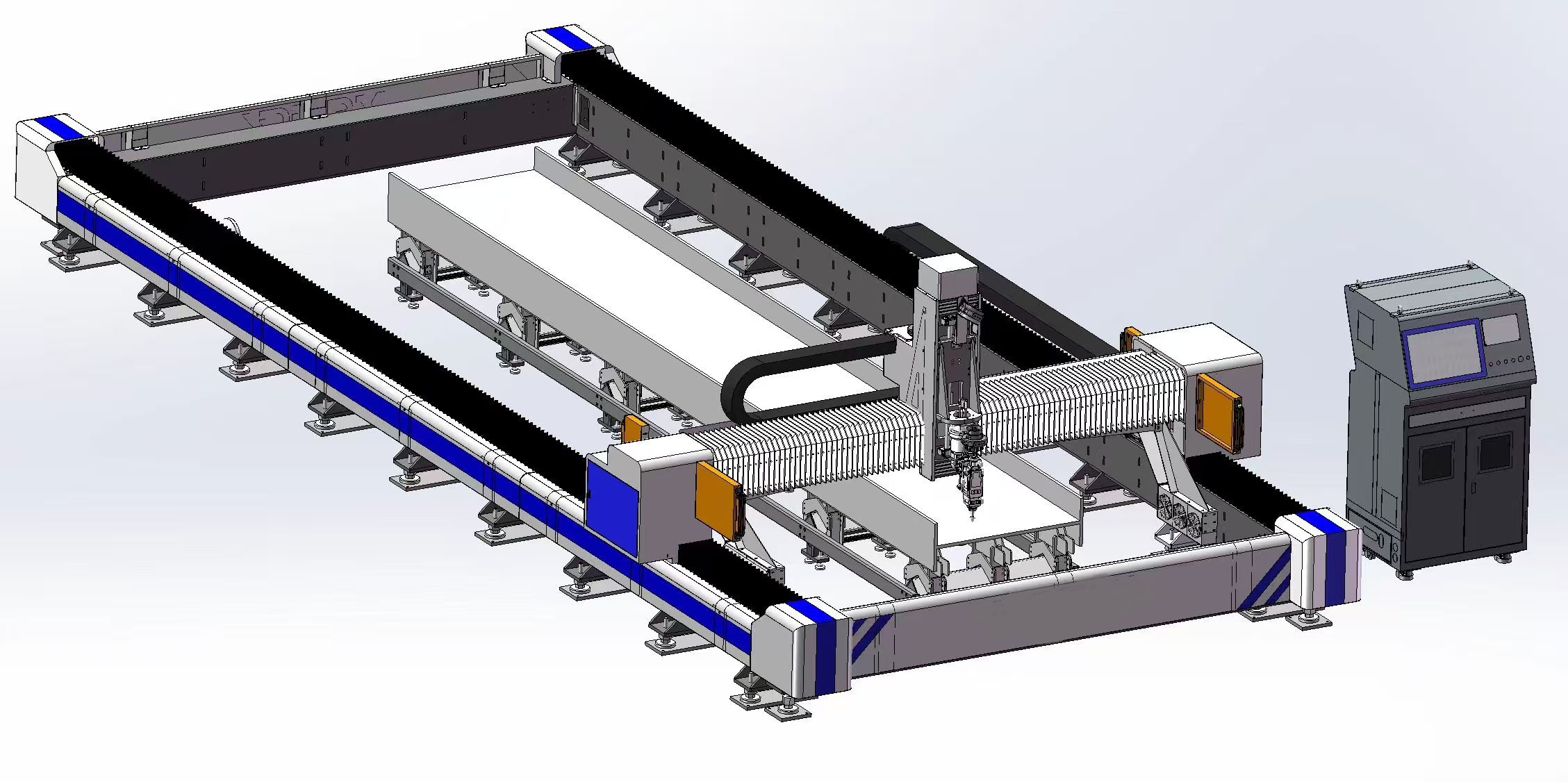
Industrial Application of H-Beam Plasma Cutter
Robotic Integration and 3D Profiling in H-Beam Processing
The H-Beam Plasma Cutter units currently being deployed are not simple linear cutting tools; they are multi-axis robotic cells capable of complex 3D profiling. In the context of Antofagasta’s industrial output, these machines are utilized to execute bolt holes, copes, notches, and weld preparations in a single pass. The precision of robotic motion control, often calibrated to within tenths of a millimeter, ensures that the structural geometry of the H-beam is maintained without the need for secondary mechanical finishing.
A critical component of this technology is the use of sophisticated sensing systems. Before the plasma torch is ignited, the machine performs a laser scan of the H-beam profile. Structural steel often possesses slight dimensional variances or “mill tolerances” such as web off-center or flange tilt. The software compensates for these variances in real-time, adjusting the cutting path to ensure that every cut is mathematically aligned with the center of the beam. This level of accuracy is vital for agricultural machinery frames, where the alignment of hydraulic cylinders and rotating shafts depends on the absolute squareness of the structural skeleton.
Optimizing Agri-Machinery Longevity Through Advanced Metallurgy
Agricultural machinery operates in environments characterized by high vibration and varying soil resistance. These conditions necessitate structural steel fabrication that can withstand high-cycle fatigue. When an H-beam is cut with a minimized HAZ, the transition zone between the cut edge and the base metal is less prone to the formation of martensite—a hard, brittle phase of steel that occurs during rapid cooling from high temperatures.
By utilizing specialized gas mixtures, such as Oxygen-Oxygen or Argon-Hydrogen, the plasma systems in Antofagasta can achieve a “cool” cut edge. This reduces the risk of edge cracking, which is a common failure mode in agricultural equipment subjected to torsional stress. Furthermore, a smaller HAZ improves the quality of subsequent welding processes. When the edge chemistry of the H-beam is preserved, the weld pool remains stable, resulting in deeper penetration and a stronger molecular bond. This synergy between precision cutting and high-quality welding directly translates to a longer service life for the machinery, reducing the Total Cost of Ownership (TCO) for end-users in the global agricultural market.
Antofagasta as a Strategic Hub for Global Supply Chains
The geographic location of Antofagasta provides a strategic advantage for the distribution of these high-tech structural components. With direct access to major Pacific shipping routes, the region can serve as a primary supplier for agricultural manufacturers in Australia, North America, and Southeast Asia. The ability to export pre-processed, high-precision H-beams that are “ready-to-assemble” allows global OEMs (Original Equipment Manufacturers) to bypass the high capital expenditure of installing their own robotic plasma lines.
The local expertise in Antofagasta has matured through decades of servicing the mining industry, which demands zero-failure components. This culture of precision has naturally migrated into the agricultural sector. The integration of ISO-certified quality control measures with H-Beam Plasma Cutter technology ensures that every component leaving the Chilean facilities meets international standards for structural integrity and dimensional tolerance.
Industry Insight: The Shift Toward Thermal Precision
The global manufacturing landscape is witnessing a definitive shift away from “mass-production” toward “precision-production.” In the realm of structural steel, the era of oversized, heavy frames is being replaced by optimized, high-strength designs that prioritize weight reduction without sacrificing durability. This optimization is only possible when the fabrication process can guarantee the preservation of material properties.
The development of small-HAZ technology is the cornerstone of this shift. As agricultural machinery becomes larger and more automated, the stresses placed on the structural frame increase exponentially. Engineers can no longer afford the “safety margins” required to compensate for the damage caused by imprecise, high-heat cutting methods. The data indicates that components processed with high-definition plasma exhibit a 15-20 percent increase in fatigue life compared to those processed with traditional oxy-fuel.
Concluding, the industrial complex in Antofagasta is setting a benchmark for how regional hubs can leverage specific technological advancements—like the H-Beam Plasma Cutter—to influence global machinery standards. The focus on minimizing thermal impact is not merely a technical preference; it is a fundamental requirement for the next generation of high-performance, long-lived industrial assets. As global demand for efficient food production grows, the reliability of the machinery used to cultivate and harvest will depend increasingly on the metallurgical precision established during the primary fabrication phase.
Industrial Expertise & Support
Are you looking for high-performance H-Beam Plasma Cutter tailored for the Global market? Our engineering team provides comprehensive solutions for modern manufacturing.





