Precision Structural Fabrication in the Mining Hub of Antofagasta
Antofagasta, Chile, serves as the primary logistical and industrial nexus for the global copper mining industry. The region’s harsh environmental conditions and the scale of its infrastructure projects demand structural steel components that meet rigorous mechanical standards. In this high-stakes environment, the integration of the H-Beam Plasma Cutter has redefined the parameters of throughput and precision. By automating the complex geometries required for structural joints, fabricators in the Atacama region are addressing the critical need for high-strength connections in seismic zones.
The transition from manual layout and mechanical sawing to automated robotic plasma cutting represents a significant leap in metallurgical integrity. In large-scale mining infrastructure, such as conveyor supports, processing plant frameworks, and heavy-duty storage facilities, the accuracy of the structural fit-up is the primary determinant of project longevity. The deployment of multi-axis plasma systems allows for the execution of complex cuts on heavy profiles with a degree of repeatability that manual processes cannot replicate.
The Technical Necessity of 45-Degree Beveling
In structural engineering, the strength of a welded joint is often dependent on the depth of fusion. For H-beams and I-beams subjected to dynamic loads, full-penetration welding is frequently a non-negotiable requirement. Achieving this level of penetration requires precise edge preparation, specifically the creation of V-groove or Y-groove geometries. The 45-degree beveling capability of modern plasma systems is the industry standard for facilitating these high-strength bonds.
When a plasma torch executes a 45-degree bevel, it creates the necessary volume for the weld filler metal to penetrate the root of the joint. In Antofagasta’s industrial sector, where structures must withstand both heavy vibrations and potential seismic activity, the uniformity of this bevel is critical. Variations of even a few degrees can lead to incomplete fusion or excessive weld volume, both of which introduce structural vulnerabilities and increase consumable costs. Automated beveling ensures that the root face and the bevel angle remain constant across the entire flange or web of the beam.
Robotic Kinematics and 8-Axis Motion Control
The execution of a 45-degree bevel on an H-beam is significantly more complex than a standard perpendicular cut. It requires the coordination of multiple planes of movement. High-end systems utilize 8-axis robotic movement to navigate the interior and exterior surfaces of the beam. This includes the longitudinal movement along the rail (X-axis), the transverse movement (Y-axis), the vertical adjustment (Z-axis), and the rotational and tilting movements of the robotic wrist (A/B/C axes).
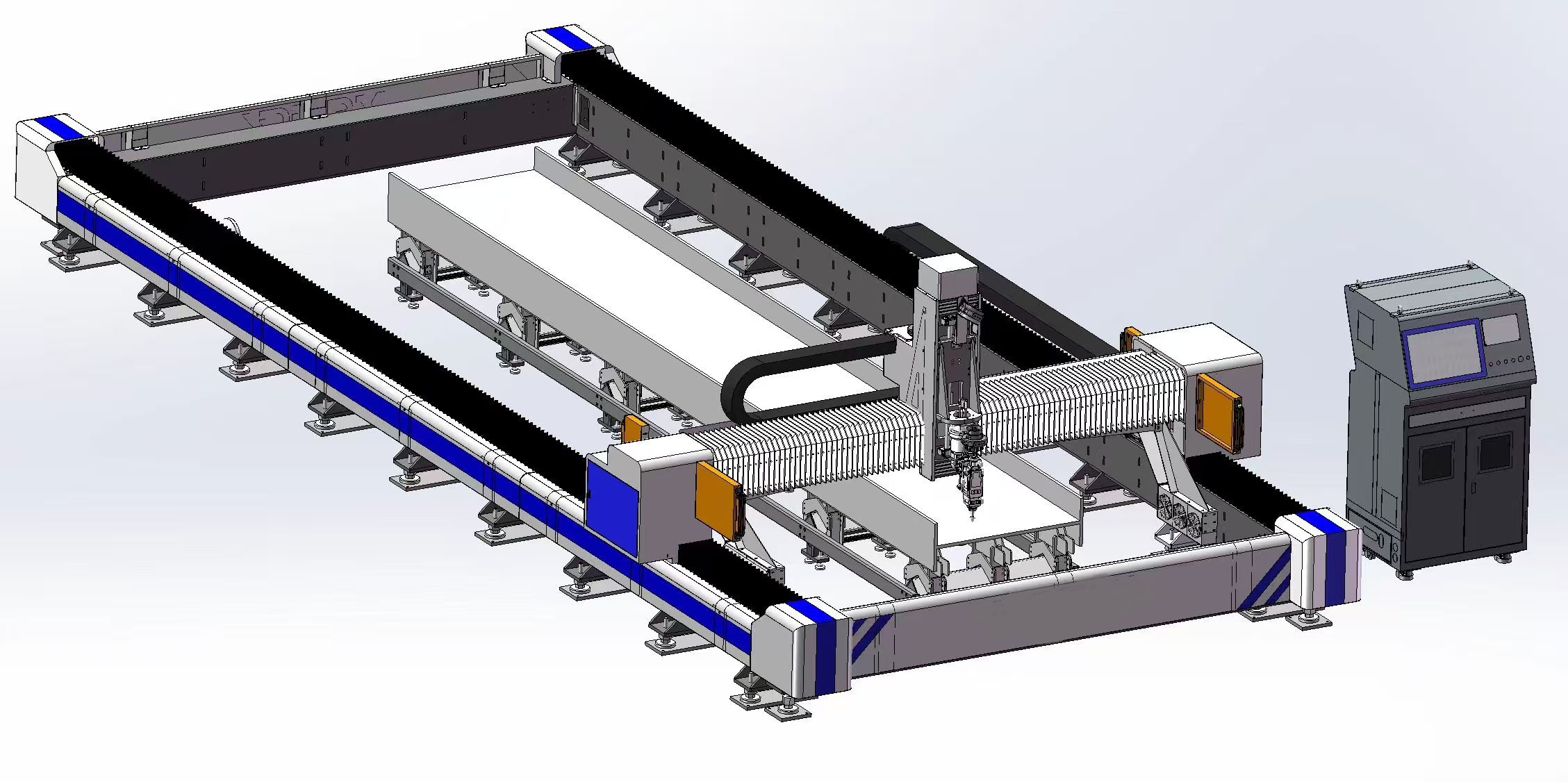
Industrial Application of H-Beam Plasma Cutter
This multi-axis synchronization allows the torch to maintain a constant distance from the workpiece, which is vital for voltage regulation and arc stability. In the context of Antofagasta’s fabrication shops, these robotic systems compensate for material deviations. Even high-quality steel beams may have slight twists or bows; advanced sensors and laser probing systems map the actual profile of the beam in real-time, adjusting the cutting path to ensure the bevel angle is relative to the beam’s surface rather than a theoretical coordinate system.
Optimizing the Heat-Affected Zone (HAZ)
A primary concern in plasma cutting is the thermal impact on the base metal. The Heat-Affected Zone (HAZ) is the area of the steel that has not been melted but has had its microstructure and properties altered by the heat of the cutting process. In high-tensile steel commonly used in mining, an excessive HAZ can lead to local hardening or embrittlement, which may cause cracking during the welding phase or under operational stress.
Modern H-beam plasma cutters utilized in the Chilean market employ high-definition plasma technology. By narrowing the plasma arc and increasing the energy density, these systems achieve faster cutting speeds. This increased velocity reduces the total heat input into the material, thereby narrowing the HAZ. When preparing a 45-degree bevel, the ability to control the gas flow (using mixtures such as Oxygen/Air or Argon/Hydrogen) further refines the edge quality, resulting in a dross-free surface that requires minimal post-cut grinding before welding begins.
Integration with BIM and CNC Workflows
The efficiency of the plasma cutting process in Antofagasta is further enhanced by its integration into the digital thread. Building Information Modeling (BIM) software generates complex structural designs that are exported directly to the plasma cutter’s CNC interface. This eliminates the manual transcription of measurements, which is a frequent source of error in structural fabrication.
The software automatically calculates the necessary kerf compensation for beveled cuts. Because a 45-degree cut passes through more material than a 90-degree cut, the CNC must adjust the torch speed and gas pressure to maintain a clean edge. This level of automation allows fabricators to move from raw material to a weld-ready component in a single handling cycle, drastically reducing the lead times for critical mining infrastructure projects.
Economic Impact on Global Supply Chains
From a B2B perspective, the adoption of advanced plasma cutting technology in northern Chile has broad implications for the global supply chain. By localizing high-precision fabrication, mining companies can reduce their reliance on imported pre-fabricated components. This not only lowers logistics costs but also allows for rapid on-site adjustments to structural designs as geological or engineering requirements evolve during a project’s lifecycle.
Furthermore, the reduction in labor hours per ton of steel is substantial. Manual beveling of an H-beam flange can take hours of skilled labor with a handheld torch and a grinder. An automated system can complete the same task in minutes with superior accuracy. This efficiency gain is essential for maintaining the competitiveness of Chilean fabrication firms in the international market, particularly as they bid on large-scale astronomical and energy projects in the region.
Industry Insight: The Future of Autonomous Fabrication
The trajectory of structural steel fabrication is moving toward total process autonomy. In the coming decade, we expect to see the integration of artificial intelligence with plasma cutting systems to predict consumable wear and optimize nesting patterns even further. For regions like Antofagasta, which face extreme environmental variables, the shift toward robotic systems that can operate with minimal human intervention in dust-heavy or high-UV environments is a matter of operational resilience.
The 45-degree bevel is more than a geometric requirement; it is a symbol of the precision-first approach that is becoming mandatory in heavy industry. As welding standards become more stringent and structural designs more complex, the ability to produce seamless, weld-ready edges on demand will be the dividing line between Tier 1 fabricators and the rest of the market. The investment in high-degree-of-freedom plasma systems is no longer an optional upgrade but a fundamental requirement for participation in the global industrial economy.
Industrial Expertise & Support
Are you looking for high-performance H-Beam Plasma Cutter tailored for the Global market? Our engineering team provides comprehensive solutions for modern manufacturing.





