Industrial Integration of Fiber Laser Welder Technology in Valparaíso, Chile
The industrial landscape of Valparaíso, Chile, is characterized by a high concentration of maritime engineering, port logistics, and heavy manufacturing. As global supply chains demand higher precision and lower operational costs, the transition from traditional gas-tungsten arc welding (GTAW) and metal inert gas (MIG) systems to advanced laser-based solutions has become a strategic necessity. Central to this transition is the Fiber Laser Welder, a tool that utilizes a solid-state laser source to provide high-density thermal energy for material fusion.
Valparaíso’s unique position as a primary Pacific gateway necessitates equipment that can withstand maritime atmospheric conditions while maintaining high throughput. The implementation of energy-efficient fiber source technology represents a shift toward sustainable industrial practices, reducing the carbon footprint of large-scale fabrication while significantly increasing the Wall-Plug Efficiency (WPE) of manufacturing facilities.
Technical Architecture of Energy-Efficient Fiber Sources
The core of modern fiber laser systems lies in the ytterbium-doped fiber source. Unlike CO2 lasers that rely on gas mixtures and complex mirror alignments, fiber lasers generate the beam within an optical fiber doped with rare-earth elements. This architecture allows for a monolithic design, eliminating the risk of internal contamination and reducing the need for frequent recalibration.
From a technical standpoint, the energy efficiency of these systems is measured by their Wall-Plug Efficiency. Traditional CO2 lasers often operate at a WPE of 8 percent to 12 percent. In contrast, fiber laser sources used in Valparaíso’s industrial sectors achieve efficiencies between 35 percent and 45 percent. This efficiency is achieved through superior optical-to-optical conversion. Diode pumping at specific wavelengths—typically around 915 nm or 976 nm—excites the ytterbium ions, which then emit photons at a wavelength of approximately 1070 nm. This narrow wavelength is ideal for absorption by metallic substrates, including stainless steel, carbon steel, and highly reflective materials like aluminum and copper.
Precision Control and the Heat-Affected Zone (HAZ)
One of the most critical metrics in B2B metal fabrication is the minimization of the Heat-Affected Zone (HAZ). In Valparaíso’s shipyards and repair facilities, structural integrity is paramount. Conventional welding methods introduce significant thermal stress into the workpiece, leading to grain growth and potential embrittlement of the metal surrounding the weld bead.
The Fiber Laser Welder operates with a high power density, often exceeding megawatts per square centimeter. This concentration allows for “keyhole” welding, where the laser creates a vapor cavity that penetrates deep into the material. Because the energy is so localized, the total heat input is a fraction of what is required for arc welding. The resulting Heat-Affected Zone (HAZ) is exceptionally narrow, preserving the mechanical properties of the base metal and reducing post-weld distortion. For technical applications involving thin-gauge materials or precision sensors, this thermal control is indispensable.
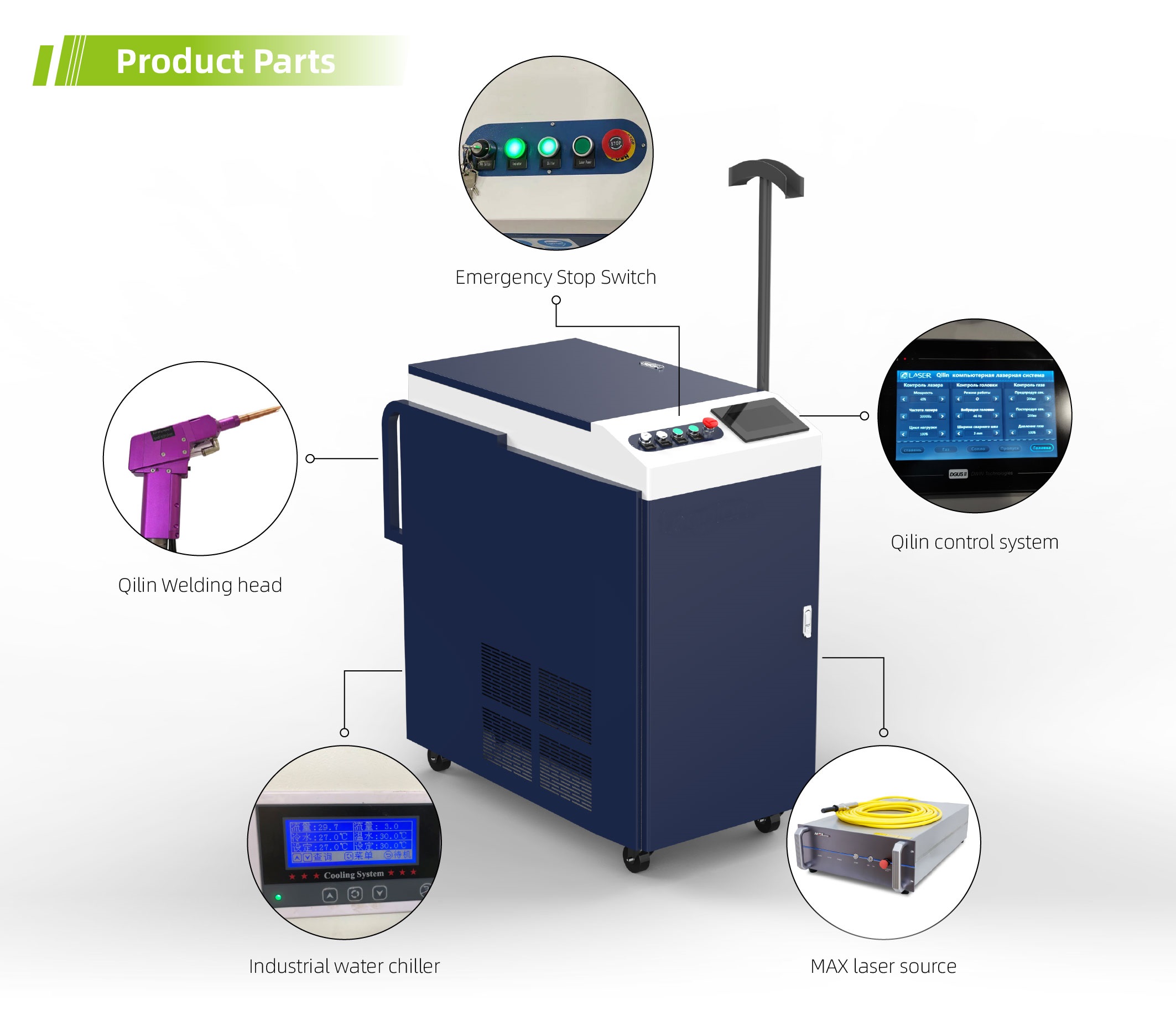
Industrial Application of Fiber Laser Welder
Beam Quality and Beam Parameter Product (BPP)
The performance of a laser welder is fundamentally defined by its beam quality, quantified by the Beam Parameter Product (BPP). BPP is the product of the laser beam’s smallest radius (the beam waist) and its half-angle divergence. A lower BPP indicates a beam that can be focused to a smaller spot size over a longer working distance.
Fiber sources are engineered to provide near-diffraction-limited beam quality. For B2B operations in Valparaíso, this translates to greater flexibility in optical head configurations. Whether utilizing a fixed focus head or a wobble-head galvanometer, the high-quality beam ensures consistent penetration depth and bead morphology. In automated environments, this consistency allows for tighter tolerances in CNC programming and robotic pathing, ensuring that every joint meets rigorous ISO and AWS standards for industrial safety.
Economic Impact and Operational Expenditures (OPEX)
For Chilean enterprises, the adoption of fiber laser technology is driven by the total cost of ownership (TCO). While the initial capital expenditure (CAPEX) for a fiber system may exceed that of traditional welders, the reduction in operational expenditures (OPEX) provides a rapid return on investment. The energy-efficient nature of the fiber source reduces electricity consumption by up to 70 percent compared to legacy systems.
Furthermore, the maintenance requirements of a Fiber Laser Welder are minimal. The absence of discharge electrodes, high-voltage power supplies, and internal mirrors means that the Mean Time Between Failures (MTBF) often exceeds 100,000 hours for the pump diodes. In the high-demand environment of Valparaíso’s port-side manufacturing, where downtime results in significant financial penalties, the reliability of solid-state fiber technology is a critical competitive advantage.
Material Versatility in Maritime and Heavy Industry
Valparaíso’s industrial base frequently handles diverse alloys. Traditional welding often struggles with the high thermal conductivity of aluminum or the high reflectivity of copper. Fiber lasers, operating at the 1.07-micron wavelength, are highly absorbed by these non-ferrous metals. This allows for stable processing of marine-grade aluminum alloys used in vessel construction and copper components used in electrical infrastructure.
The ability to toggle between continuous wave (CW) and pulsed modes allows engineers to tailor the energy delivery to the specific metallurgical requirements of the task. Pulsed mode is particularly effective for heat-sensitive components, providing high peak power for penetration while allowing the material to cool between pulses, further refining the microstructure of the weld joint.
Safety and Environmental Standards
Integration of fiber laser technology in Chile must also adhere to strict safety and environmental regulations. Fiber laser beams are invisible to the human eye and pose significant ocular risks. Therefore, the implementation of Class 1 laser enclosures and interlocked safety systems is standard for B2B installations in the region. From an environmental perspective, the high efficiency of the fiber source aligns with global initiatives to reduce industrial energy waste. By minimizing the need for filler wire and shielding gas in many applications, the process also reduces the consumption of raw materials and the emission of welding fumes, improving the air quality within the fabrication facility.
Industry Insight: The Future of Fiber Integration
The trajectory of laser welding technology is moving toward increased autonomy and real-time process monitoring. As Valparaíso continues to modernize its industrial infrastructure, the integration of Artificial Intelligence (AI) and machine learning with fiber laser systems will become the next standard. These systems will utilize coaxial sensors to monitor the melt pool in real-time, automatically adjusting power and feed rate to compensate for fit-up variations.
The shift toward energy-efficient fiber sources is not merely a trend but a fundamental evolution in material science and mechanical engineering. For the global B2B market, the data is clear: the transition to fiber-based systems offers a level of precision, efficiency, and reliability that traditional methods cannot match. As Valparaíso positions itself as a technological hub in the Southern Hemisphere, the Fiber Laser Welder will remain at the forefront of this industrial resurgence, providing the technical foundation for the next generation of infrastructure and maritime excellence.
Industrial Expertise & Support
Are you looking for high-performance Fiber Laser Welder tailored for the Global market? Our engineering team provides comprehensive solutions for modern manufacturing.





