Precision Engineering in the Heartland of Brazilian Industry: The Rise of Fiber Laser Welding
São Paulo has long served as the industrial engine of South America, particularly within the specialized sector of agricultural machinery manufacturing. As global demand for high-yield farming increases, the mechanical requirements for harvesters, planters, and tillage equipment have shifted toward higher-strength alloys and more complex geometries. Traditional joining methods, such as Metal Inert Gas (MIG) or Tungsten Inert Gas (TIG) welding, are increasingly meeting their physical limits regarding thermal management and structural integrity. The integration of the Fiber Laser Welder into the production lines of São Paulo’s industrial clusters represents a significant technical pivot toward mitigating the deleterious effects of excessive heat input during the fabrication process.
The agricultural environment in Brazil, characterized by highly abrasive soils and high-intensity duty cycles, demands machinery that can withstand significant cyclical loading. In this context, the longevity of a component is not merely a function of the base material’s strength but is dictated by the integrity of its welded joints. The adoption of fiber laser technology allows manufacturers to achieve deep penetration with minimal energy expenditure, directly addressing the primary cause of premature mechanical failure: the alteration of the metal’s crystalline structure through heat.
Analyzing the Technical Impact of the Heat Affected Zone (HAZ)
In traditional arc welding, the substantial energy required to melt the filler material results in a wide Heat Affected Zone (HAZ). This is the area of the base metal that has not been melted but has had its microstructure and mechanical properties altered by the intense heat of the welding process. In high-strength low-alloy (HSLA) steels commonly used in Brazilian agri-machinery, a large HAZ often leads to grain coarsening and the formation of brittle phases, such as untempered martensite. This localized degradation significantly reduces the fatigue resistance of the component.
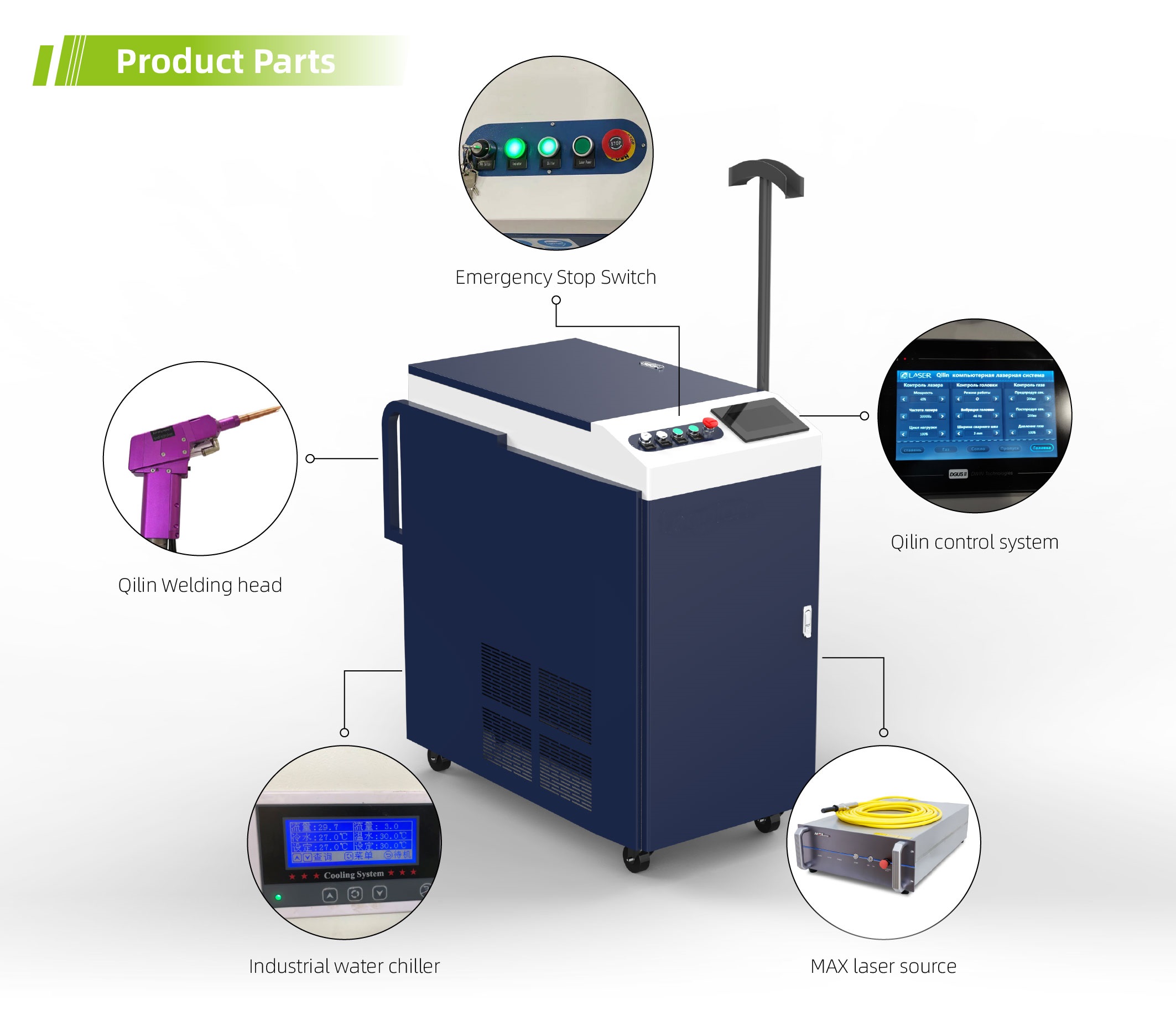
Industrial Application of Fiber Laser Welder
The Fiber Laser Welder utilizes a high-intensity, coherent light beam to create a concentrated heat source. This concentration enables a “keyhole” welding mode, where the energy is focused into a small diameter, resulting in a weld pool with a high aspect ratio (depth-to-width). Because the energy is so localized, the total heat input into the workpiece is a fraction of that required for arc welding. Consequently, the HAZ is narrowed by up to 80%, preserving the original mechanical properties of the engineered steel and ensuring that the joint does not become a point of structural divergence under field stress.
Material Science and Thermal Conductivity in Heavy Machinery
Agri-machinery components are often subjected to varying thermal conductivity challenges. For instance, the transition from thick structural plates to thinner gauge hydraulic supports requires precise thermal control to prevent warping. Traditional welding methods often result in thermal distortion, necessitating post-weld straightening processes that introduce residual stresses into the frame. Fiber laser systems, through their high power density, allow for faster travel speeds, which minimizes the time the material spends at critical phase-transformation temperatures.
By maintaining the microstructural degradation at a negligible level, the fiber laser process ensures that the yield strength of the assembly remains uniform. This is particularly vital for the sugar cane harvesters manufactured in the interior of São Paulo state, where machines operate in 24-hour cycles. The reduction in residual stress achieved via small HAZ technology translates directly into a higher threshold for stress-corrosion cracking, a common failure mode in equipment exposed to fertilizers and fluctuating environmental moisture.
Operational Efficiency and the Keyhole Welding Mechanism
The technical superiority of the fiber laser also stems from the keyhole welding mechanism. In this state, the laser beam vaporizes a small amount of metal, creating a vapor cavity that allows the laser energy to be absorbed deep into the thickness of the joint. This is fundamentally different from the conduction-mode welding seen in traditional processes, where heat must travel from the surface downward. The keyhole effect allows for single-pass welding of thick plates (up to 12mm or more depending on laser power), which eliminates the need for multi-pass arc welding and the associated risk of inter-pass inclusions or porosity.
Furthermore, the high beam quality of fiber lasers (measured by the M2 factor) ensures that the energy remains focused over a longer working distance. This allows for the integration of robotic arm systems in São Paulo’s factories, enabling the welding of complex 3D contours found in modern chassis designs. The automation of these high-precision welds reduces human error and ensures that the HAZ remains consistent across every unit produced, a requirement for global B2B supply chains that demand rigorous quality certifications.
Economic Implications of Technology Adoption in São Paulo
While the initial capital expenditure for fiber laser systems is higher than that of arc welding equipment, the total cost of ownership (TCO) in the agri-machinery sector favors the laser. The elimination of edge preparation (beveling) in many applications, the reduction in filler wire consumption, and the near-elimination of post-weld grinding provide immediate operational savings. More importantly, for the end-user—the large-scale agricultural enterprise—the longevity of the machinery reduces downtime during critical harvest windows.
In the competitive landscape of São Paulo’s industrial districts, such as Piracicaba and Ribeirão Preto, the shift toward fiber laser technology is also driven by the need for light-weighting. By utilizing thinner, higher-strength materials that can only be effectively joined via low-heat laser processes, manufacturers can reduce the overall weight of the machinery. This decreases soil compaction and improves fuel efficiency, two major selling points in the global agricultural market.
Concluding Industry Insight: The Future of Laser Integration
As we look toward the next decade of industrial evolution, the role of the fiber laser in São Paulo will expand beyond simple joining. We are seeing a convergence of laser welding with real-time monitoring systems that utilize artificial intelligence to adjust beam parameters instantaneously based on thermal feedback. For the agricultural machinery sector, this means the “zero-defect” manufacturing goal is becoming a technical reality. The ability to control the HAZ at a microscopic level is no longer a luxury but a baseline requirement for any manufacturer aiming to compete on a global scale. The technical data suggests that those who fail to transition from high-heat traditional methods to precision laser systems will face increasing challenges regarding material fatigue and structural reliability. In the context of global food security, the durability of the machines that harvest our crops is a critical engineering frontier, and São Paulo is currently at the center of this technological transformation.
Industrial Expertise & Support
Are you looking for high-performance Fiber Laser Welder tailored for the Global market? Our engineering team provides comprehensive solutions for modern manufacturing.





