Industrial Evolution: The Integration of Precision Laser Welding in Santiago
The manufacturing landscape in Santiago, Chile, has historically been anchored by heavy industry, specifically mining equipment fabrication and structural steel production. As global demand for higher structural integrity and aesthetic finish increases, the transition from traditional Gas Metal Arc Welding (GMAW) to advanced laser systems has become a strategic necessity. The implementation of the Fiber Laser Welder within this region represents a shift toward high-density energy processing, allowing for deeper penetration and significantly reduced thermal distortion. This technical transition is particularly evident in the adoption of 45-degree beveling techniques, which are essential for achieving seamless joints in medium-to-thick plate applications.
The Technical Necessity of 45-Degree Beveling for Seamless Joints
In high-precision metal fabrication, the geometry of the weld preparation determines the ultimate tensile strength and fatigue resistance of the joint. A 45-degree bevel is utilized to create a V-groove or K-groove, providing the necessary space for the laser beam to access the root of the connection. Unlike traditional plasma or oxy-fuel cutting, which often leaves a significant Heat Affected Zone (HAZ) and slag accumulation, fiber laser beveling produces a chemically clean surface with micron-level tolerances.
When a laser system executes a 45-degree cut, it ensures that the subsequent welding process can achieve full penetration without the need for excessive filler wire. This precision is critical for seamless welding, where the objective is to make the transition between two workpieces indistinguishable in terms of both structural metallurgy and surface topography. In Santiago’s specialized workshops, this capability is being leveraged to manufacture pressure vessels and heavy-duty chassis components that must withstand extreme mechanical stress.
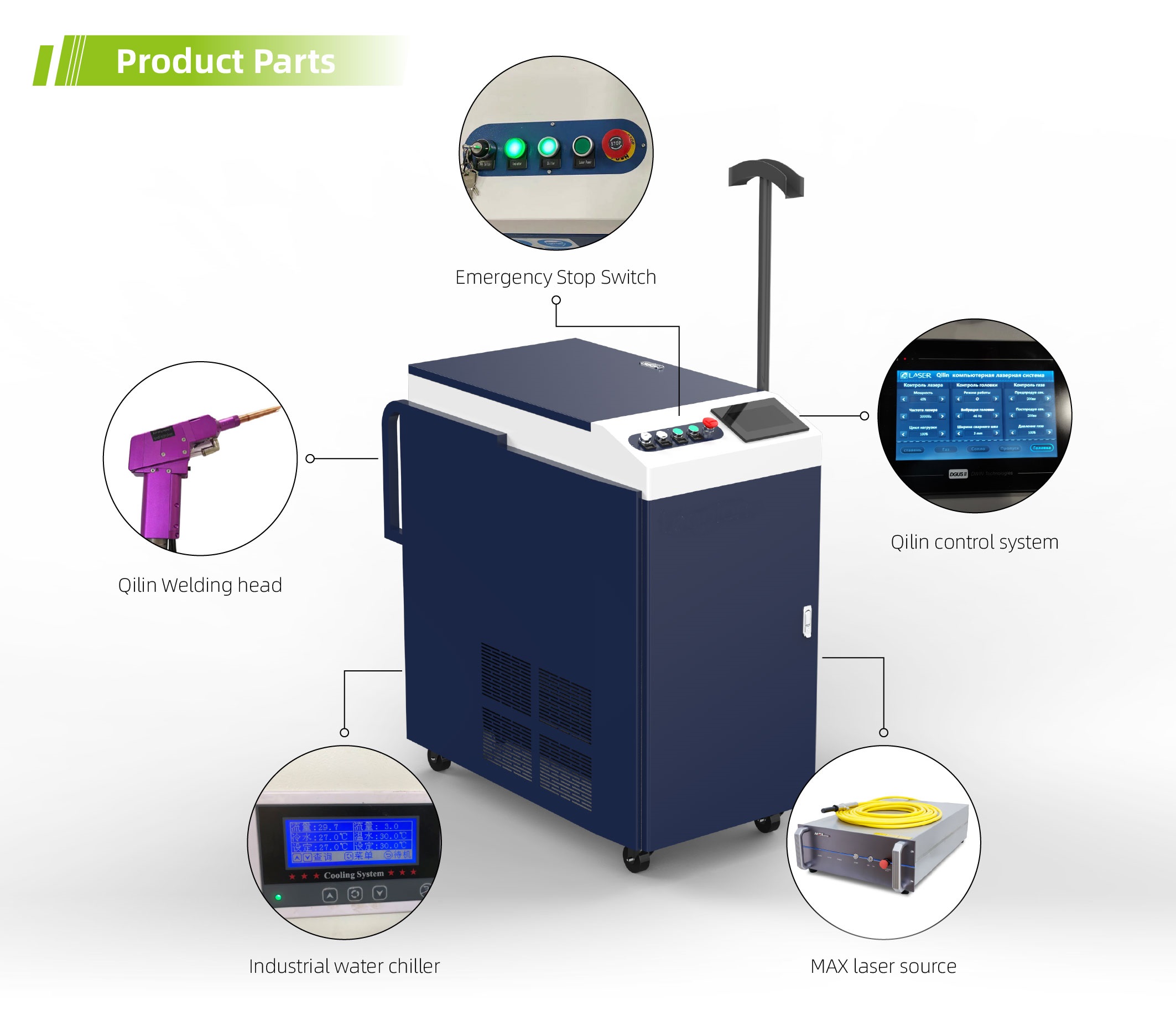
Industrial Application of Fiber Laser Welder
Optics and Beam Delivery in Beveling Operations
The execution of a 45-degree bevel requires sophisticated beam delivery optics. Most modern systems utilize a 5-axis CNC head or a robotic arm integrated with a Galvanometer Scanner. The galvanometer allows for high-speed oscillation of the beam, often referred to as “wobble” technology, which broadens the weld pool and compensates for slight fit-up inconsistencies.
The optical train must maintain a constant focal point while the head is tilted at a 45-degree angle. This requires real-time height sensing and capacitive sensors that adjust the nozzle distance to the workpiece within milliseconds. By maintaining a stable power density (measured in watts per square centimeter), the system ensures that the kerf width remains uniform throughout the length of the bevel, preventing the “dross” or re-solidified metal that typically complicates post-weld finishing.
Material Science and Thermal Dynamics
One of the primary advantages of using a Fiber Laser Welder for beveled joints is the management of thermal dynamics. Traditional welding methods involve high heat input, which alters the grain structure of the base metal. In contrast, the high energy density of a fiber laser (typically in the 1070nm wavelength range) allows for high-speed processing with minimal heat conduction into the surrounding material.
For Chilean manufacturers working with high-strength alloys or stainless steel, this means the mechanical properties of the material—such as hardness and corrosion resistance—are preserved. The 45-degree bevel facilitates a “keyhole” welding mode, where the laser vaporizes a small channel through the material, allowing the molten metal to flow around the beam and solidify into a narrow, deep, and incredibly strong weld bead.
Comparative Efficiency: Laser vs. Traditional Methods
Data from industrial implementations in the Santiago Metropolitan Region indicates a significant increase in throughput when switching to laser-based beveling and welding. Traditional edge preparation via grinding or milling is labor-intensive and introduces the risk of human error. A CNC-controlled fiber laser can perform the beveling and the welding in a continuous workflow, reducing part handling time by up to 60 percent.
Furthermore, the reduction in consumables—such as grinding disks, shielding gas volume, and filler wire—contributes to a lower Total Cost of Ownership (TCO). In a seamless welding application, the 45-degree bevel allows for a flush finish that requires zero post-weld grinding, making the components ready for powder coating or galvanizing immediately after the welding cycle is complete.
Automation and Software Integration
The synergy between hardware and software is what enables the precision of 45-degree beveling. Advanced CAM software calculates the complex kinematics required for the laser head to maintain the correct angle and velocity around corners and contours. In Santiago’s growing tech-manufacturing sector, the integration of Wobble Welding Technology within these software suites has allowed operators to adjust the amplitude and frequency of the laser path in real-time. This adaptability is crucial when dealing with varying material thicknesses or slight deviations in the raw material’s flatness.
Concluding Industry Insight: The Global Shift Toward Integrated Laser Workflows
The adoption of 45-degree beveling and fiber laser technology in Santiago is a microcosm of a larger global trend: the move toward “Single-Pass Manufacturing.” As the industry moves away from fragmented processes (where cutting, beveling, and welding are handled by separate machines), the demand for multi-functional laser cells will intensify.
For global B2B stakeholders, the insight is clear: the competitive edge no longer rests solely on the power of the laser source, but on the precision of the edge preparation and the integration of the motion control system. Seamless welding is not merely an aesthetic preference; it is a technical requirement for the next generation of aerospace, automotive, and energy infrastructure. Companies that invest in the geometric precision of 45-degree laser beveling today are positioning themselves to meet the rigorous non-destructive testing (NDT) standards of tomorrow, ensuring long-term viability in an increasingly automated global supply chain.
Industrial Expertise & Support
Are you looking for high-performance Fiber Laser Welder tailored for the Global market? Our engineering team provides comprehensive solutions for modern manufacturing.





