Precision Metallurgy: The Integration of Fiber Laser Welding in Mendoza’s Industrial Sector
The industrial landscape of Mendoza, Argentina, historically recognized for its viticulture and energy-related manufacturing, is currently undergoing a significant technological transition. As global demand for high-precision metal fabrication increases, local manufacturers are moving away from traditional Metal Inert Gas (MIG) and Tungsten Inert Gas (TIG) processes toward advanced laser-based solutions. Central to this evolution is the implementation of the Fiber Laser Welder, a tool that provides the high energy density required for complex joint geometries. In particular, the adoption of 45-degree beveling as a preparatory stage for seamless welding has redefined structural integrity standards for stainless steel and carbon steel assemblies in the region.
Mendoza’s manufacturing hub serves critical sectors including pressure vessel fabrication, large-scale irrigation infrastructure, and specialized food processing equipment. These applications demand weld joints that not only withstand high mechanical stress but also meet stringent sanitary and aesthetic requirements. The shift toward fiber laser technology, combined with precision edge preparation, addresses the inherent limitations of conventional thermal joining, such as excessive distortion and wide thermal profiles.
The Technical Necessity of 45-Degree Beveling for High-Penetration Welds
In the context of laser welding, the geometry of the joint preparation is a primary determinant of the final weld quality. While fiber lasers are capable of autogenous welding on square-butt joints for thin-gauge materials, thicker sections—often exceeding 4mm—require specific edge preparation to ensure Full Penetration Welding. A 45-degree bevel creates a controlled V-groove that allows the laser beam to access the root of the joint more effectively, facilitating a consistent melt pool across the entire cross-section of the workpiece.
The 45-degree angle is mathematically optimized for a balance between material removal and filler wire integration. When two plates with 45-degree bevels are abutted, they form a 90-degree included angle. This specific V-Groove Geometry provides several technical advantages:
1. Enhanced Beam Access: It allows the focused laser spot to reach the bottom of the joint without premature clipping of the beam on the sidewalls, which is critical for maintaining power density.
2. Controlled Dilution: It provides a reservoir for filler material when required, ensuring that the chemical composition of the weld bead remains within specification despite the high-speed fusion process.
3. Stress Distribution: The angled interface increases the surface area of the bond, distributing mechanical loads more evenly across the fusion zone compared to a standard butt joint.
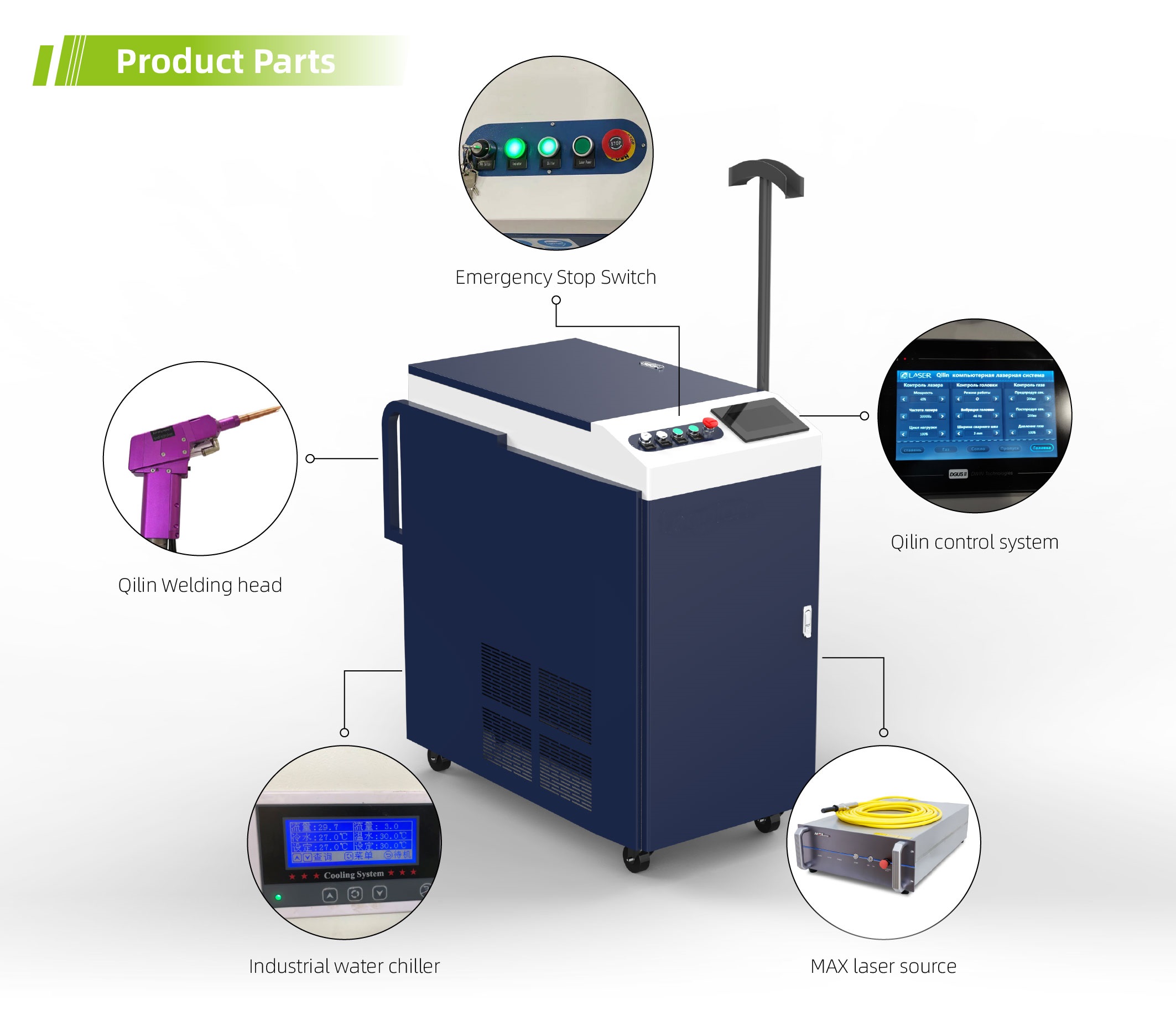
Industrial Application of Fiber Laser Welder
Performance Parameters of the Fiber Laser Welder
The core advantage of utilizing a Fiber Laser Welder in the Mendoza industrial corridor lies in its wavelength and beam quality. Operating typically at a wavelength of approximately 1.06 µm, fiber lasers exhibit high absorption rates in metallic substrates. This efficiency allows for a concentrated heat source, which results in a significantly reduced Heat-Affected Zone (HAZ). The minimization of the HAZ is vital for maintaining the metallurgical properties of the base metal, particularly in high-strength alloys where excessive heat can lead to grain coarsening or loss of corrosion resistance.
Technical specifications for machines deployed in this region often range from 1.5kW to 3kW of continuous wave power. For a 45-degree beveled joint, the laser’s oscillation (or “wobble”) parameters are adjusted to bridge the gap created by the bevel. By modulating the frequency and width of the laser path, operators can achieve a “seamless” finish where the transition between the base metal and the weld bead is nearly indistinguishable. This is achieved through a high cooling rate that produces a fine dendritic structure within the fusion zone, enhancing the overall tensile strength of the assembly.
Operational Efficiency and Material Considerations in Mendoza
Mendoza’s industrial environment often involves the fabrication of large-scale stainless steel tanks for the wine industry. In these applications, the 45-degree bevel serves a dual purpose: structural reliability and hygienic compliance. A seamless weld, free of porosity and undercut, prevents the accumulation of organic matter and bacteria, which is a non-negotiable requirement in food-grade engineering.
From an operational standpoint, the transition to fiber laser systems reduces post-processing requirements. Traditional welding on thick plates often results in significant thermal warping, necessitating secondary straightening processes. The high-speed capability of the Fiber Laser Welder—often 4 to 10 times faster than TIG welding—means that the total heat input per unit length is remarkably low. Consequently, the 45-degree bevel is filled with precision, leaving a flat or slightly convex profile that requires minimal grinding or polishing. This reduction in labor-intensive finishing directly impacts the Return on Investment (ROI) for local fabrication shops.
Comparative Analysis: Fiber Laser vs. Conventional Arc Welding
To quantify the advantages of this technology in the Mendoza market, a comparison of thermal input is necessary. In a standard 45-degree V-groove weld on 6mm stainless steel, a TIG process might require multiple passes with high amperage, leading to a wide HAZ and potential carbide precipitation. In contrast, the fiber laser approach utilizes a high-power density beam that completes the joint in a single or dual pass. The energy is focused so tightly that the surrounding material remains relatively cool, preserving the molybdenum and chromium distribution within the stainless steel matrix.
Furthermore, the gas consumption patterns differ. While TIG requires extensive shielding gas coverage to prevent oxidation of the wide melt pool, the fiber laser’s narrow fusion zone requires less gas volume, typically using nitrogen or argon to protect the keyhole and the immediate solidification area. This efficiency is particularly relevant in the Argentine market, where industrial gas costs and logistics can impact project margins.
Industry Insight: The Future of Laser Fabrication in South America
The adoption of 45-degree beveling and fiber laser technology in Mendoza reflects a broader global trend toward “Smart Manufacturing” and the “Industry 4.0” framework. As the South American market becomes more integrated into global supply chains, the ability to produce components that meet international tolerances and aesthetic standards is paramount. The integration of CNC-controlled beveling machines with handheld or robotic fiber laser systems represents the next phase of this evolution.
The concluding industry insight for the Mendoza region is one of specialized optimization. The transition is no longer about simply joining two pieces of metal; it is about the precision engineering of the joint interface. As local manufacturers invest in higher-kilowatt systems, the reliance on 45-degree beveling will become a standard protocol for ensuring that the high-power density of the laser is fully leveraged. This shift will likely lead to a decrease in material waste and an increase in the export potential of Argentine-manufactured industrial components, as they now compete on a level of technical parity with European and North American counterparts. The synergy between geometric preparation and laser physics is the cornerstone of the next generation of seamless, high-performance welding.
Industrial Expertise & Support
Are you looking for high-performance Fiber Laser Welder tailored for the Global market? Our engineering team provides comprehensive solutions for modern manufacturing.





