Industrial Integration of Fiber Laser Technology in Caxias do Sul
Caxias do Sul, located in the state of Rio Grande do Sul, stands as the second-largest metal-mechanic hub in Brazil. The region’s industrial landscape is characterized by high-volume production of transport equipment, agricultural machinery, and specialized tooling. As global manufacturing standards shift toward higher precision and lower energy consumption, the adoption of the Fiber Laser Welder has become a critical factor for local enterprises seeking to maintain international competitiveness. However, the geographical scale of Brazil presents a logistical challenge for technical maintenance and system uptime. To address this, the integration of cloud-based monitoring systems has emerged as a mandatory requirement for high-duty cycle operations.
The transition from traditional Gas Metal Arc Welding (GMAW) and Tungsten Inert Gas (TIG) processes to fiber laser systems is driven by the need for superior beam quality and localized energy input. In Caxias do Sul, where the supply chain for heavy-duty components is dense, the ability to produce high-strength joints with minimal distortion is paramount. The fiber laser, operating typically at a wavelength of 1070 nm, offers a high absorption rate in metallic substrates, facilitating deeper penetration and faster processing speeds compared to legacy CO2 systems.
Technical Architecture of Remote Cloud Diagnostics
The implementation of Remote Cloud Diagnostics within laser welding units involves a multi-layered telemetry architecture. At the hardware level, the welding system is equipped with an array of sensors that monitor real-time parameters including laser power stability, coolant temperature, shielding gas flow rates, and protective window integrity. These data points are aggregated by an industrial gateway and transmitted via secure protocols to a centralized cloud server.
For manufacturers in the Serra Gaúcha region, this connectivity provides a fail-safe against prolonged downtime. In a territory where specialized laser technicians may be located thousands of kilometers away in São Paulo or overseas, the ability to perform a remote handshake with the machine’s internal logic controller is invaluable. Technical support teams can analyze error logs, adjust pulse frequency parameters, and update firmware without the need for physical intervention. This capability is particularly vital for the Industrial Internet of Things (IIoT) frameworks that are currently being adopted by Tier 1 automotive suppliers in the region.
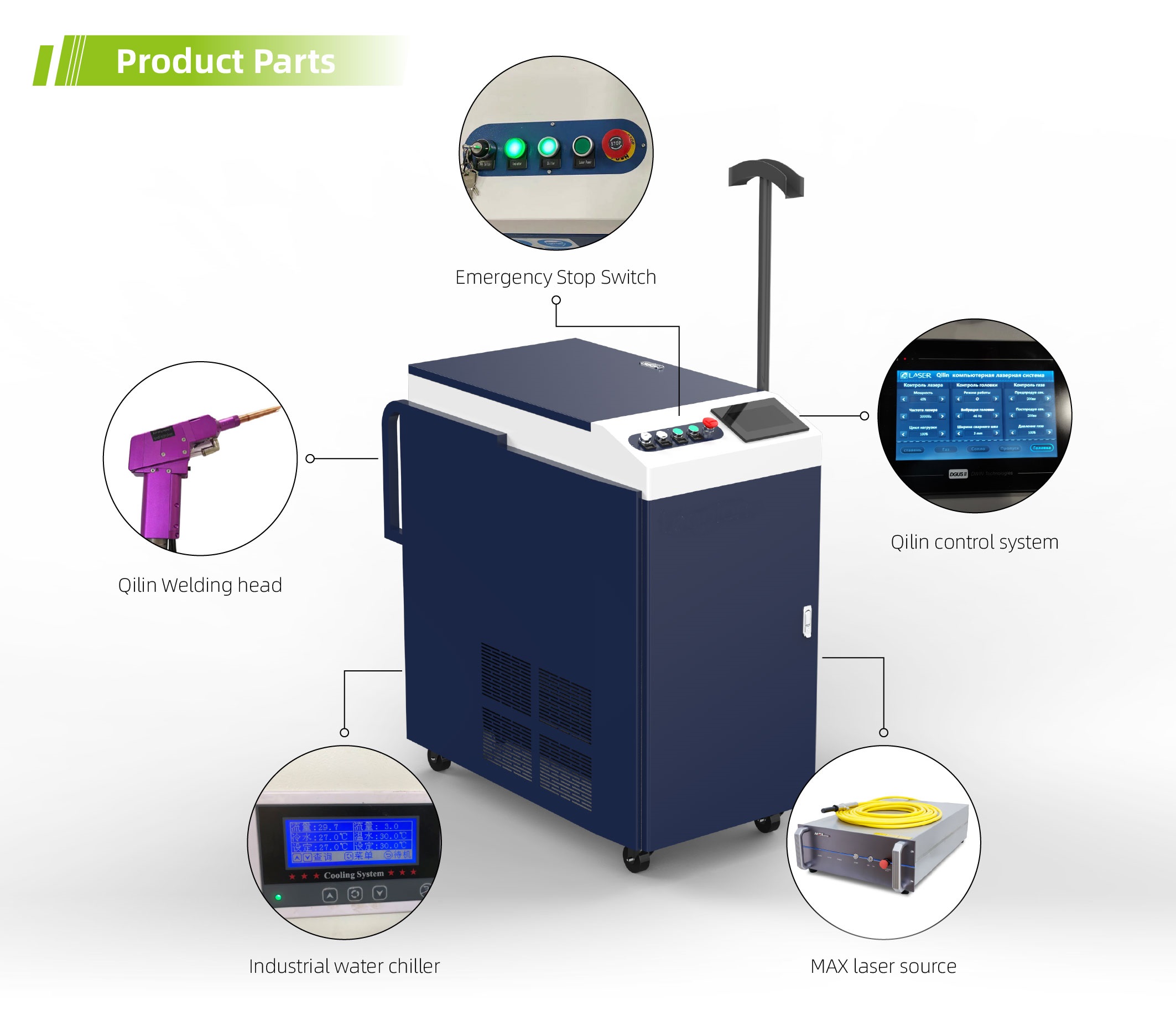
Industrial Application of Fiber Laser Welder
Mitigating Thermal Distortion and the Heat-Affected Zone
One of the primary technical advantages of using a fiber-delivered laser system is the significant reduction in the Heat-Affected Zone (HAZ). Traditional welding methods often result in macro-structural changes in the base metal, leading to warping and the necessity for secondary straightening processes. Fiber laser welding utilizes a high power density, often exceeding 10^6 W/cm², which allows for a “keyhole” welding mode. This mode results in a narrow, deep weld profile with a high aspect ratio.
In the context of Caxias do Sul’s manufacturing sector, specifically in the production of stainless steel tanks and bus chassis, controlling the HAZ is essential for maintaining the metallurgical integrity of the alloy. The cloud diagnostic system plays a role here as well; by monitoring the thermal feedback loops, the system can alert operators if the beam delivery optics are degrading, which would otherwise lead to an unintended increase in energy dispersion and a wider HAZ. Precision cooling cycles are also monitored to ensure that the fiber source remains within its optimal operating temperature range of 20°C to 25°C, preventing thermal lensing effects that could compromise weld consistency.
Data-Driven Maintenance in Vast Geographical Regions
Operating high-precision equipment in vast regions like South America requires a shift from reactive to predictive maintenance. Remote cloud diagnostics enable the application of machine learning algorithms to historical operational data. By analyzing the degradation curves of components such as the laser diode modules or the delivery fiber, the system can predict the Mean Time Between Failures (MTBF). This allows companies in Caxias do Sul to schedule maintenance during planned shutdowns, ensuring that spare parts—often imported—are on-site before a critical failure occurs.
Furthermore, the cloud interface allows for the synchronization of welding parameters across multiple production lines. If a specific parameter set for welding 5000-series aluminum is optimized on one machine, the configuration can be pushed to other Fiber Laser Welder units within the corporate network via the cloud. This ensures uniformity in production quality, regardless of the physical location of the individual manufacturing cells. The reduction in “test-and-error” cycles significantly lowers material waste, which is a key metric in modern lean manufacturing environments.
Optical Integrity and Beam Delivery Monitoring
The delivery of a high-power laser beam through a flexible optical fiber requires rigorous monitoring of the beam path. Any contamination on the protective lens or the fiber connector can lead to catastrophic back-reflections or thermal damage to the optical chain. Modern systems deployed in the Brazilian market now feature integrated sensors within the welding head that measure back-scattered light. This data is transmitted to the cloud-based diagnostic platform, providing a real-time “health score” for the optical delivery system.
In industrial environments where airborne particulates are common, such as the foundries and machining centers of Caxias do Sul, monitoring optical integrity is a prerequisite for operational stability. Remote diagnostics allow the OEM (Original Equipment Manufacturer) to provide a second layer of oversight, ensuring that the local operators are notified of maintenance requirements before the beam quality deviates from the specified M2 factor. This proactive approach maintains the focal point position and power density required for high-speed automated welding applications.
Conclusion: Industry Insight and the Future of Distributed Manufacturing
The integration of fiber laser welding with remote cloud diagnostics represents a pivotal shift in how industrial capacity is managed in geographically expansive regions. For the industrial cluster in Caxias do Sul, the value proposition extends beyond the physical act of joining metals; it encompasses the entire lifecycle of the equipment and the reliability of the production output. As fiber laser technology continues to mature, the focus will increasingly move toward autonomous parameter adjustment where the system, guided by cloud-based AI, optimizes its own output based on real-time sensor feedback.
The industry insight for the coming decade suggests that “connectivity” will become as critical a specification as “wattage.” Manufacturers will no longer view the laser welder as a standalone tool, but as a node within a global data network. In regions like Brazil, where infrastructure and distance pose constant challenges, the ability to de-link physical location from technical expertise through cloud diagnostics will be the primary driver for the next phase of industrial expansion. Companies that invest in connected fiber laser systems today are not just upgrading their welding capabilities; they are future-proofing their operations against the logistical constraints of the global supply chain.
Industrial Expertise & Support
Are you looking for high-performance Fiber Laser Welder tailored for the Global market? Our engineering team provides comprehensive solutions for modern manufacturing.





