Precision Engineering in the Caxias do Sul Metal-Mechanic Cluster
Caxias do Sul, located in the southern Brazilian state of Rio Grande do Sul, stands as the second-largest metal-mechanic hub in the country. The region’s industrial output is heavily concentrated on heavy-duty transport, agricultural machinery, and structural engineering. As global demand for infrastructure increases, the local manufacturing sector is undergoing a rigorous transition from traditional plasma and manual arc welding to automated high-power laser systems. The integration of the Fiber Laser Welder into this ecosystem represents a significant shift in how heavy structural steel is processed, moving away from high-heat, low-precision methods toward high-density energy applications.
The primary challenge in processing heavy structural steel—such as H-beams, I-beams, and large-diameter square tubing—is maintaining geometric stability during the thermal cycle. In Caxias do Sul’s fabrication plants, where components for trailers and bus frames are manufactured, the introduction of 4-chuck laser systems has addressed the limitations of standard 2-chuck or 3-chuck configurations. This technical analysis explores the mechanical and metallurgical advantages of 4-chuck stability in fiber laser applications for structural steel.
The Mechanics of 4-Chuck Stability in Heavy Profile Processing
In the context of heavy Structural Steel Fabrication, the weight and length of the workpieces often exceed 200kg per meter, with total lengths reaching 12 meters. A standard 2-chuck system lacks the necessary support to prevent “bowing” or sag in the middle of the beam, which leads to focal point deviations and inconsistent weld penetration. The 4-chuck architecture utilizes two feeding chucks and two rotating chucks that work in a synchronous, multi-point clamping sequence.
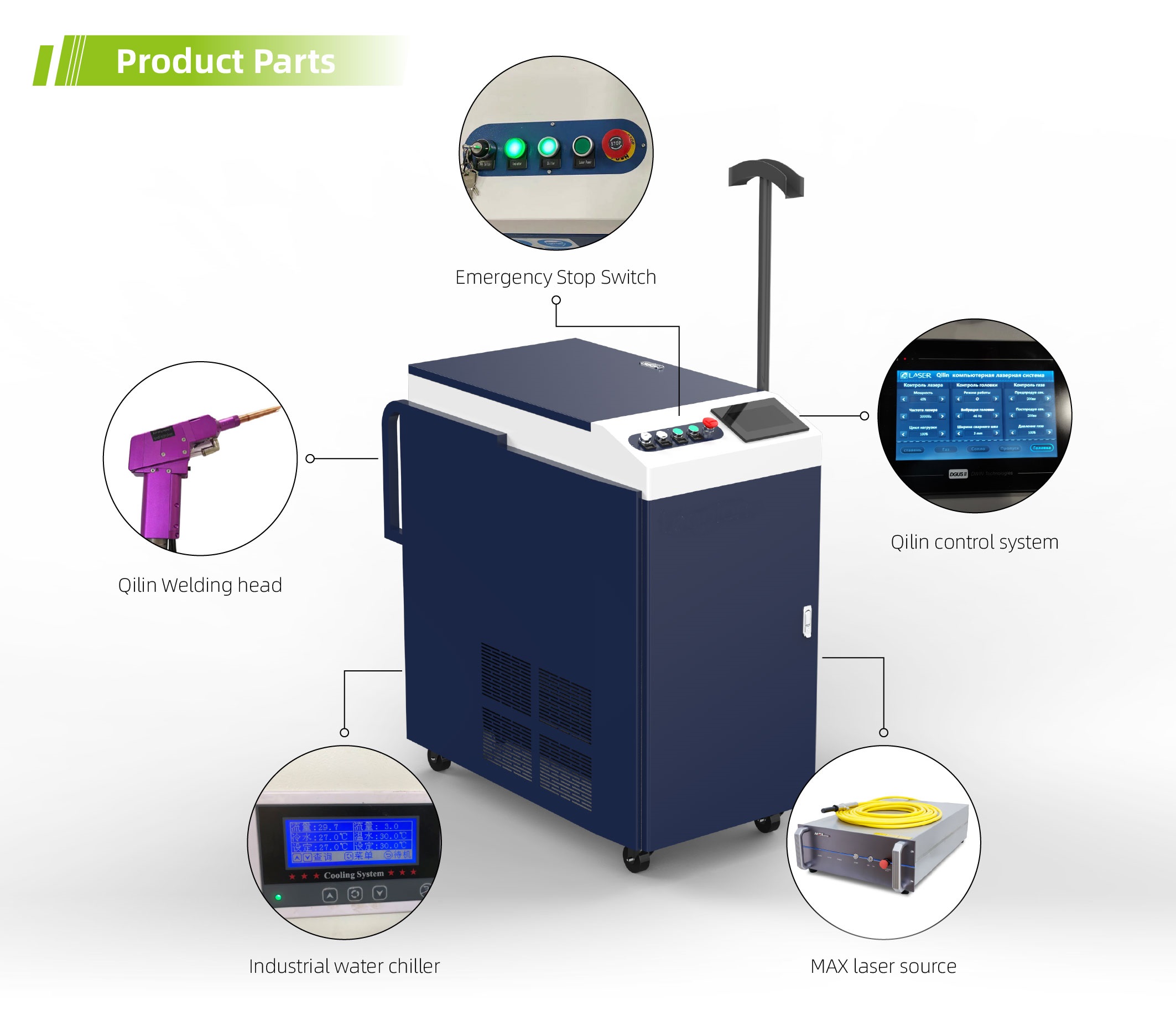
Industrial Application of Fiber Laser Welder
The technical advantage of the 4-chuck system lies in its ability to provide continuous support through the entire processing cycle. As the laser head moves along the X-axis, the chucks shift positions to ensure the section being welded or cut is always rigidly fixed between two points of minimal vibration. This eliminates the “tailing” waste—the unprocessed end of a beam—which is a common inefficiency in older systems. By achieving “zero-tailing,” manufacturers in Caxias do Sul are reducing material costs by 10% to 15% on high-volume structural runs.
Torsional Rigidity and Dynamic Balancing
Heavy structural steel often possesses inherent mill-scale irregularities and slight longitudinal twists. A 4-chuck system employs 4-chuck synchronous clamping with independent pneumatic or hydraulic pressure sensors. These sensors detect the profile’s surface deviations and adjust the clamping force in real-time. This ensures that the center of rotation remains constant, even if the beam is not perfectly straight. For the heavy-duty trailer industry in Caxias do Sul, this precision is vital for the subsequent assembly of chassis components, where tolerances are increasingly narrowed to sub-millimeter levels.
Metallurgical Integrity and the Fiber Laser Advantage
The use of a Fiber Laser Welder on structural steel offers a distinct advantage regarding the Heat-Affected Zone (HAZ). Traditional welding methods, such as Submerged Arc Welding (SAW) or Gas Metal Arc Welding (GMAW), introduce significant heat into the base metal. This prolonged thermal exposure alters the grain structure of the steel, often leading to brittleness or warping in high-tensile structural grades like ASTM A36 or high-strength low-alloy (HSLA) steels.
Fiber lasers operate at a wavelength of approximately 1.06 microns, which is highly absorbed by metallic surfaces. The high power density allows for deep-penetration keyhole welding at significantly higher speeds than conventional methods. Because the energy is concentrated, the total heat input is minimized. This results in a narrow HAZ, preserving the mechanical properties of the structural steel and reducing the need for post-weld heat treatment or straightening processes. In the competitive landscape of Caxias do Sul, reducing these secondary operations is a key driver for ROI.
Integration of Automated Feed Systems
The 4-chuck system is rarely a standalone unit in a modern B2B environment. In the industrial parks of Rio Grande do Sul, these machines are integrated into automated loading and unloading racks. The synchronization between the 4-chuck laser and the automated material handling system allows for continuous 24/7 operation. The software controlling the chucks manages the transition of the beam through the work envelope, ensuring that the laser beam remains perpendicular to the surface at all times, which is critical for maintaining the integrity of the weld root in thick-walled sections.
Operational Efficiency in the Brazilian Industrial Context
Caxias do Sul’s manufacturing sector faces specific economic pressures, including fluctuating steel prices and high labor costs for specialized welders. The adoption of 4-chuck fiber laser technology addresses these by increasing throughput. A single 12kW to 20kW fiber laser system can replace multiple manual welding stations while providing superior repeatability.
Furthermore, the 4-chuck configuration allows for complex “bird-mouth” cuts and interlocking joint geometries that are impossible to achieve with manual tools. These interlocking joints increase the structural integrity of the final product—be it a crane boom or a bridge girder—by providing more surface area for the laser weld to fuse. This “design for manufacturing” approach is becoming the standard for the top-tier exporters in the Caxias region who serve the global market.
Technical Specifications and Power Scalability
To process heavy structural steel effectively, the fiber laser source must be scaled appropriately. Most installations in Caxias do Sul utilize sources ranging from 6kW for medium-duty profiles to 30kW for ultra-thick structural members. The 4-chuck system must be rated for the maximum torque required to rotate these heavy loads rapidly. High-inertia servo motors are utilized to ensure that the acceleration and deceleration of the chucks do not lag behind the laser’s path commands, maintaining a constant velocity—a prerequisite for uniform laser welding quality.
Concluding Industry Insight: The Future of Structural Fabrication
The evolution of the metal-mechanic industry in Caxias do Sul serves as a microcosm for the global shift in heavy fabrication. The transition to 4-chuck fiber laser systems is not merely an upgrade in cutting or welding speed; it is a fundamental shift toward digital manufacturing. By stabilizing heavy profiles through four points of contact, manufacturers can now treat massive structural steel components with the same precision previously reserved for small, intricate parts.
The industry insight for the coming decade points toward the total convergence of Structural Steel Fabrication and robotic automation. As fiber laser costs stabilize and power capacities continue to rise, the 4-chuck stability model will become the baseline requirement for any facility aiming to compete in the global infrastructure market. For the B2B sector, the focus will move from simple “machine acquisition” to “process integration,” where the stability of the workpiece determines the upper limit of the technology’s potential. Caxias do Sul is currently positioning itself as a leader in this South American industrial renaissance, proving that precision and heavy-duty structural work are no longer mutually exclusive.
Industrial Expertise & Support
Are you looking for high-performance Fiber Laser Welder tailored for the Global market? Our engineering team provides comprehensive solutions for modern manufacturing.





