Industrial Integration of Fiber Laser Welder Systems in Buenos Aires
The industrial landscape of Buenos Aires, Argentina, has undergone a significant transition toward high-precision metal fabrication. As a primary hub for automotive assembly, aerospace components, and renewable energy infrastructure in South America, the demand for advanced joining technologies has escalated. Central to this evolution is the implementation of the Fiber Laser Welder, a tool that has redefined the parameters of thermal processing for non-ferrous metals. While traditional CO2 and Nd:YAG lasers faced limitations regarding energy efficiency and beam delivery, fiber-based systems utilize a doped optical fiber as the gain medium, providing superior beam quality and higher wall-plug efficiency. However, the application of these systems on highly reflective materials like copper and aluminum presents specific thermodynamic challenges that require specialized anti-reflection protocols.
The Physics of Reflectivity in Copper and Aluminum Welding
Copper and aluminum are characterized by high thermal conductivity and low photon absorption rates at the standard 1064nm to 1080nm wavelengths utilized by most industrial fiber lasers. At room temperature, polished copper can reflect upwards of 95 percent of incident infrared radiation. This physical property presents a dual challenge: the inability to initiate a stable keyhole weld and the risk of catastrophic hardware failure due to back-reflection. When the laser beam is directed at a reflective surface, the unabsorbed energy returns through the delivery fiber into the laser resonator. Without robust Back-reflection protection, this energy can destabilize the pump diodes and damage the internal optical architecture of the laser source.
In the manufacturing corridors of Greater Buenos Aires, technical engineers are increasingly deploying high-brightness fiber lasers equipped with multi-stage optical isolators. These components act as one-way valves for photons, allowing the forward beam to pass while diverting reflected energy into a water-cooled dump. This hardware-level protection is essential for maintaining the duty cycle required in high-volume production environments where copper busbars for electric vehicle (EV) batteries or aluminum heat exchangers are the primary output.
Anti-Reflection Technological Solutions and Beam Modulation
To overcome the initial Absorption Coefficient barrier of reflective metals, modern systems in the Argentinian market utilize advanced beam modulation and power ramping techniques. The process begins with a high-peak-power pulse to overcome the reflectivity threshold. Once the material reaches its melting point, its absorption rate increases significantly, allowing the system to transition to a stable, lower-power continuous wave (CW) mode. This transition must be managed with microsecond precision to prevent overheating or burn-through.
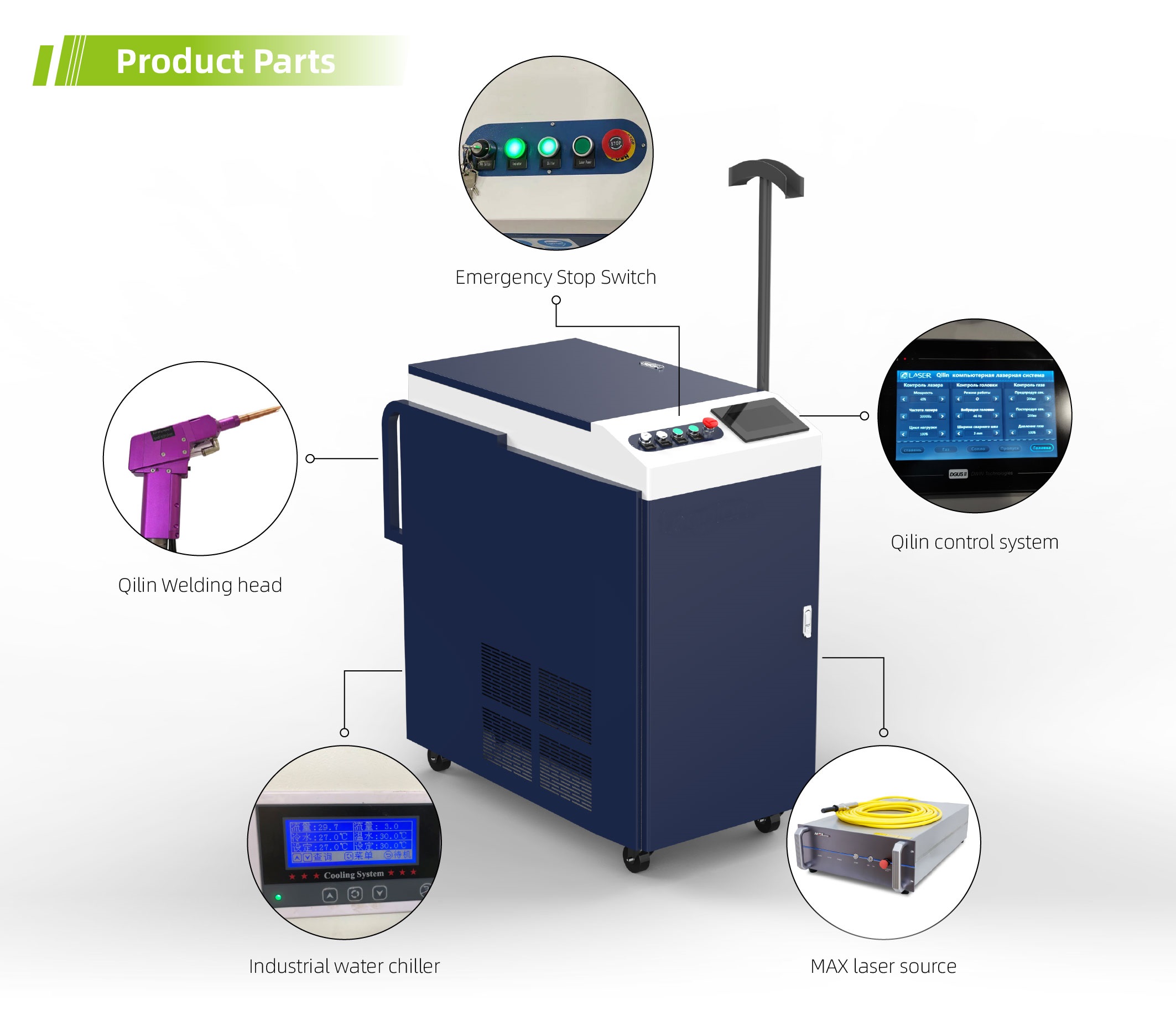
Industrial Application of Fiber Laser Welder
Furthermore, the integration of “wobble” welding heads has become a standard practice. By oscillating the beam in various patterns—such as circles, figure-eights, or zig-zags—the Fiber Laser Welder can effectively stir the melt pool. This oscillation assists in degassing the weld, which is particularly critical for aluminum alloys (such as the 6000 series) that are prone to porosity. The mechanical stirring action also helps to distribute the thermal load, reducing the concentration of back-reflected light on a single point of the optical path, thereby enhancing the lifespan of the protective windows and collimating lenses.
Technical Specifications and Beam Parameter Product (BPP)
The efficacy of a laser system in the Buenos Aires industrial sector is often measured by its Beam Parameter Product (BPP). A lower BPP indicates a beam that can be focused to a smaller spot size with a longer depth of field. For copper welding, a high-brightness beam with a low BPP is mandatory to achieve the power density required to initiate the “keyhole” effect. In many local facilities, systems ranging from 2kW to 6kW are being deployed, featuring fiber core diameters as small as 50 microns. These specifications allow for deep penetration welds with a narrow heat-affected zone (HAZ), preserving the structural integrity and electrical conductivity of the workpieces.
Technical data from local implementations suggest that utilizing a Fiber Laser Welder with integrated real-time back-reflection monitoring significantly reduces downtime. These sensors detect the intensity of reflected light and can trigger an automatic shutdown within nanoseconds if the levels exceed a safe threshold. This level of process control is vital for the precision-heavy electronics sector in Argentina, where the cost of a single damaged laser module can exceed tens of thousands of dollars.
Operational Optimization in the Argentinian Manufacturing Context
The shift toward fiber laser technology in Buenos Aires is also driven by the operational cost-benefit ratio. Compared to traditional TIG (Tungsten Inert Gas) or MIG (Metal Inert Gas) welding, fiber lasers offer travel speeds that are five to ten times faster. For aluminum fabrication, this speed is crucial because it minimizes the time available for the material to conduct heat away from the joint, resulting in less thermal distortion. In a region where energy costs and material efficiency are critical components of the B2B value chain, the high wall-plug efficiency (often exceeding 30 percent) of fiber lasers provides a competitive edge over older gas laser technologies.
Local distributors and technical service centers in Buenos Aires are now focusing on providing end-to-end solutions that include specialized shielding gas mixtures. While argon is standard, the addition of helium or specific nitrogen blends can further stabilize the plasma plume and enhance the absorption of the laser energy into the copper or aluminum substrate. This holistic approach to the welding cell—combining the laser source, the anti-reflection optics, and the atmospheric control—ensures consistent weld quality that meets international standards such as ISO 3834.
Concluding Industry Insight: The Future of Laser Processing
As the global manufacturing sector moves toward “Industry 4.0,” the role of the Fiber Laser Welder in Buenos Aires will transition from a standalone tool to an integrated, data-driven node within the production line. The ability to weld copper and aluminum with high reliability is no longer just a technical requirement but a strategic necessity for the burgeoning EV and green energy markets in South America. The future of this technology lies in the refinement of “Blue Laser” or “Green Laser” hybrids, which operate at shorter wavelengths where the absorption rates for copper are naturally higher. However, for the current medium-term horizon, the optimization of infrared fiber lasers through advanced anti-reflection hardware and intelligent beam oscillation remains the most commercially viable and technically robust solution for high-reflectivity metal joining. Companies that master these optical nuances will define the next decade of metallurgical excellence in the Southern Cone.
Industrial Expertise & Support
Are you looking for high-performance Fiber Laser Welder tailored for the Global market? Our engineering team provides comprehensive solutions for modern manufacturing.





