Modernizing Structural Fabrication: The Rise of Fiber Laser Welding in Buenos Aires
The industrial landscape of Buenos Aires, Argentina, is currently undergoing a significant technological transition. As the primary hub for South American heavy manufacturing and infrastructure development, the region is shifting away from traditional metal inert gas (MIG) and tungsten inert gas (TIG) processes toward high-precision automated systems. Central to this evolution is the implementation of the Fiber Laser Welder, a technology that has redefined the parameters of structural steel fabrication. In the context of heavy-duty construction—ranging from maritime engineering to skyscraper frameworks—the integration of 4-chuck stability systems has become the technical benchmark for quality and structural integrity.
The adoption of laser technology in the Greater Buenos Aires industrial belt is driven by the demand for higher throughput and reduced post-processing requirements. Unlike traditional arc welding, which introduces significant thermal stress into thick-walled steel, fiber laser systems utilize a concentrated coherent light source to achieve deep penetration with minimal distortion. This article examines the technical mechanics of 4-chuck stabilization and why it is critical for the heavy structural steel sector in the Argentinian market.
The Technical Architecture of 4-Chuck Stability Systems
In heavy structural steel processing, the primary challenge is the management of long-form materials, such as H-beams, I-beams, and large-diameter rectangular tubing. Traditional 2-chuck or 3-chuck systems often suffer from material sagging or vibration during the rotation and welding cycle. The 4-chuck configuration introduces a redundant yet necessary level of support that ensures the workpiece remains perfectly coaxial with the machine’s rotational axis.
The 4-chuck system operates through a synchronized pneumatic or hydraulic clamping mechanism. Two chucks act as the primary drivers, while the remaining two provide auxiliary support and material feeding. This configuration allows for 4-Chuck Synchronous Clamping, which effectively eliminates the “whiplash” effect seen in long-span steel beams. By maintaining four points of contact, the system distributes the gravitational load of heavy structural members more evenly, preventing the microscopic deviations that lead to weld seam misalignment.
Furthermore, the 4-chuck architecture facilitates zero-tailing technology. In a standard setup, the last section of a beam cannot be processed because the chucks cannot grip the remaining material without interfering with the laser head. In a 4-chuck system, the chucks can pass through one another or hand off the material in a “relay” fashion, allowing the Fiber Laser Welder to process the entire length of the beam, significantly reducing material waste and increasing the ROI for fabrication firms in Buenos Aires.
Industrial Application of Fiber Laser Welder
Thermal Dynamics and the Heat Affected Zone (HAZ)
One of the most critical technical advantages of utilizing a fiber laser for heavy structural steel is the control over the Heat Affected Zone (HAZ). In traditional welding, the prolonged application of heat alters the microstructure of the steel, often leading to brittleness or reduced tensile strength in the areas surrounding the weld. This is particularly problematic in the high-salinity environments found near the port facilities of Buenos Aires, where structural integrity is paramount to resisting corrosion and fatigue.
Fiber lasers operate at a wavelength of approximately 1.06 microns, which allows for high absorption rates in ferrous metals. The energy density is several orders of magnitude higher than that of a plasma or arc source. This results in “keyhole” welding, where the laser vaporizes a small column of metal, creating a narrow, deep weld pool. The speed at which the laser traverses the joint ensures that the total heat input remains low. Consequently, the Heat Affected Zone (HAZ) is minimized, preserving the mechanical properties of the base metal (such as S355 or S460 structural steel) and eliminating the need for secondary heat treatment or straightening processes.
Integration of CNC and Real-Time Monitoring in Argentinian Facilities
The deployment of a Fiber Laser Welder in a professional B2B environment requires sophisticated control software. In the industrial sectors of Argentina, integration with CNC (Computer Numerical Control) platforms is standard. These systems utilize advanced algorithms to coordinate the movement of the 4-chuck assembly with the laser’s power output and focal position. This synchronization is vital when welding complex geometries, such as the intersection of two heavy-walled tubes at an acute angle.
Modern systems also incorporate real-time seam tracking and monitoring. Using optical sensors or laser-based triangulation, the machine can detect deviations in the joint gap in real-time and adjust the beam path accordingly. This level of automation is essential for heavy structural steel, where slight variations in beam straightness are common. By compensating for these physical imperfections, the 4-chuck fiber laser system ensures a consistent weld throat and penetration depth across the entire workpiece, meeting international ISO and AWS standards for structural safety.
Economic Impact and Throughput Efficiency
From a B2B perspective, the transition to 4-chuck fiber laser welding is justified by the massive increase in throughput. Traditional welding of heavy structural components is a labor-intensive process involving multiple passes, slag removal, and frequent quality inspections. A high-power fiber laser system (often ranging from 12kW to 30kW for heavy steel) can complete a single-pass weld on thick plates that would otherwise require four or five passes with a MIG welder.
In the Buenos Aires market, where labor costs and project timelines are critical variables, the ability to reduce welding time by 300 to 500 percent provides a significant competitive advantage. Additionally, the precision of the 4-chuck system means that the “fit-up” requirements are less stringent, as the machine can handle heavier loads with greater stability, reducing the time spent on manual jigging and fixturing.
Technical Specifications for Heavy-Duty Applications
When evaluating a Fiber Laser Welder for structural steel, several technical parameters must be prioritized:
1. Power Density: For heavy structural steel (12mm to 25mm thickness), a minimum of 15kW is generally recommended to maintain high travel speeds and ensure full penetration.
2. Beam Quality (M2): A low M2 factor ensures that the laser beam can be focused to a very small spot size, which is essential for achieving the high power density required for keyhole welding.
3. Chuck Payload Capacity: In a 4-chuck system, each chuck must be rated for the maximum linear weight of the heaviest beams used in Argentinian infrastructure, often exceeding 200kg per meter.
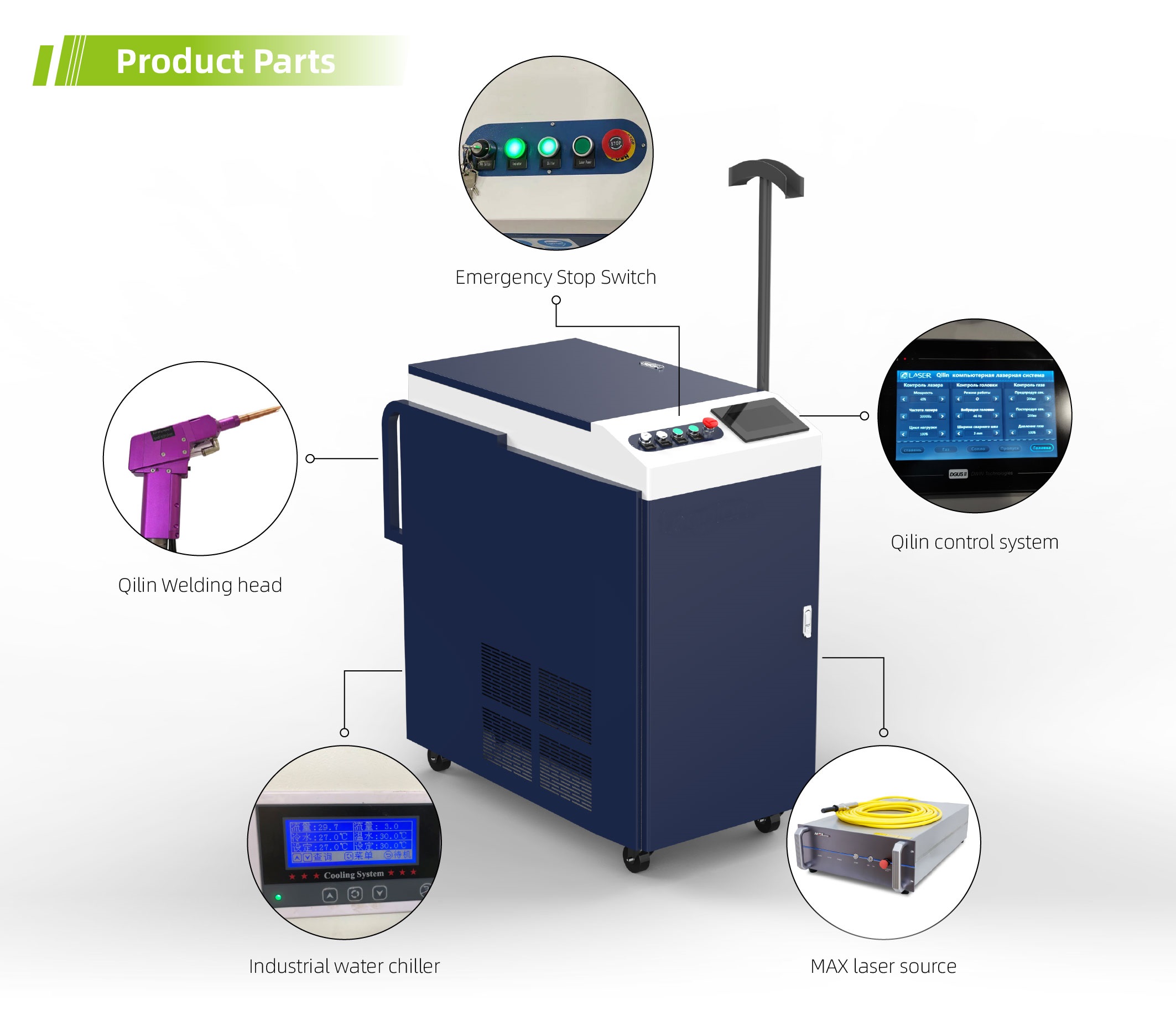
4. Cooling Systems: High-power fiber lasers generate significant heat within the resonator and the delivery optics. A dual-circuit chilling system is required to maintain the stability of the laser source and the welding head during continuous duty cycles.
Industry Insight: The Future of Metal Fabrication in South America
The industrial sector in Buenos Aires is at a crossroads where the adoption of “Industry 4.0” technologies is no longer optional but a prerequisite for global competitiveness. The shift toward 4-chuck fiber laser welding represents a broader trend of “digitalization of hardware.” As structural demands become more complex—driven by the need for more efficient material use and more resilient infrastructure—the precision offered by laser systems becomes the only viable solution.
The concluding insight for the industry is this: The future of heavy structural steel fabrication lies in the fusion of high-energy physics and robust mechanical stabilization. The 4-chuck system is not merely a material handling upgrade; it is a fundamental shift in how we approach the physics of joining metal. Companies in Argentina that invest in this technology today are not just buying a welder; they are investing in a platform that eliminates traditional manufacturing bottlenecks, reduces carbon footprints through decreased material waste, and sets a new standard for structural reliability in the South American market. As the region continues to develop its energy and transport infrastructure, the Fiber Laser Welder will undoubtedly be the cornerstone of that growth.
Industrial Expertise & Support
Are you looking for high-performance Fiber Laser Welder tailored for the Global market? Our engineering team provides comprehensive solutions for modern manufacturing.





