The industrial landscape of Bogotá, Colombia, has undergone a significant transition toward high-precision manufacturing, particularly within the automotive, aerospace, and renewable energy sectors. As global supply chains demand higher tolerances and faster throughput, the adoption of advanced joining technologies has become a necessity. Central to this evolution is the deployment of the Fiber Laser Welder, a tool that has redefined the capabilities of local fabrication facilities. However, the welding of non-ferrous metals such as copper and aluminum presents unique metallurgical and optical challenges—specifically regarding high reflectivity and thermal conductivity. This article examines the technical implementation of anti-reflection technology within fiber laser systems and its impact on the manufacturing output of the Andean region.
The Challenge of Reflective Materials in Laser Processing
Copper and aluminum are fundamental to modern electrical and structural engineering due to their high electrical conductivity and strength-to-weight ratios. From a laser processing perspective, these materials are classified as highly reflective. At the standard 1070 nm wavelength of most fiber lasers, copper reflects approximately 90 to 95 percent of incident energy at room temperature. Aluminum, while slightly more absorptive, still poses a significant risk for back-reflection.
Back-reflection occurs when the laser beam is redirected from the molten pool or the solid metal surface back into the delivery fiber and the resonator. Without specialized mitigation, this reflected energy can cause catastrophic damage to the optical components, lead to power instability, or trigger automatic safety shutdowns that disrupt production cycles. In the context of Bogotá’s growing electronics and EV battery assembly sectors, overcoming this optical barrier is essential for maintaining a competitive edge in the global market.
Mechanisms of Anti-Reflection Technology
To address the hazards of back-reflection, modern industrial fiber lasers utilize a multi-layered hardware and software approach. The primary defense is the Back-Reflection Isolation system. This optical component acts as a one-way valve, allowing the primary beam to pass toward the workpiece while diverting any returning light into a water-cooled beam dump. This ensures that the laser source, often the most expensive component of the system, remains protected even during the welding of polished copper plates.
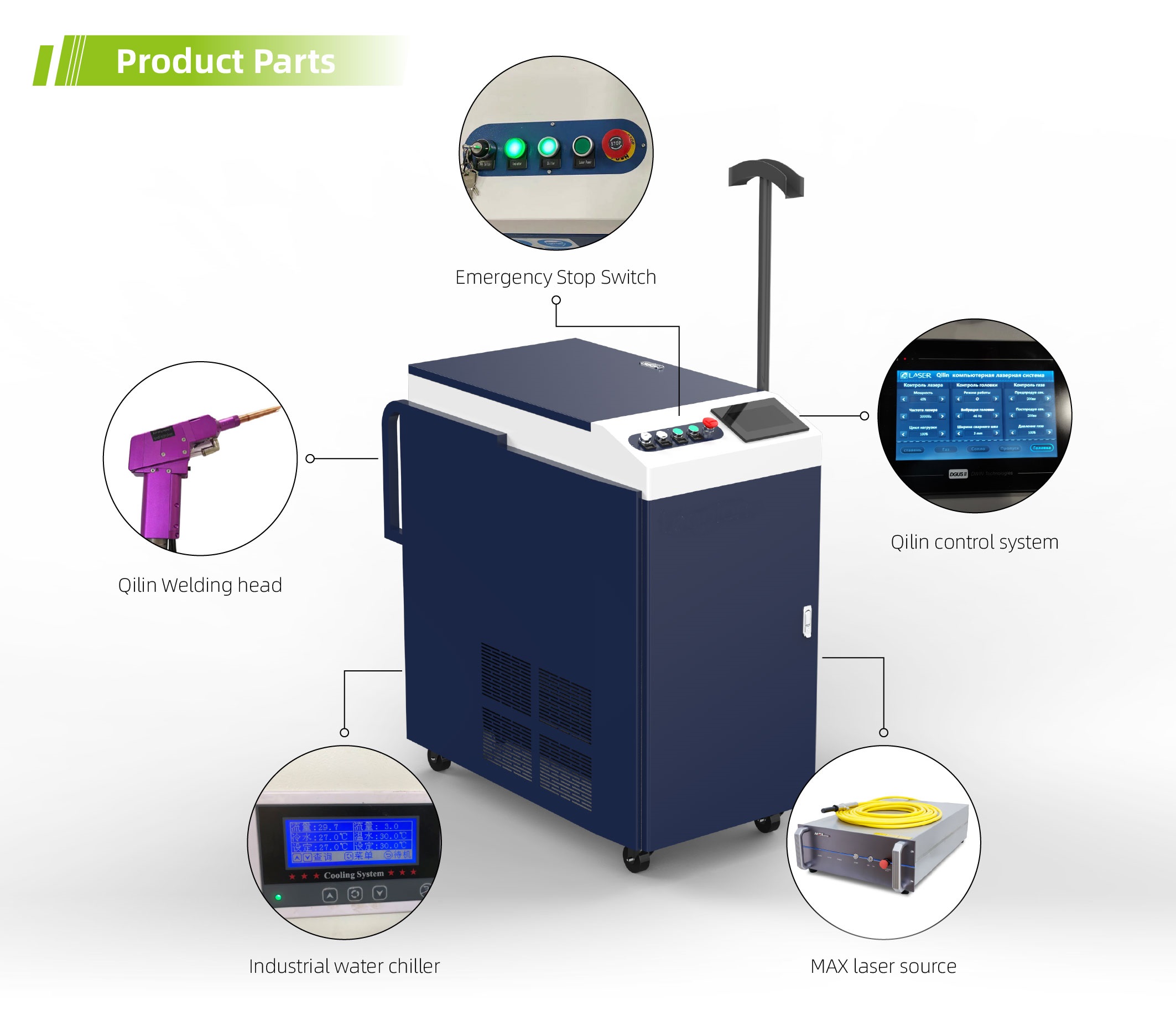
Industrial Application of Fiber Laser Welder
Furthermore, power modulation and sensing technologies allow the system to detect abnormal levels of reflected light in real-time. If the sensor detects a spike in back-reflected energy—common during the initial “piercing” phase before a stable keyhole is established—the system can adjust the pulse frequency or peak power to stabilize the melt pool and increase absorption. This closed-loop control is vital for achieving the consistency required in high-volume B2B manufacturing environments.
Wobble Head Integration and Beam Dynamics
Beyond internal isolation, the mechanical delivery of the laser beam plays a crucial role in managing reflectivity. The integration of Wobble Head Integration technology has transformed the welding of aluminum and copper. By oscillating the laser beam in various patterns—such as circles, infinity loops, or zig-zags—the energy density is distributed more effectively across the joint.
This oscillation serves two technical purposes. First, it increases the effective width of the weld, allowing for better fit-up tolerance. Second, and more importantly for reflective metals, the continuous movement of the beam disrupts the surface tension and stabilizes the keyhole. This stabilization reduces the likelihood of the beam reflecting directly back into the optics. In Bogotá’s precision workshops, this allows for the welding of 6xxx series aluminum and oxygen-free copper with minimal porosity and high tensile strength.
Thermal Management and Metallurgical Integrity
The high Thermal Conductivity Management required for copper welding is often overlooked. Because copper dissipates heat rapidly, the laser must provide sufficient power density to reach the melting point before the heat is conducted away into the surrounding material. A high-brightness fiber laser provides the necessary beam quality (M2 < 1.1) to create a high-aspect-ratio weld with a narrow heat-affected zone (HAZ).
By concentrating energy into a very small spot size, the fiber laser achieves a “keyhole” welding mode. This mode significantly increases the absorption rate of the laser energy, as the beam undergoes multiple reflections within the vapor capillary (the keyhole) itself. This transition from conduction-mode welding to keyhole-mode welding is the tipping point where the reflectivity of the material becomes a secondary concern to the fluid dynamics of the melt pool.
Economic Impact on Bogotá’s Industrial Sector
For B2B entities operating out of Colombia, the transition to fiber laser systems with anti-reflection capabilities represents a shift from labor-intensive TIG (Tungsten Inert Gas) welding to automated, high-speed processing. The reduction in post-weld processing is substantial; because the laser delivers localized heat, distortion of thin-walled aluminum components is nearly eliminated. This is particularly relevant for the production of busbars, heat exchangers, and specialized HVAC components destined for export to North American and European markets.
The reliability of these systems also reduces the total cost of ownership. Previous generations of CO2 lasers or poorly protected fiber lasers suffered from high downtime due to optical failure. With robust anti-reflection technology, manufacturers in Bogotá can guarantee 24/7 operation with predictable maintenance schedules, a critical factor for Tier 1 and Tier 2 suppliers in the automotive supply chain.
Technical Specifications and System Selection
When selecting a system for reflective metal applications, technical buyers must evaluate several key parameters:
- Beam Quality: A lower M2 factor allows for higher energy density, essential for initiating the melt in copper.
- Isolation Rating: The decibel (dB) rating of the optical isolator indicates its effectiveness in suppressing back-reflection.
- Pulse Shaping: The ability to customize the ramp-up and ramp-down of laser power helps in managing the solidification of the weld pool, preventing cracks in sensitive aluminum alloys.
Concluding Industry Insight
The integration of anti-reflection technology in fiber laser systems marks a maturation of the laser welding market. As we look toward the next decade, the industry is moving beyond simple power increases toward “intelligent” beam delivery. The future of non-ferrous metal joining lies in the synergy between multi-wavelength lasers—combining blue or green lasers with traditional infrared fiber lasers—to achieve near-perfect absorption from the first millisecond of contact. For manufacturing hubs like Bogotá, staying at the forefront of these optical advancements is not merely a technical upgrade; it is a strategic requirement. The ability to join dissimilar materials and highly reflective alloys with the precision of a fiber laser will be the primary differentiator for companies seeking to dominate the high-tech hardware and green energy infrastructure markets globally. The focus must remain on the physics of light-matter interaction to drive the next generation of industrial efficiency.
Industrial Expertise & Support
Are you looking for high-performance Fiber Laser Welder tailored for the Global market? Our engineering team provides comprehensive solutions for modern manufacturing.





