Precision Engineering: The Integration of Fiber Laser Welding and 45-Degree Beveling
The industrial landscape of Belo Horizonte, Brazil, has long been defined by its metallurgical prowess and its role as a central hub for the South American steel industry. As global manufacturing requirements shift toward higher precision and reduced cycle times, the adoption of advanced joining technologies has become mandatory. Among these advancements, the Fiber Laser Welder has emerged as the primary tool for high-precision fabrication, particularly when integrated with 45-degree beveling techniques. This combination addresses the critical need for seamless welding in heavy-duty structural components, automotive assemblies, and aerospace enclosures.
Traditional arc welding methods often struggle with thermal distortion and inconsistent penetration when dealing with thick-gauge materials. In contrast, fiber laser technology utilizes a high-intensity coherent light beam to achieve deep penetration with minimal heat input. By implementing a 45-degree bevel on the workpiece edges prior to the welding process, fabricators in Belo Horizonte are optimizing the fusion zone geometry, ensuring that the resulting joint meets stringent international standards for structural integrity and aesthetic finish.
The Technical Rationale for 45-Degree Beveling in Laser Systems
In the context of laser welding, the geometry of the joint preparation is a decisive factor in determining the mechanical properties of the weldment. A 45-degree bevel serves to create a “V-groove” configuration when two plates are abutted. This specific angle is engineered to facilitate Full Penetration Welding, allowing the laser beam to reach the root of the joint without premature cooling or shadowing effects. For materials exceeding 4mm in thickness, a square-butt joint often results in incomplete fusion at the center of the cross-section; the 45-degree preparation mitigates this risk by increasing the accessible surface area for the laser energy.
Furthermore, the beveling process allows for the controlled application of filler wire. While autogenous laser welding is effective for thin sheets, thicker plates require the addition of material to compensate for the kerf and to reinforce the joint. The 45-degree void provides a precise channel for the wire-feed system to deposit molten metal, which is then homogenized by the high-frequency oscillation of the laser head. This results in a seamless transition between the base metals, characterized by a refined grain structure and the absence of porosity.
Optimizing the Heat-Affected Zone (HAZ)
One of the primary advantages of utilizing a Fiber Laser Welder in the Belo Horizonte industrial sector is the significant reduction in the Heat-Affected Zone (HAZ). In conventional TIG or MIG welding, the prolonged application of heat alters the microstructure of the surrounding metal, often leading to embrittlement or loss of corrosion resistance. Fiber lasers, operating at wavelengths typically around 1070 nm, focus energy into a spot size as small as 100 to 300 microns.
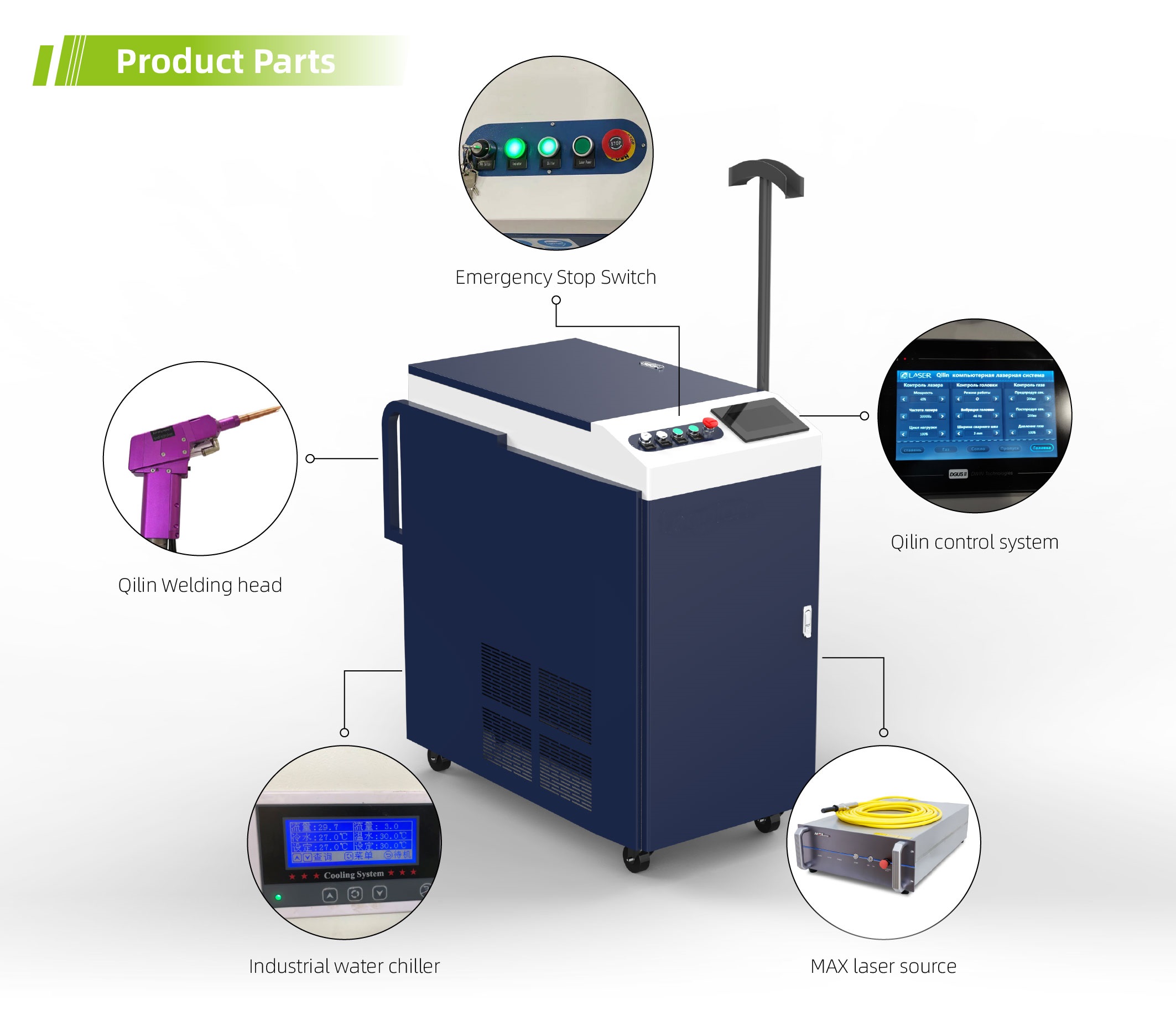
Industrial Application of Fiber Laser Welder
The 45-degree bevel preparation complements this precision. Because the laser can be directed with extreme accuracy into the groove, the total energy required to achieve fusion is lower than that of an unprepared joint. This localized heating ensures that the bulk of the material remains at ambient temperature, preserving the mechanical properties of the alloy. In high-stress applications, such as mining equipment manufactured in the Minas Gerais region, this preservation of material integrity is vital for preventing fatigue-related failures.
Hardware Configuration and Beam Dynamics
The implementation of seamless welding in Belo Horizonte’s fabrication facilities requires specific hardware configurations. Modern fiber laser systems are often equipped with “wobble” welding heads. This technology oscillates the laser beam in various patterns (circular, linear, or O-type) as it traverses the 45-degree bevel. This oscillation broadens the weld pool, making the process more tolerant to slight fit-up variations and ensuring that both faces of the 45-degree bevel are thoroughly wetted by the molten metal.
Key technical parameters include:
Power Density and Beam Quality
The Power Density of the laser source, measured in watts per square centimeter, must be calibrated to the thermal conductivity of the material. For stainless steel, a lower power density with higher travel speeds may be used, whereas aluminum requires higher initial energy to overcome its reflective properties. The beam quality, often expressed as the M2 factor, determines how well the laser can be focused over the depth of the 45-degree bevel.
Gas Shielding Dynamics
To achieve a seamless finish, the use of inert shielding gases—typically Argon or Nitrogen—is critical. In a beveled joint, the gas flow must be laminar to displace oxygen from the V-groove effectively. Any turbulence within the 45-degree cavity can introduce atmospheric contaminants, leading to oxidation and compromising the “seamless” visual and structural requirement.
Economic Impact on the Belo Horizonte Manufacturing Sector
While the initial capital expenditure for a fiber laser system is higher than traditional equipment, the return on investment for Belo Horizonte enterprises is realized through throughput and post-processing reduction. Traditional welding of thick plates often requires multiple passes and extensive grinding to achieve a flush surface. By using a 45-degree bevel and a fiber laser, the weld can often be completed in a single pass with a crown profile that requires little to no secondary finishing.
The reduction in consumables is another factor. The efficiency of the Fiber Laser Welder means that less filler wire is wasted, and the electricity consumption per meter of weld is significantly lower than that of plasma or arc systems. For the global market, this translates to lower per-unit costs and faster lead times, making Brazilian-manufactured components highly competitive on an international scale.
Concluding Industry Insight
The transition toward integrated laser beveling and welding represents a maturation of the fabrication industry. As we look toward the future of industrial manufacturing, the emphasis is shifting from mere “joining” to “material optimization.” The use of 45-degree beveling is no longer just a preparation step; it is a strategic geometric intervention that enables the fiber laser to perform at its theoretical limits.
In regions like Belo Horizonte, where the concentration of metallurgical expertise is high, the move toward automated laser systems with multi-axis beveling capabilities will likely redefine the standards for “seamless” construction. The industry is moving toward a “First-Time-Right” manufacturing philosophy, where the precision of the edge preparation dictates the success of the final assembly. For global B2B stakeholders, investing in or sourcing from facilities that utilize this technical synergy ensures a level of structural reliability and aesthetic consistency that traditional methods simply cannot replicate. The convergence of high-power fiber optics and precision geometry is the current benchmark for excellence in modern metalwork.
Industrial Expertise & Support
Are you looking for high-performance Fiber Laser Welder tailored for the Global market? Our engineering team provides comprehensive solutions for modern manufacturing.





